Dom Prosper Gueranger:
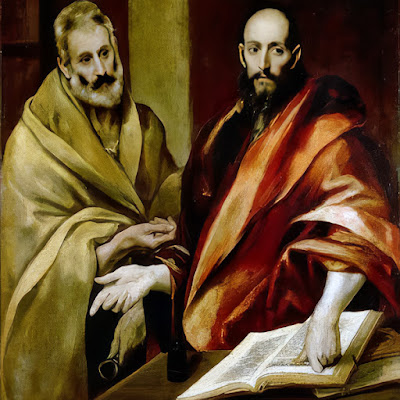
Whereas the Greeks on this day are uniting in one Solemnity, “the Memory,” as they express it, “of the illustrious Saints, the Twelve Apostles, worthy of all praise,” let us follow in spirit the Roman populace who are gathered around the Successor of Peter, and are making the splendid Basilica on the Via Ostiense re-echo with songs of victory while he is offering to the Doctor of the Gentiles the grateful homage of the City and of the world.
On the twenty fifth of January we beheld Stephen leading to Christ’s mystic crib, the once “ravenous wolf of Benjamin” (Genesis xlix. 27) tamed at last, but who in the morning of his impetuous youth, had filled the Church of God with tears and bloodshed. His evening did indeed come when, as Jacob had foreseen, Saul, the persecutor, would outstrip all his predecessors among Christ’s disciples in giving increase to the Fold, and in feeding the Flock, with the choicest food of his heavenly doctrine.
By an unexampled privilege, Our Lord, though already seated at the Right Hand of His Father, vouchsafed not only to call, but personally to instruct this new disciple so that he might one day be numbered among His Apostles. The ways of God can never be contradictory one to another. Hence this creation of a new Apostle may not be accomplished in a manner derogatory to the divine constitution already delivered to the Christian Church by the Son of God. Therefore, as soon as the illustrious Convert emerges from those sublime contemplations during which the Christian dogma has been poured into his soul, he must needs go to Jerusalem to see Peter, as he himself relates to his disciples in Galatia. “It behoved him,” says Bossuet, “to collate his own Gospel with that of the Prince of the Apostles.”
From that moment, aggregated as a co-operator in the preaching of the Gospel, we see him at Antioch (in the Acts of the Apostles) accompanied by Barnabas, presenting himself to the work of opening the Church to the Gentiles, the conversion of Cornelius having been already effected, be it remembered, by Peter himself. He passes a whole year in this city, reaping an abundant harvest. After Peter’s imprisonment in Jerusalem, at his subsequent departure for Rome, a warning from on high makes known to those who preside over the Church at Antioch that the moment is come for them to impose hands on the two missionaries, and confer on them the sacred character of Ordination.
From that hour, Paul attains the full stature of an Apostle, and it is clear that the mission to which he had been preparing is now opened. At the same time, in Saint Luke’s narrative, Barnabas almost disappears, retaining but a very secondary position. The new Apostle has his own disciples, and he henceforth takes the lead in a long series of peregrinations marked by as many conquests. His first is to Cyprus, where he seals an alliance with ancient Rome analogous to that which Peter contracted at Caesarea. In the year 43, when Paul landed in Cyprus, its pro-consul was Sergius Paulus, illustrious for his ancestry, but still more so for the wisdom of his government. He wished to hear Paul and Barnabas: a miracle worked by Paul under his very eyes convinced him of the truth of his teaching, and the Christian Church counted, that day, among her sons one who was heir to the proudest name among the noble families of Rome. Touching was the mutual exchange that took place on this occasion. The Roman Patrician had just been freed by the Jew from the yoke of the Gentiles. In return the Jew until then called Saul received and thenceforth adopted the name of Paul, as a trophy worthy of the Apostle of the Gentiles.
From Cyprus Paul travelled successively to Cilicia, Pamphylia, Pisidia and Lycaonia, everywhere preaching the Gospel and founding Churches. He then returned to Antioch in the year 47, and found the Church there in a state of violent agitation. A party of Jews, who had come over to Christianity from the ranks of the Pharisees, while consenting indeed to the admission of Gentiles into the Church, were maintaining that this could only be on condition of their being likewise subjected to Mosaic practices, such as circumcision, distinction of meats, etc. The Christians who had been received from among the Gentiles were disgusted at this servitude to which Peter had not subjected them, and thus the controversy became so hot that Paul deemed it necessary to undertake a journey to Jerusalem where Peter had lately arrived, a fugitive from Rome, and where the Apostolic College was at that moment furthermore represented by John, as well as by James the bishop of the city. These being assembled to deliberate on the question, it was decreed, in the name and under the influence of the Holy Ghost, that the exacting of anything relative to Jewish rites should be utterly forbidden in the case of Gentile converts. It was on this occasion too, that Paul received from these “Pillars,” as he styles them, the confirmation of this his Apostolate super-added to that of the Twelve, and to be specially exercised in favour of the Gentiles. By this extraordinary ministry deputed to the nations, the Christian Church definitively asserted her independence of Judaism, and the Gentiles could now freely come flocking into her bosom.
Paul then resumed his course of apostolic journeys over all the Provinces he had already evangelised, in order to confirm the Churches. Thence, passing through Phrygia, he came to Macedonia, stayed a while at Athens, and then on to Corinth, where he remained a year and a half, At his departure, he left in this city a flourishing Church by which he excited against him the fury of the Jews. From Corinth, Paul went to Ephesus where he stayed two years. So great was his success with the Gentiles there that the worship of Diana was materially weakened, whereupon a tumult ensuing, Paul thought the moment come for his departure from Ephesus. During his abode there he made known to his disciples a thought that had long haunted him: he must needs see Rome. The Capital of the Gentile world was indeed calling the Apostle of the Gentiles. The rapid growth of Christianity in the Capital of the Empire had brought face-to-face and in a manner more striking than elsewhere, the two heterogeneous elements which formed the Church of that day: the unity of Faith held together in one fold, those that had formerly been Jews, and those that had been pagans.
Now it so happened that some of both of these classes, too easily forgetting the gratuity of their common vocation to the Faith, began to go so far as to despise their brethren of the opposite class, deeming them less worthy than themselves of that Baptism which had made them all equal in Christ. On the one side, certain Jews disdained the Gentiles, remembering the polytheism which had sullied their past life with all those vices which come in its train. On the other side, certain Gentiles contemned the Jews, as coming from an ungrateful and blinded people, who had so abused the favours lavished on them by God as to crucify the Messiah. In the year 53, Paul already aware of these debates, profited of a second journey to Corinth to write to the Faithful of the Church in Rome that famous Epistle in which he emphatically sets forth how gratuitous is the gift of Faith, and maintains how Jew and Gentile alike being quite unworthy of the divine adoption, have been called solely by an act of pure Mercy. He likewise shows how Jew and Gentile, forgetting the past, have but to embrace one another in the fraternity of one same Faith, thus testifying their gratitude to God through whom both of them have been alike prevented by Grace. His Apostolic dignity so fully recognised, authorised Paul to interfere in this matter, though touching a Christian centre not founded by him.
While awaiting the day when he could behold with his own eyes the Queen of all Churches, lately fixed by Peter on the Seven Hills, the Apostle was anxious once again to make a pilgrimage to the City of David. Jewish rage was just at that moment rampant in Jerusalem against him. National pride being more specially piqued, in that he the former disciple of Gamaliel, the accomplice of Stephen’s murder, should now invite the Gentiles to be coupled with the sons of Abraham under the one same Law of Jesus of Nazareth. The Tribune Lysias was scarce able to snatch him from the hands of these bloodthirsty men ready to tear him to pieces. The following night Christ appeared to Paul saying to him: “Be constant, for as you have testified of Me in Jerusalem, so must you bear witness also at Rome.”
It was not, however, till after two years of captivity that Paul, having appealed to Caesar, landed in Italy, at the beginning of the year 56. Then at last, the Apostle of the Gentiles made his entry into Rome. The trappings of a victor surrounded him not. He was but a humble Jewish prisoner led to the place where all appellants to Caesar were mustered. Yet was he that Jew whom Christ Himself had conquered on the way to Damascus. No longer Saul, the Benjamite, he now presented himself under the Roman name of Paul. Nor was this a robbery on his part, for after Peter, he was to be the second glory of Rome, the second pledge of her immortality. He brought not the primacy with him indeed, as Peter had done — for that had been committed by Christ to one alone — but he came to assert in the very centre of the Gentile world the divine delegation which he had received in favour of the nations, just as an affluent flows into the main stream, which mingling its waters with its own, at last empties them united into the ocean. Paul was to have no successor in his extraordinary mission, but the element which he had deposited in the Mistress, the Mother Church, was of such value that in course of ages the Roman Pontiffs, heirs to Peter’s monarchical power, have ever appealed to Paul’s memory as well, pronouncing their mandates in the united names of the “Blessed Apostles Peter and Paul.”
Instead of having to await in prison the day on which his cause was to be heard, Paul was at liberty to choose a lodging place in the city. He was obliged, however, to be accompanied day and night by a soldier to whom, according to the usual custom, he was chained, but only in such a way as to prevent his escape: all his movements being otherwise left perfectly free, he could easily continue to preach the Word of God. Towards the close of the year 57, in virtue of his appeal to Caesar, the Apostle was at last summoned before the praetorium, and the successful pleading of his cause resulted in his acquittal. Being now free, Paul revisited the East, confirming on his Evangelical course the Churches he had previously founded. Thus Ephesus and Crete once more enjoyed his presence. In the one he left his disciple Timothy as bishop, and in the other Titus.
But Paul had not quitted Rome forever: marvellously illumined as she had been, by his preaching, the Roman Church was yet to be gilded by his parting rays and purpled by his blood. A heavenly warning, as in Peter’s case, bade him also return to Rome where martyrdom was awaiting him. This fact is attested by Saint Athanasius. We learn the same also from Saint Asterius of Ameseus who remarks that the Apostle entered Rome once more, “in order to teach the very masters of the world, to turn them into his disciples, and by their means to wrestle with the whole human race.” “There, Paul finds Peter engaged in the same work. He at once yokes himself to the same divine chariot with him, and sets about instructing the children of the Law within the Synagogues, and the Gentiles outside.” At length Rome possesses her two Princes conjointly: the one seated on the eternal chair, holding in his hands the keys of the kingdom of heaven, the other surrounded by the sheaves he has garnered from the fields of the Gentile world. They will now part no more. Even in death, as the Church sings, they will not be separated. The period of their being together was necessarily short, for they must needs render to their Master the testimony of blood before the Roman world should be freed from the odious tyranny under which it was groaning.
Their death was to be Nero’s last crime. After that he was to fade from sight, leaving the world horrors stricken at his end, as shameful as it was tragic. It was in the year 65, that Paul returned to Rome. once more signalising his presence there by the manifold works of his Apostolate. From the time of his first labours there, he had made converts even in the very palace of the Caesars: being now returned to this former theatre of his zeal, he again finds entrance into the imperial abode. A woman who was living in criminal intercourse with Nero, as likewise a cup-bearer of his, were both caught in the Apostolic net, for it were hard indeed to resist the power of that mighty word. Nero, enraged at “this foreigner’s” influence in his very household, was bent on Paul’s destruction. Being first of all cast into prison, his zeal cooled not, but he persisted the more in preaching Jesus Christ. The two converts of the imperial palace having abjured, together with paganism, the manner of life they had been leading, this two-fold conversion of theirs did but hasten Paul’s martyrdom. He was well aware that it would be so, as can be seen in these lines addressed to Timothy: “I labour even to bands, as an evil doer. But the word of God is not bound. Therefore, I endure all things for the sake of the elect. For I am even now ready to be sacrificed, like a victim already sprinkled with the lustral water, and the time of my dissolution is at hand. I have fought the good " fight, I have finished my course, I have kept the faith. As to the rest, there is laid up for me a crown of justice which the Lord, the just Judge, will render to me in that day” (2 Timothy).
On the 29th of June 67 AD, while Peter having crossed the Tiber by the Triumphal bridge was drawing near to the cross prepared for him on the Vatican plain, another martyrdom was being consummated on the left bank of the same river. Paul, as he was led along the Via Ostiensis, was also followed by a group of the Faithful who mingled with the escort of the condemned. His sentence was that he should be beheaded at the Salvian Waters. A two miles’ march brought the soldiers to a path leading eastwards, by which they led their prisoner to the place fixed upon for the martyrdom of this, the Doctor of the Gentiles. Paul fell on his knees, addressing his last prayer to God. Then having bandaged his eyes, he awaited the death-stroke. A soldier brandished his sword, and the Apostle’s head, as it was severed from the trunk, made three bounds along the ground. Three fountains immediately sprang up on these several spots. Such is the local tradition, and to this day, three fountains are to be seen on the site of his martyrdom, over each of which an altar is raised.
* * * * *
To you, O Paul, we turn this day! Happily fixed as we are on Peter, the Rock that supports the Church, could we possibly forget you by whose labours our forefathers the Gentiles became part of the City of God? Sion, once the well-beloved, rejected the Stone and stumbled against it. Tell us then the mystery of this other Jerusalem come down from Heaven, the materials of which were nevertheless drawn up from the abyss! Compacted together in admirable masonry, they proclaim the glory of the skilful Architect who laid them on the Corner-Stone. And precious stones of such surpassing brilliancy are they, as to out-shine all the gems of the Daughter of Sion. To whom is this new-comer indebted for all her beauty, for all these her bridal honours? How have the sons of the forsaken one come out from the unclean dens where their mother dwelt, a companion of dragons and of leopards? (Canticles iv. 8). It is because the Voice of the Spouse was heard saying: “Come, my Bride, come from Libanus; from the top of Amana, from the top of Sanir and Hermon.”
Nevertheless, the Spouse in His own Sacred Person, while He lived here below, never quitted the ancient Land of Promise, and His mortal accents never once fell on the ear of her who dwelt beyond the confines of Jacob. But, Paul, did you not exclaim: “How will they call on Him, how believe Him of whom they have not heard? (Romans x. 14). Yet whoever knows your love of the Spouse has nothing to fear, mindful that you yourself, holy Apostle, have proposed the problem and can solve it. Lo, this is the answer — we sang it on the day of Christ’s triumphant Ascension: “"When the beauty of the Lord will arise above the heavens, He will be mounted on a cloud, and the wing of the wind will be His swift steed; and, clad in light, He will dart from pole to pole across the heavens, giving His gifts to the children of men.”
You yourself, Paul, are this cloud, this wing of the wind bearing the Bridegroom’s message to the nations. Yes, you were expressly chosen from on high to teach the Gentiles, as those pillars of the Church, Peter James, and John, have attested (Galatians ii. 7-9). How beauteous your feet, when having quitted Sion, you appeared on our mountains and cried out to the Gentiles: “This God will reign” (Isaias lii. 7). How sweet your voice, when it murmured in the ear of the poor forsaken one the heavenly call: “Hearken, daughter, and see, and incline the ear of your heart” (Psalms xliv. 11). How tender the pity you evinced to her who had long lived a stranger to the Covenant, without promise, without a God in this world! (Ephesians ii. 12).
Alas, afar off indeed was she whom it behoved you to lead to the Lord Jesus and to bring so near Him, that He and she should form but one body! You experienced, in this immense labour, both the pains of childbirth and the cares of a mother giving the breast to her new-born babe. You had to bear the tedious delay of the growth of the Bride to ward from her every defilement, to inure her gradually to the dazzling light of the Spouse, until, at last, rooted and founded in charity, and having reached to the measure of the age of the fullness of Christ she might indeed be His glory, and be filled by Him to all the plenitude of God. But what a toil to bring up this new creation from the original slime to the throne of the heavenly Adam at the Right Hand of the Father! Often repulsed, betrayed, put in chains, misunderstood in the most delicate sentiments of thine Apostolic heart, you had nothing for your salary save untold anguish and suffering. Yet, fatigue, watchings, hunger, cold, nakedness, abandonment, open violence, perfidious attacks, perils of all kinds, far from abating, did but excite your zeal. Joy super-abounded in you, for these sufferings were the filling up of those which Jesus had endured to purchase that alliance so long ambitioned by Eternal Wisdom. After His example, you too had but one end to which tended all your strength and gentleness: along the dusty Roman roads, or tempest-tossed into the depth of the sea, in the city or the desert, borne aloft on ecstatic wing into the third heavens, or bowed beneath the whips of the Jews and the sword of a Nero: everywhere bearing the embassy of Christ you boldly defied alike life and death, powers of Earth and powers of Heaven, to stay the Might of the Lord or of His Love by which you were upheld in your vast enterprise. Then as if aware by anticipation, of the amazement that would be excited by these enthusiastic outpourings of your great soul, you uttered this sublime cry: “Would to God that you could bear with some little of my folly: but hear with me, for I am jealous of you with the jealousy of God. For I have espoused you to one husband, that I may present you as a chaste virgin to Christ” (2 Corinthians xi. 1-2).
Yesterday, Paul, your work was ended. Having given all, you at length gave yourself. The sword, by striking off your sacred head, accomplished Christ’s triumph as you had predicted. Peter’s death fixes the throne of the Spouse in its predestined place, but to you is the Bride, the Gentile world, indebted for that she is now able, as she sits at the right hand of the Spouse, to turn to the rival Synagogue exclaiming: “I am black, but beautiful, daughters of Jerusalem. Therefore has the King loved me and chosen me to be His Queen! (Canticles i. 4; iv. 8).
Praise then be to you, Apostle, now and forever! Eternity itself will not suffice to exhaust the gratitude of us, the “Nations.” Accomplish your work in each one of us during all ages . Permit not that by the falling off of any one among those called by Our Lord to complete His Mystic Body, the Bride be deprived of one single increase on which she might have counted. Uphold and brace against despondency the Preachers of the Sacred Word, all those who by the pen or by any title whatever, are continuing your work of light. Multiply those valiant Apostles who are ever narrowing on our globe the boundaries of darkness. You promised to remain with us, to be ever watchful of Faith’s progress in souls, and to cause the pure delights of divine union to be ever developing there. Keep your promise. Because of your going away to Jesus, your word is nonetheless plighted to those who like ourselves could not know you here below. For to those who have not seen your face in the flesh, you have left, in one of your immortal Epistles, the assurance that you will take care “that their hearts be comforted, being instructed in charity, and to all riches of fullness of understanding, to the knowledge of the mystery of God the Father and of Christ Jesus, in whom are hid all the treasures of wisdom and knowledge” (Colossian ii. 1-3).
During this season of the sacred Cycle, the reign of the Holy Spirit who forms saints (Romans viii.), grant that Christians of good will may be brought to understand how, by their very Baptism, they are put in possession of that sublime vocation which is too often imagined to be the happy lot of but a chosen few. Oh would that they could seize this grand yet very simple idea which you have given of the mystery in which is contained the absolute and universal principle of Christian Life (Romans vi.): that, having been buried with Jesus under the waters, and thereby incorporated with Him, they must necessarily be bound by every right and title, to become saints, to aim at union with Jesus in His Life, since they have been granted union with Him in His Death. “You are dead and your life is hidden with Christ in God!” (Colossians iii. 3). These were the words addressed by you to our forefathers: O then repeat them to us likewise, for you gave them as a truth intended for all without distinction! Suffer not, Doctor of us, Gentiles, that the Light grow dim among us, to the great detriment of the Lord and of His Bride.
Epistle – Galatians i. 11‒20
I give you to understand, brethren, that the gospel which was preached by me is not according to man. For neither did I receive it of man: nor did I learn it but by the revelation of Jesus Christ. For you have heard of my conversation in time past in the Jews’ religion: how that, beyond measure, I persecuted the church of God and wasted it. And I made progress in the Jews’ religion above many of my equals in my own nation, being more abundantly zealous for the traditions of my fathers. But when it pleased Him who separated me from my mother’s womb and called me by his grace, to reveal His Son in me, that I might preach Him among the Gentiles: immediately I condescended not to flesh and blood. Neither went I to Jerusalem, to the apostles who were before me: but I went into Arabia, and again I returned to Damascus. Then, after three years, I went to Jerusalem to see Peter: and I tarried with him fifteen days. But other of the apostles I saw none, saving James the brother of the Lord. Now the things which I write to you, behold, before God, I lie not.
Thanks be to God.
Gospel – Matthew x. 16‒22
Behold I send you as sheep in the midst of wolves. Be therefore wise as serpents and simple as doves. Simple... that is, harmless, plain, sincere, and without guile. But beware of men. For they will deliver you up in councils, and they will scourge you in their synagogues. And you will be brought before governors, and before kings for my sake, for a testimony to them and to the Gentiles: But when they deliver you up, take no thought how or what to speak: for it will be given you in that hour what to speak: For it is not you that speaks, but the Spirit of your Father that speaks in you. The brother also will deliver up the brother to death, and the father the son; and the children will rise up against their parents, and will put them to death. And you will be hated by all men for my name’s sake: but he who perseveres to the end will be saved.
Praise be to you, O Christ.
Also on this day according to the ROMAN MARTYROLOGY:
At Limoges in France, St. Martial, bishop, with two priests, Alpinian and Austriclinian, whose lives were distinguished for miracles.
The same day, the saints Caius, priest, and Leo, subdeacon.
At Alexandria, the passion of St. Basilides, under the emperor Severus. He protected from the insults of profligate men the saintly virgin Potamioena, whom he was leading to execution, and received from her the reward of his pious action. For, at the end of three days, she appeared to him and placing a crown on his head, not only converted him to Christ, but by her prayers made of him, after a short combat, a glorious martyr.
At Rome, St. Lucina, a disciple of the Apostles, who relieved the necessities of the saints with her goods, visited the Christians detained in prison, buried the martyrs, and was laid by their side in a crypt constructed by herself.
In the same city, St. Æmiliana, martyr.
In the territory of Viviers, St. Ostian, priest and confessor.
And in other places, many other holy martyrs, confessors and virgins.
Thanks be to God.
O Roma felix, quae duorum Principium
Es consecreta glorioso sanguine:
Horum cruore purpurata caeteras,
Excellis orbis una pulchritudines.
Dom Prosper Gueranger:
“Simon, son of John, do you love me?” Behold the hour when the answer which the Son of Man exacted of the Fisher of Galilee re-echoes from the Seven Hills and fills the whole Earth. Peter no longer dreads the triple interrogation of his Lord. Since that fatal night on which, before the first cock-crow, the Prince of the Apostles had denied his Master, tears have not ceased to furrow the cheeks of this same Vicar of the Man-God. Lo, the day when at last his tears will be dried! From that gibbet to which, at his own request, the humble disciple has been nailed head downwards, his bounding heart repeats now at last without fear the protestation which ever since the scene enacted on the brink of Lake Tiberias has been silently wearing his life away. “Yes, Lord, you know that I love you” (John xxi).
Sacred day on which the oblation of the first of Pontiffs assures to the West the rights of Supreme Priesthood! Day of triumph in which the effusion of a generous life-blood wins for God the conquest of the Roman soil, in which upon the cross of his representative, the Divine Spouse concludes His eternal alliance with the Queen of nations!
This tribute of death was all unknown to Levi. This dower of blood was never exacted of Aaron by Jehovah: for who is it that would die for a slave? The Synagogue was no Bride! (Galatians iv. 22-31). Love is the sign which distinguishes this age of the new dispensation from the Law of servitude. Powerless, sunk in cringing fear, the Jewish priest could but sprinkle with the blood of victims substituted for himself, the horns of the figurative altar. At once both Priest and Victim, Jesus expects more of those whom He calls to a participation of the sacred prerogative which makes Him Pontiff, and that for ever according to the order of Melchisedech (Psalms cix. 4). “I will not now call you servants: for the servant knows not what his lord does”: thus says He to these men whom He has just raised above angels at the last Supper. “But I have called you friends, because all things whatever I have heard of my Father, I have made known to you (John xv. 15). As the Father has loved me, I also have loved you. Abide in my love” (John xv. 9).
Now, in the case of a Priest admitted thus into partnership with the Eternal Pontiff, love is not complete save when it extends itself to the whole of Mankind ransomed by the great Sacrifice. And, mark it well: this entails upon him, more than the obligation common to all Christians, of loving one another as fellow members of one Head, for by his Priesthood he forms part of that Head, and by this very title, charity should assume in him something in depth and character of the love which this divine Head bears towards His members. But more than this. What, if to the power he possesses of immolating Christ, to the duty incumbent on him of the joint offering of himself likewise, in the secret of the Mysteries, the plenitude of the Pontificate be added, imposing the public mission of giving to the Church that support she needs, that fecundity which the heavenly Spouse exacts of her? Then it is, that (according to the doctrine expressed from the earliest ages by the Popes, the Councils and the Fathers) the Holy Ghost adapts him to his sublime role by fully identifying his love with that of the Spouse whose obligations he fulfils, whose rights he exercises. But then, likewise, according to the same teaching of universal tradition, there stands before him the precept of the Apostle. Yes, from throne to throne of all the Bishops, whether of East or West, the Angels of the Churches pass on the word: “Husbands, love your wives, as Christ also loved the Church and delivered Himself up for her, that He might sanctify her” (Ephesians v. 25-26).
Such is the divine reality of these mysterious nuptials, that every age of sacred history has blasted with the name of adultery the irregular abandoning of the Church first espoused. So much is there exacted by such a sublime union that none may be called to it who is not already abiding steadfast on the lofty summit of perfection, for a Bishop must ever hold himself ready to justify in his own person that supreme degree of charity of which Our Lord says: “Greater love than this no man has, that he lay down his life for his friends” (John xv. 13). Nor does the difference between the hireling and the true Shepherd end there (John x. 11-18). This readiness of the Pontiff to defend to death the Church confided to him, to wash away even in his own blood every stain that disfigures the beauty of this Bride (Ephesians v. 27), is itself the guarantee of that contract by which he is wedded to this chosen one of the Son of God, and it is the just price of those purest of joys reserved to him: “These things have I spoken to you,” says Our Lord when instituting the Testament of the New Alliance, “that My joy may he in you and your joy may be filled” (John xv. 11).
If such should be the privileges and obligations of the Heads of the Churches, how much more so in the case of the universal Pastor! When regenerated man was confided to Simon, son of John, by the Incarnate God, His chief care was in the first place to make sure that he would indeed be the Vicar of His love: that, having received more than the rest, he would love more than all of them: that being the inheritor of the love of Jesus for His own who were in the world, he would love, as He had done, even to the end (John xiii. 1). For this very reason, the establishing of Peter on the summit of the Hierarchy coincides in the Gospel narrative with the announcement of his martyrdom (John xxi. 18). Pontiff-king, he must needs follow even to the cross his Supreme Hierarch (John xxi. 19-22).
The Feasts of his two Chairs, that of Antioch and that of Rome, have recalled to our minds the Sovereignty by which he presides over the government of the whole world, and the Infallibility of the doctrine which he distributes as food to the whole flock. But these two feasts, and the Primacy to which they bear witness on the sacred Cycle, call for that completion and further sanction afforded by the teachings included in today’s festival. Just as the power received by the Man-God from His Father (Matthew xxviii. 18) and the full communication made by Him of this same power to the visible Head of His Church had but for end the consummation of glory, the one object of the Thrice-Holy God in the whole of His work (John xvii. 4), so likewise all Jurisdiction, all Teaching, all Ministry here below, says Saint Paul, has for end the consummation of the Saints (Ephesians iv. 12) which is but one with the consummation of this sovereign Glory: now, the sanctity of the creature and the glory of God, Creator and Saviour, taken together, find their full expression only in the Sacrifice which embraces both Shepherd and flock in one same Holocaust.
It was for this final end of all Pontificate, of all Hierarchy, that Peter, from the day of Jesus’ Ascension, traversed the earth. At Joppa, when he was but opening the career of his Apostolic labours, a mysterious hunger seized him: “Arise, Peter, kill and eat,” said the Spirit, and at that same hour, in symbolic vision were presented before his gaze, all the animals of earth and all the birds of heaven (Acts x. 9-16). This was the gentile world which he must join to the remnant of Israel on the divine Banquet-board. Vicar of the Word, he must share his vast hunger. His preaching, like a two-edged sword, will strike down whole nations before him. His charity, like a devouring fire, will assimilate to itself the peoples. Realising his title of Head, the day will come when as true Head of the world, he will have formed (from all mankind, become now a prey to his avidity) the Body of Christ in his own person. Then like a new Isaac, or rather, a very Christ, he will behold rising before him, the mountain where the Lord sees, awaiting the oblation (Genesis xxii. 14).
Let us also “look and see,” for this future has become the present, and even as on the great Friday, so now we a ready know how the Drama is to end. A final scene all bliss, all triumph: for herein deicide mingles not its wailing note to that of Earth’s homage, and the perfume of sacrifice which earth is exhaling does but fill the heavens with sweet gladness. Divinised by virtue of the adorable Victim of Calvary, it might indeed be said, this day that earth is able now to stand alone. Simple son of Adam as he is by nature, and yet nevertheless true Sovereign Pontiff, Peter advances bearing the world: his own sacrifice is about to complete that of the Man-God, with whose dignity he is invested (Colossians i. 24). Inseparable as she is from her visible Head, the Church likewise invests him with her own glory (1 Corinthians xi. 7). Far from her now are the horrors of that midday darkness which shrouded her tears when, for the first time, the cross was up-reared. She is all song, and her inspired Lyric celebrates “the beauteous Light Eternal that floods with sacred fires this Day which opens out to the guilty a free path to Heaven” (Hymn of Vespers).
What more could the day of the Sacrifice of Jesus Himself ? But this is because by the power of this other cross which is rising up, Babylon becomes today the Holy City. The while Sion sits accursed for having once crucified her Saviour, vain is it on the contrary for Rome to reject the Man-God, to pour out the blood of his Martyrs like water in her streets. No crime of Rome’s is able to prevail against the great fact fixed forever at this hour: the cross of Peter has transferred to her all the rights of the cross of Jesus, leaving to the Jews the curse, she now becomes the True Jerusalem.
Such being then the meaning of this day, it is not surprising that Eternal Wisdom should have willed to enhance it still further by joining the sacrifice of Paul to that of Peter. More than any other, Paul advanced by his preachings,the building up of the body of Christ (Ephesians iv. 12). If on this day holy Church has attained such full development as to be able to offer herself in the person of her visible Head as a sweet smelling sacrifice, who better than Paul may deservedly perfect the oblation, furnishing from his own veins the sacred libation? (Colossians i. 24; 2 Corinthians xxi. 15). The Bride having attained fullness of age (Ephesians iv. 13), his own work is likewise ended (2 Corinthians xi. 2). Inseparable from Peter in his labours by faith and love, he will accompany him also in death. Both quit this Earth, leaving her to the gladness of the divine Nuptials sealed in their blood while they ascend together to that eternal abode in which that union is consummated (2 Corinthians v.).
* * * * *
Since the terrible persecution of the year 64, Rome had become for Peter a sojourn fraught with peril, and he remembered how his Master had said to him, when appointing him Shepherd of both lambs and sheep: “Follow me” (John xxi.). The Apostle, therefore awaited the day when he must mingle his blood with that of s0 many thousands of Christians whom he had initiated into the faith, and whose Father he truly was. But before quitting earth, Peter must triumph over Simon the Magician, his base antagonist. This heresiarch did not content himself with seducing souls by his perverse doctrines. He sought even to mimic Peter in the prodigies operated by him. So he proclaimed that on a certain day he would fly in the air. The report of this novelty quickly spread through Rome, and the people were full of the prospect of such a marvellous sight. If we are to believe Dion Chrysostom, Nero seems even to have entertained at his court this wondrous personage who pledged himself to soar aloft in mid-air. More than that, the Emperor would even with his own presence honour this rare sight. The imperial lodge was reared upon the Via Sacra, where the scene was to be enacted. But cruel for the impostor did this deception prove. “Scarce had this Icarus begun to poise his flight,” says Suetonius, “than he fell close to Nero’s lodge which was bathed in his blood.”
The gravest writers of Christian antiquity are unanimous in attributing to the prayer of Peter, this humiliation inflicted on the Samaritan Juggler in the very midst of Rome where he had dared to set himself up as the rival of Christ’s Vicar. The disgrace of the heresiarch, as well as his blood, had fallen on the Emperor himself. Curiosity and ill-will but needed, therefore, to be combined, in order to attract personally upon Peter an attention that might prove disastrous. Moreover, be it remembered there was yet another danger, and to this Saint Paul alludes, namely the peril of fake brethren. To understand this term and justly to appreciate the situation, we must bear in mind how inevitable are the clashing of certain characters in a society so numerous as was already that of the Christians in Rome, and how discontent is necessarily caused to vulgar minds when sometimes existing circumstances demand higher interests to be exclusively consulted, in the always difficult question of choosing persons to offices of trust, or to special confidence. These things well borne in mind, it will be easy to account for what Saint Clement, an eye-witness of the Apostle’s martyrdom, attests in a letter to the Corinthians, viz. That “rivalries and jealousies” had a large share in the tragic end brought about, through the suspicions at last conceived by the authorities, against “this Jew.”
The filial devotedness of the Christians of Rome took alarm and they implored Saint Peter to elude the danger for a while by instant flight. “Although he would have much preferred to suffer,” says Saint Ambrose, Peter set out along the Appian Way. Just as he reached the Capuan gate, Christ suddenly presented himself, seemingly about to enter the City. “Lord, where are you going?” cried out the Apostle. “To Rome,” Christ replied, “to be there crucified again.” The disciple understood his Master. He at once retraced his steps, having no thought now save to await his hour of martyrdom. This Gospel-like scene expresses the sequel of our Lord’s designs upon the venerable old man. With a view to founding the Christian Church in unity, He had extended to His disciples His own prophetic name of the “Rock,” or “Stone” (Petrus). Now, to the Cross itself, was He about to make him His participator.
Rome having replaced Jerusalem must likewise have her Calvary. In his flight, Peter dropped from his leg a bandlet which a disciple picked up with much respect. A monument was afterwards raised on the spot where this incident occurred: it is now the Church of Saints Nereus and Achilles anciently called Titulus fascioloe, the Title of the handlet. According to the designs of Providence, the humble fasciola was to recall the memory of that momentous meeting at the gates of Rome where Christ in person stood face to face with His Apostle, the visible Head of His Church, and announced that the hour of his sacrifice on the cross was at hand. From that moment, Peter set everything in order with a view to his approaching end. It was at this time he wrote his Second Epistle, which is as it were his last testament and loving farewell to the Church. In it he declares that the close of his life is near, and compares his body to a temporary shelter, a tent, which one takes down, to journey further on. “The laying away of this my tabernacle is at hand, according as our Lord Jesus Christ also has signified to me” (2 Peter i. 14). These his words are evidently an allusion to the apparition on the Appian way. But before quitting this world Peter must provide for the transmission of his pastoral charge and for the needs of Holy Church, now about to be widowed of her visible Head. To this he refers in these words: “And I will do my endeavour that after my decease you may also often have, whereby you may keep a memory of these things” (2 Peter i. 15).
Into whose hands are those keys to pass, which he received from Christ, as a sign of his dominion over the whole Flock? Linus had been for more than ten years the Auxiliary of the holy Apostle in the midst of the Christians of Rome. The still further increase of the Faithful induced Peter to give Linus a colleague in the person of Cletus. Yet on neither of these two did the choice of Peter fall at this solemn moment in which he was about to fulfil the promise contained in his farewell letter to provide for the continuance of his ministry. Clement, whose nobility of birth recommended him to the consideration of the Romans, while at the same time, his zeal and learning merited the esteem of the Faithful, was the one on whom the Prince of the Apostles fixed his choice. During these last days still remaining to him, Peter imposed hands on Clement, and having invested him with the Episcopal character, enthroned him in his own Chair, declaring his intention to have him for his Successor. These facts related in the Liber Pontificalis are confirmed by the testimony of Tertullian and Saint Epiphanius.
Thus the quality of Bishop of Rome entailed that of Universal Pastor, and Peter must needs leave the heritage of the divine keys to him who should next occupy the See he held at the moment of death. So had Christ ordained, and a heavenly inspiration had led Peter to choose Rome for his last station: Rome prepared long beforehand, by Providence, to universal Empire. Hence, at the moment when the Supremacy of Peter passed to one of his disciples, no astonishment was manifested in the Church. It was well known that the Primacy was and must necessarily be a local heritage, and none ignored the fact that Rome herself was that spot made choice of by Peter, long years before. Nor after Peter’s death did it ever occur to the mind of any of the Christians to seek the centre of Holy Church either at Jerusalem, or at Alexandria, or at Antioch, or elsewhere. The Christians in Rome made great account of the paternal devotedness he had lavished on their city. Hence their alarms, to which the Apostle once consented to yield.
Saint Peter’s Epistles so redolent of affection, bear witness to the tenderness of soul with which he was, to a very high degree, gifted. He is ever the Shepherd all devotedness to his sheep, fearing above all else anything savouring of a domineering tone. He is ever the Vicar effacing himself so that nothing may transpire save the dignity and rights of Him whom he represents. This exquisite modesty is further increased in Peter by the remembrance which haunts his whole life, (as ancient writers say), of the sin he had committed and which he continues to deplore up to these closing days of extreme old age. Faithful ever to that transcending love of which his divine Master had required him to make a triple affirmation before confiding to him the care of His Flock, he endured unflinchingly the immense labours of his office of Fisher of men. One circumstance of his life which relates to this its closing period reveals most touchingly the devotedness wherewith he clung to Him who had vouchsafed both to call him to follow Him, and to pardon his fragility. Clement of Alexandria has preserved this detail, as follows.
Before being called to the Apostolate, Peter had lived in the conjugal state. From that time forth, his wife became but a sister in his regard. She nevertheless continued in his company, following him about from place to place in his various journeys, in order to render him service (1 Corinthians ix.). She was in Rome while Nero’s persecution was raging, and the honour of martyrdom thus sought her out. Peter watched her as she stepped forth on her way to triumph, and at that moment, his solicitude broke out in this one exclamation: “Oh! Bethink you of the Lord.” These two Galileans had seen the Lord, had received Him into their house, had made Him their guest at table. Since then, the Divine Pastor had suffered on the cross, had risen again, had ascended into Heaven, leaving the care of His Flock to the Fisherman of Lake Genezareth. What else then would Peter have his wife do at this moment, save to recall such sweet memories and to dart forwards to Him whom she had erstwhile known here below in His Human Features, and who was now about to crown her hidden life with immortal glory!
The moment for entering into this same glory came at last for Peter himself. “When you will be old,” mysteriously had his Master said to him, “you will stretch forth your hands, and another will gird you, and lead you where you would not” (John xxi.). So Peter was to attain an advanced age. Like his Master, he must stretch forth his arms on a cross. He must know captivity and the weight of chains with which a foreigner’s hand will load him. He must be subjected, in its violent form, to death from which nature recoils, and drink the chalice from which even his Divine Master Himself prayed to be spared. But like his Master also, he will arise strong in the divine aid, and will press forwards to the cross. Lo, this oracle is about to be accomplished to the letter. On the day fixed by God’s decree, pagan power gave orders for the Apostle’s arrest. Details are wanting as to the judicial procedure which followed, but the constant tradition of the Roman Church is that he was incarcerated in the Mamertine Prison.
By this name is known the dungeon constructed at the foot of the Capitoline hill, by Ancus Martius, and afterwards completed by Servius Tullus, from which it is also called Carcer Tullianus. Two outer staircases, called the Steps of Sighs, led to this frightful den. An upper dungeon gave immediate entrance to that which was to receive the prisoner and never to deliver him up alive, unless he were destined to a public execution. To be put into this horrible place, he had to be let down by cords through an opening above, and by the same was he finally drawn up again, whether dead or alive. The vaulting of this lower dungeon was high and its darkness was utter and horrible so that it was an easy task to guard a captive detained in it, especially if he were laden with chains.
On the twenty-ninth of June, in the year 67, Peter was at length drawn up to be led to death. According to Roman law, he must first be subjected to the scourge, the usual prelude to capital punishment. An escort of soldiers conducted the Apostle to his place of martyrdom outside the city walls, as the laws required. Peter was marched to execution, followed by a large number of the Faithful drawn by affection along his path, and for his sake defying every peril. Beyond the Tiber, facing the Campus Martins there stretches a vast plain which is reached by the bridge named the Triumphal, by which the city is put in communication with the Via Triumphalis and the Via Cornelia, both of which roads lead to the north. On its further side from the river the plain is bounded on the left, by the Janiculum, and beyond that in the background, by the Vatican hills whose chain continues along to the right in the form of an amphitheatre. Along that bank of the Tiber the land is occupied by immense gardens, which three years previously had been made by Nero the scene of the principal immolation of the Christians, just at this same season also. To the West of the Vatican Plain and beyond Nero’s gardens, was a circus of vast extent, usually called by his name, although in reality it owes its origin to Caligula, who placed in its centre an obelisk which he had transported from Egypt. Outside the Circus, towards its furthest end, rose a temple to Apollo, the protector of the public games. At the other end, the declivity of the Vatican hills begins, and about the middle, facing the Obelisk, was planted a turpentine tree well known to the people. The spot fixed upon for Peter’s execution was close to this said turpentine tree. There, likewise, was his tomb already dug. No other spot in all Rome could be more suitable for so august a purpose.
From remotest ages, something mysterious had hovered over the Vatican. An old oak, said by the most ancient traditions to be anterior to the foundation of Rome, was there held in great reverence. There was much talk of Oracles heard in this place. Moreover, where could a more choice resting place be found for this Old Man who had just conquered Rome, than a mound beneath this venerated soil, opening upon the Triumphal Way and the Cornelian Way, thus uniting the memories of victorious Rome and the name of the Cornelii which had now become inseparable from that of Peter? There is something supremely grand in this taking possession of these places by the Vicar of the Man-God. The Apostle having reached the spot and come up to the instrument of death, implored of his executioners to set him on it, not in the usual way, but head downwards, in order, said he, that the servant be not seen in the same position once taken by the Master. His request was granted, and Christian tradition in all ages renders testimony to this fact which moreover adds further evidence to the deep humility of so great an Apostle. Peter, with outstretched arms, prayed for the city, prayed for the whole world, the while his blood flowed down on that Roman soil, the conquest of which he had just achieved. At this moment Rome became for ever the new Jerusalem. When the Apostle had gone through the whole round of his sufferings, he expired, but he was to live again in each one of his Successors to the end of time.
* * * * *
“The crowd is pressing more than usual, clad in festal garb. Tell me, my friend, what means this concourse: all Rome is swaying to and fro, mad as it were, with joy? Because this day recalls a memory of a triumph the most gorgeous: Peter and Paul, both of them Victors in a death sublime, have ennobled this day with their blood. Tiber, henceforth sacred, since he flows betwixt their tombs set on either bank, was witness of the cross and of the sword. Double trophy, double riches, claiming homage of the Queen-City. Double solemnity on one day! Wherefore, behold the people of Romulus, in two streams crossing one another, athwart the city! Let us haste our speed that we may be able to share in the two feasts. Let us lose not one of these sacred hymns. First, let us pursue the way which leads to the Adrian bridge. Beyond gilded roofs, mark the spot where Peter reposes. There, at early dawn, the Pontiff offers his first vows. Hastening on and reaching the left bank, he comes presently to Paul’s tomb, there to offer once again the Holy Sacrifice. So remember, thus is honoured this twice sacred day.”
It is Prudentius, the great Christian poet of the fourth century who has just come forward in the above words as witness of the enthusiasm with which the solemnity of the Apostles was celebrated in Rome at his time. Theodoret and Saint Asterius of Amasea tell us that the piety of the Faithful on this feast was not less demonstrated in such distant Churches as those of Syria and Asia. In the codes which bear their name, Theodosius and Justinian lay down or repeat the prohibition of toil or trade, of law-suits or profane shows on the day of the Martyrdom of the Apostles, the “Masters of Christendom.” In this respect even schism and heresy have not been suffered in the East to prevail over gratitude and love. Nearer home too, yes, in the very midst of the ruin brought about by the pretended reform in Protestant England, its Book of common Prayer still marks this feast of June 29th and a fast too, on its Vigil. Nevertheless, by a strange phenomenon, little in keeping with the tendencies of the Establishment, Saint Paul is discarded on this day, leaving all the festal honours to Saint Peter of whom only is mention made in the day’s service: of him whose successor the Bishop of Rome is, whereas this same Anglican calendar retains no memory of Saint Paul save the feast of his Conversion, January 25th.
The poem of Prudentius cited above brings to light a certain degree of difficulty formerly experienced by the Roman people in order not to lose any part of the double station proper to this day. The distance was great indeed, from the Vatican Basilica to that on the Ostian Way, and the two streams of people, to which the poet alludes, prove significantly that a great number of pilgrims, from the impossibility of their being present at both Masses, were reduced to the necessity of making choice of one or other. Added to this difficulty, let us remember that the preceding night had not been without fatigue, if at that same period, as certainly was the case in later ages, the Matins of the Apostles begun at dusk had been followed by those of the Martyrs at the first cock-crow. Saint Gregory the Great, wishing therefore to spare his people and clergy an accumulation of services which turned rather to the detriment, than to the increase of honour paid to the two Princes of the Apostles, put off, till the morrow, the Station on the Ostian Way with its Solemn Commemoration of the Doctor of the Gentiles. Consequently, it is not surprising that, save the Collect common to the two Apostles, the formulae chanted at the Mass which is about to follow, relate exclusively to Saint Peter: this Mass was formerly, only the first of the day, namely the one which was celebrated in the early morning at the Tomb of the Vicar of the Man-God.
Epistle – Acts xii. 1‒11
In those days, king Herod stretched forth his hands to afflict some of the Church, and he killed James, the brother of John, with the sword. Seeing that it pleased the Jews, he proceeded to take up Peter also, Now it was in the days of the Azymes, and when he had apprehended him, he cast him into prison, delivering him to four files of soldiers to be kept, intending after the Pasch to bring him forth to the people. Peter therefore was kept in prison; but prayer was made without ceasing by the Church to God for him. And when Herod would have brought him forth, the same night Peter was sleeping between two soldiers, bound with two chains; and the keepers before the door kept the prison. Behold an Angel of the Lord stood by him, and a light shined in the room, and he striking Peter on the side, raised him up, saying: “Arise quickly,” and the chains fell off from his hands. And the angel said to him, “gird yourself and put on your sandals,” and he did so: and he said to him, “Cast your garment about you and follow me.” Going out he followed him, and he knew not that it was true which was done by the Angel, but he thought he saw a vision. Passing through the first and the second ward, they came to the iron gate that lead to the city, which of itself opened to them. Going out, they passed on through one street, and immediately the angel departed from him. Peter coming to himself said, “Now I know in very deed that the Lord has sent His angel, and has delivered me out of the hand of Herod, and from all the expectation of the people of the Jews.”
Thanks be to God.
Dom Prosper Gueranger:
It would be difficult to insist more than does today’s Liturgy, on the episode of Peter’s captivity in Jerusalem. Several Antiphons and all the Capitula of this Office are drawn from there. The Introit has just sung the same, and here our Epistle comes giving us every line of that which seems to interest the attention of Mother Church in so special a manner today. The secret of her preference can easily be divined. This Festival celebrates the fact that Peter’s death confirms the Queen of the Gentile world in her august prerogatives of Sovereign Lady, Mother and Bride. But then, the starting point of all this greatness of hers was the solemn moment in which the Vicar of the Man-God, shaking the dust from off his feet (Luke x. 11) over Jerusalem, turned his face westwards and transferred to Rome those rights that the Synagogue had repudiated. Now it was on quitting Herod’s prison that all this happened. “And going out of the city,” says the Acts, “he went into another place” (Acts xii. 17). This other place, according to the testimony of history and tradition, is no other than Rome, then about to become the new Sion where Simon Peter arrived some weeks afterwards. Thus, catching up the Angel’s word, the Gentile Church sings this night in one of her Responsories at Matins: “Peter, arise, and put on your garments: gird yourself with strength to save the nations, for the chains have fallen from off your hands.”
Just as in by-gone days Jesus slept in the barque that was on the point of sinking, so Peter was sleeping quietly on the eve of the day doomed for his death. Tempests and dangers of all kinds are not spared, in the course of ages, to Peter’s successors. But never is there seen on the barque of Holy Church the dire dismay which held aghast the companions of Our Lord on that vessel tossed as it was by the wild hurricane. Faith was then lacking in the breasts of the disciples, and its absence was that which caused their terror (Mark iv. 40). Since the Descent of the Holy Ghost, however, this precious faith, from which all other gifts flow, can never be lost in the Church. Faith it is that imparts to Superiors the calmness of their Divine Master. Faith maintains in the hearts of the Christian people that uninterrupted prayer, whose humble confidence silently triumphs over the world and the elements, yes even, over God Himself. Should the barque of Peter near the abyss, should the Pilot Himself seem to sleep, never will Holy Church imitate the disciples in the storm of Lake Genezareth. Never will she set herself up as judge of the due means and moments for Divine Providence, nor deem it lawful for her to find fault with Him who is watching over all: remembering that she possesses within her a better and a surer means than any other, of bringing to a solution, and that without display or commotion, crises the most extreme: never ignoring, that if intercessory prayer but falter not, the Angel of the Lord will surely come at the given hour to awaken Peter and break his chains asunder.
Oh how far more potent are a few souls that in their unobtrusive simplicity know how to pray, than all the policy and all the soldiers of a thousand Herods put together! That small community assembled in the house of Mary, Mother of Mark (Acts xii. 12) were few indeed in numbers, but there, day-by-day and night-by-night, arose one continual prayer. Fortunately that fatal naturalism was unknown there, which under the specious pretext of not tempting God, refrains from asking of Him the impossible whenever there is question of the Church’s interests. This pest of naturalism is a domestic enemy harder far to grapple with at a critical moment than the crisis itself! To be sure, the precautions taken by Herod Agrippa not to suffer his prisoner to escape his hands, do credit to his prudence, and certainly it was an impossible thing asked for by Holy Church when she begged the deliverance of Peter at such a moment: so much so indeed, that even those who were praying, when their prayers were heard, did not at first believe their own eyes! But the prevailing force of their strength was just in that, namely, to hope against all hope (Romans iv. 18). for what they themselves knew to be holy foolishness (Acts xii. 14-15) that is to say, to submit in prayer the judgement of reason to the sole views of Faith!
Gospel – Matthew xvi. 13‒19
At that time Jesus came into the quarters of Caesarea Philippi, and He asked His disciples saying, “Who do men say the Son of Man is?” They said, “Some, John the Baptist, and other some Elijah, and others Jeremiah, or one of the prophets.” Jesus said to them, “But who do you say I am?” Simon Peter answered and said, “You are the Christ, the Son of the living God.” And Jesus answering said to him, “Blessed are you, Simon Bar-Jona, because flesh and blood has not revealed it to you, but my Father who is in heaven, and I say to you that you are Peter, and upon this rock I will build my Church, and the gates of hell will not prevail against it; and I will give you the keys of the kingdom of heaven, and whatever you will bind on earth will be bound also in heaven, and whatever you will loose on earth will be loosed also in heaven.”
Praise be to you, O Christ.
Dom Prosper Gueranger:
In the Epistle, Rome has celebrated the day on which Judah’s obstinacy in rejecting the Vicar of the Man-God won for the Gentile Church the honours of the Bride. See how in joyous gratitude she now recalls the memory of that blissful moment when first Earth hailed the Spouse by His divine title: “You are Christ, Son of the Living God!” O happy word awaited for centuries, and for which John the Baptist has been preparing the Bride! But the Precursor himself had quitted the world ere its accents awakened an echo in Earth too long dormant. His role was to bring the Word and the Church face-to-face. After that he was to disappear, as indeed he did, leaving the Bride to the spontaneity of her own effusions. Now is not the pure gold of the Divinity with which His Head is adorned the first of the Beloved’s excellencies pointed out by the Bride in the Sacred Canticle? (Canticles v. 11; 1Corinthians xi. 3) Thus, therefore, does she speak on the plains of Caesarea Philippi, and her organ is Simon Bar-Jonah, who for having thus rendered her heart’s full utterance, remains for ever the “Mouth of Holy Church.”
Faith and love with one accord, hereupon, constitute Peter Supreme and most ancient summit of Theologians, as Saint Denis calls him, in his book of the Divine Names. First verily, both in order of time and in plenitude of dogma, he resolves the problem, the insolvable formula of which had stretched to the utmost the theology of Prophetic times. “The words of him that gathers the peoples,” said the wise man, “the words of the son of him who scatters truths, the vision which the man spoke with whom God is, and who being strengthened by God abiding with him said: ‘I have not learned wisdom... Who has ascended up into heaven, and descended, so that he may know the name of Him who made the earth? And what is the name of His Son? Who can tell it?’” (Proverbs xxx. 1-4). Then, after this mysterious exordium leading up to the mysterious question, the wise man without pursuing it further, concludes with a confiding reserve yet mingled with timidity: “Every Word of God is fire-tried: he is a buckler to them that hope in him. Add not anything to his words, lest you be reproved and found a liar” (Proverbs xxx. 5-6).
What then, Peter, are you more wise than Solomon? And can that which the Holy Ghost declared to be above all science be confided as a secret to a poor fisherman? Yes, even so. None know the Father, but the Son (Matthew xi. 27), yet the Father Himself has revealed to Simon the Mystery of His Son, and the word which attests it may not be gainsaid. For that word is no lying addition to divine Dogma: it is the oracle of Heaven which, passing through human lips, raises its happy interpreters above the level of mere flesh and blood. Like Christ, whose Vicar it causes him to become, his one mission is to be Heaven’s faithful echo here below (John xv. 15), transmitting to men only what he received (John xvii. 18) — that is, the Word of the Father (John xvii. 14). Here we have the entire Mystery of the Church, at once of Heaven and of Earth, and against which Hell may not prevail.
* * * * *
O PETER, we also hail your glorious tomb! Well does it behove us, your chosen sons of the West, to celebrate with faith and love the glories of this day. If all nations are moved at the tidings of your triumphant death, if all tongues proclaim that from Rome perforce must the Law of the Lord come forth to the whole world, is it not because this death of yours has turned Babylon into that City of divine oracles hailed by the son of Amos in his prophecy? (Isaias ii. 1-5). Is it not because the mountain prepared in distant ages to bear the House of the Lord begins to peer from out the mist, and now stands forth in full daylight to the eyes of the nations? The site of the new Sion is forever fixed, for on this day is the cornerstone laid (Isaias xxviii. 16) and Jerusalem is to have no other foundation than this tried and precious Stone.
Peter, on you must we build, for fain are we to be dwellers in the Holy City. We will follow our Lord’s counsel (Matthew vii. 24-27) by raising our structure upon the rock so that it may resist the storm and may become an eternal abode. Our gratitude to you, who has vouchsafed to uphold us, is all the greater since this our senseless age pretends to construct a new social edifice which it would fix on the shifting sands of public opinion, and hence realises nothing save downfall and ruin! Is the stone rejected by our modem architects any the less head of the corner? And does not its strength appear in the fact (as it is written) that having rejected and cast it aside, they stumble against it and are hurt, yes, broken? (1 Peter ii. 6, 8). Standing erect amid these ruins, firm upon the foundation, the rock against which the gates of Hell cannot prevail, we have all the more right to extol this day on which the Lord has, as our Psalm says, established the Earth (Psalms xcii. 1). The Lord did indeed manifest His greatness when He cast the vast orbs into space and poised them by laws so marvellous that the mere discovery of them does honour to science. But His reign, His beauty, His power, are far more stupendous when He lays the basis prepared by Him to support that temple of which a myriad worlds scarce deserve to be called the pavement. Of this immortal day did Eternal Wisdom sing, when divinely foretasting its pure delights, and preluding our gladness, he thus led on our happy chorus: “When the mountains with their huge bulk were being established, and when the earth was being balanced on its poles, when he established the sky above, and poised the fountains of waters, when he laid the foundations of the earth, I was with him, forming all things; and was delighted every day playing before him at all times; playing in the world, for my delights are to be with the children of men” (Proverbs viii.).
Now that Eternal Wisdom is raising up on you, Peter, the House of her mysterious delights (Proverbs ix.). Where else could we possibly find Her, or be inebriated with her chalice, or advance in her love? Now that Jesus has returned to Heaven and given us you to hold His place, is it not henceforth from you that we have the words of Eternal Life? (John vi. 69). In you is continued the mystery of the Word made Flesh and dwelling among us. Hence, if our religion, our love of the Emmanuel hold not on to you, they are incomplete. You yourself also having joined the Son of Man at the Right Hand of the Father, the cultus paid to you on account of your divine prerogatives reaches the Pontiff, your Successor, in whom you continue to live by reason of these very prerogatives: a real cultus, extending to Christ in His Vicar, and which consequently cannot possibly be fitted into a subtile distinction between the See of Peter, and him who occupies it. In the Roman Pontiff, you are ever, Peter, the one sole Shepherd and support of the world. If our Lord has said: “No one comes to the Father but by Me” (John xiv. 6), we also know that none can reach the Lord, save by you. How could the rights of the Son of God, the Shepherd and Bishop of our souls, suffer in such homages as these paid by a grateful Earth to you? No, we cannot celebrate your greatness without at once, turning our thoughts to Him, likewise, whose sensible sign you are, an august Sacrament, as it were. You seem to say to us, as before to our fathers by the inscription on your ancient statue: CONTEMPLATE THE GOD WORD, THE STONE DIVINELY CUT IN THE GOLD, UPON WHICH BEING FIRMLY FIXED I CANNOT BE SHAKEN! (1 Peter ii. 25).
Today is the principal patronal feast of the Priestly Fraternity of Saint Peter, a Clerical Society of Apostolic Life of Pontifical Right. Its members are priests who do not take religious vows but work together for (1) the formation and sanctification of priests by way of the liturgical books approved by Pope John XXIII in 1962, and (2) the pastoral deployment of the priests in the service of the Roman Catholic Church. See http://www.fssp.org/
Also on this day according to the ROMAN MARTYROLOGY:
At Argenton, St. Marcellus, martyr, who was beheaded for the faith of Christ together with the soldier Anastasius.
At Genoa, the birthday of St. Syrius, bishop.
At Narni, St. Cassius, bishop of that city, of whom St. Gregory related, that he permitted scarcely any day of his life to pass without offering the victim of propitiation to Almighty God, and he was well worthy to do it, for he distributed in alms all he possessed, and his devotion was such that abundant tears flowed from his eyes during the holy sacrifice. At last, he came to Rome on the birthday of the Apostles, as was his yearly custom, and after having solemnly celebrated Mass and given the Lord’s body and the kiss of peace to all, he departed for heaven.
In Cyprus, St. Mary, mother of John, surnamed Mark.
In the territory of Sens, St. Benedicta, virgin.
And in other places, many other holy martyrs, confessors and virgins.
Thanks be to God.

Leo Maneius was born in Sicily in 611. Known for his piety, he was proficient in Greek and Latin and learned in the science and literature of his times. He was also an excellent musician who reformed the music of the sacred hymns and psalms and wrote several liturgical hymns. Leo succeeded Saint Agatho to the See of Rome in 682. He approved the acts of the sixth General Council which was held at Constantinople under the Presidency of the Legates of the Apostolic See in the presence of the Emperor Constantine, the patriarchs of Constantinople and Antioch, and one 170 bishops. This Council condemned Cyrus, Sergius, and Pyrrhus for teaching that there is in Christ only one Will and one Operation. Leo broke the pride of the Archbishops of Ravenna who had puffed themselves up under the power of the Exarchs, declaring that the elections of the clergy of Ravenna should be considered null until they had been confirmed by the authority of the Bishop of Rome. Leo II was a father to the poor, not only by providing money, but also by his acts, works and advice, by which he relieved the poverty and loneliness of widows and orphans. He led all to live holy and godly lives, not by mere preaching, but by the example of his own life. Leo governed the Church for only 9 months and 27 days. He died in 683 and was buried in the Basilica of Saint Peter. During his short pontificate he ordained 9 priests, 3 deacons and 23 bishops.
Dom Prosper Gueranger:
It were fitting that our attention should not be diverted on this Vigil [of the feast of Saints Peter and Paul] from the august object which is occupying the Church in the preparation of her chants. But the triumph of Peter will shine out with all the more splendour in proportion as the testimony he rendered to the Son of God is shown to have been maintained with all fidelity during the long series of succeeding ages by the Pontiffs, inheritors of his primacy. For a considerable time, the twenty-eighth of June was consecrated to the memory of Saint Leo the Great. It was the day chosen by Sergius I for the Translation of the illustrious Doctor, and indeed a more magnificent usher into tomorrow’s Solemnity could hardly be desired.
From no other lips but his has Rome ever set forth in such elevated language the glories of these two Princes of the Apostles and her own fame. Never since the incomparable scene enacted at Caesarea Philippi has the Mystery of the Man-God been affirmed in manner so sublime, as on that day on which the Church, striking the impious Eutyches at Chalcedon, received from Leo the immortal formula of Christian Dogma. Peter once more spoke by the mouth of Leo. Yet far was the cause from being then ended: two centuries more were needed, and another Leo it was, he whom we this day celebrate, who had the honour of ending it at the Sixth Council.
The Spirit of God ever watchful over the development of the Sacred Liturgy, by no means wished any change to be effected on this day in the train of thought of the faithful people. Thus when towards the beginning of the fourteenth century the 11th of April was again assigned to Saint Leo I (for that was really the primitive place occupied by him on the Cycle), Saint Leo II, the anniversary of whose death was this 28th of June, and who until then had been merely commemorated on it, being now raised to the rank of a semi-double, came forward, as it were, to remind the Faithful of the glorious struggles maintained both by his predecessor and by himself in the order of Apostolic confession.
How was it that Saint Leo’s clear and complete exposition of the dogma and the anathemas of Chalcedon did not succeed in silencing the arguments of that heresy which refused to our nature its noblest title by denying that it had been assumed in its integrity by the Divine Word? Because for Truth to win the day it suffices not merely to expose the lie uttered by error. More than once, alas, history gives instances of the most solemn anathemas ending in nothing but lulling the vigilance of the guardians of the Holy City. The struggle seemed ended, the need of repose was making itself felt amid the combatants, a thousand other matters called for the attention of the Church’s rulers. And so while feigning utmost deference, ardour even, if needful for the new enactments, error went on noiselessly making profit of the silence which ensued after its defeat.
Then did its progress become all the more redoubtable at the very time it was pretending to have disappeared without leaving a track behind. Thanks, however, to the Divine Head who never ceases to watch over His work, such trials as we have been alluding to seldom reach to such a painful depth as that into which Leo II had to probe with steel and fire in order to save the Church. Once only has the terrified world beheld anathema strike the summit of the holy mount. Honorius, placed on the pinnacle of the Church, “had not made her shine with the splendour of apostolic doctrine, but by profane treason, had suffered the faith, which should be spotless, to be exposed to subversion” (Leon, II. Epist. Confirm. Concil. Constantinop. III.)
Leo II, therefore, sending forth his thunders in unison with the assembled Church against the new Eutychians and their accomplices, spared not even his predecessor. And yet, as all acknowledge, Honorius had otherwise been an irreproachable Pope. And even in the question at stake he had been far from either professing heresy or teaching error. In what, then, did his fault lie? The Emperor Heraclius, who by victory had reached the height of power, beheld with much concern how division persistently lived on between the Catholics of his Empire and the late disciples of Eutyches. The Bishop of the Imperial City, the Patriarch Sergius, fostered these misgivings in his master’s mind. Vain of a certain amount of political skill which he fancied himself to possess, he now aimed at re-establishing, by his sole effort, that unity which the Council of Chalcedon and Saint Leo the Great had failed to obtain: thus would he make himself a name. The disputants agreed in acknowledging two Natures in Jesus Christ. Hence to reply to these advances of theirs, one thing were needed, thought he: to impose silence on the question as to whether there are in Him two Wills or only one.
The enthusiasm with which this evident compromise was hailed by the various sects rebellious to the Fourth General Council showed well enough that they still preserved and hallowed all the venom of error. And the very fact of their denying or, (which came practically to the same thing), hesitating to acknowledge that in the Man-God there is any other Will than that proper to the Divine Nature, was equivalent to declaring that He had but assumed a semblance of Human Nature, since this Nature could by no means exist devoid of that Will which is proper to It. Therefore, the Monophysites or partisans of the one Nature in Christ, made no difficulty in henceforth being called by the name of Monothelites, or partisans of the one Will. Sergius, the apostle of this novel unity, might well congratulate himself: Alexandria, Antioch, Constantinople, hailed with one accord the benefit of this peace. Was not the whole East here represented in her patriarchates? If Rome in her turn would but acquiesce, the triumph would be complete!
Jerusalem, however, proved a jarring note in this strange concert. Jerusalem, the witness of the anguish suffered by the Man-God in His Human Nature, had heard Him cry out in the Garden of His Agony: “Father, if it be possible, let this chalice pass from me. Yet, not My Will, but Yours be done! (Luke xxii. 42). The City of Dolours knew better than any other what to hold concerning these two Wills brought there face-to-face, yet which had by the heroism of Incomparable Love been maintained in such full harmony. The time for her to bear testimony was come. The Monk Sophronius, now her Bishop, was by his sanctity, courage and learning up to the mark for the task that lay before him. But while in the charity of his soul he was seeking to reclaim Sergius before appealing against him to the Roman Pontiff, the Bishop of Constantinople already took the initiative. He succeeded thus, by a hypocritical letter, in circumventing Honorius and in getting him to impose silence on the Patriarch of Jerusalem. Hence, when at last Saint Sophronius, at the head of the Bishops of his province assembled in council, thought it had become a positive duty on his own part to turn towards Rome, it was but to receive for answer a confirmation of the prohibition to disturb the peace. Woeful mistake! Yet withal, it by no means directly implicated the Infallible Magistracy. It was a measure exclusively political, but one which was, all the same, to cost bitter tears and much blood to the Church, and was to result fifty years later in the condemnation of the unfortunate Honorius.
The Holy Ghost, indeed, who has guaranteed the infallible purity of the doctrine flowing officially from the Apostolic Chair, has not pledged Himself to protect in a like degree from all failure, either the virtue, or the private judgement, or even the administrative acts of the Sovereign Pontiff. Entering into the views of this marvellous solidarity which the Creator made to reign both on Earth and in Heaven, the Man-God, when He founded the society of saints on the authentic and immutable basis of the Faith of Peter, willed that to the prayers of all should be confided the charge of completing his work by obtaining for the Successors of Peter such preservative graces as do not of themselves necessarily spring from the divine Constitution of the Church.
Meanwhile Mahomet was just letting loose his hordes upon the world. Heraclius was now to learn the worth of his Patriarch’s lying peace, and was to come down lower in shame than he had been exalted in glory by his victories over the Persians in the days when he had acted as the hero of the Cross. Palestine, Syria and Egypt fell simultaneously beneath the blows of the lieutenants of the Prophet. Sophronius, placed as he was in the very midst of the scene of invasion, grew still greater under trial. Abandoned by the Emperor where the defence of the empire was at stake, disavowed by Rome, as regarded Faith he alone intrepidly treated with Omar, as power opposed to power. And when about to die, still hoping against all hope in Rome, though thence had come a blow harder far to bear than that of the Caliph, he confided to Stephen of Dora, the supreme mission, which the latter thus relates:
“In his justice strong as a lion, contemning calumnies and intrigues, blessed Sophronius took me, unworthy as I am, and conducted me to the sacred spot of Calvary. There he bound me by an indissoluble engagement in these words: ‘You will have to render account to Him who being God was voluntarily crucified for us according to the Flesh on this spot, when on the day of His terrible Coming He will appear in glory to judge the living and the dead, if you defer or neglect the interests of His Faith now in peril. Well know you, that I cannot in the body do this thing, being hindered by the incursion of the Saracens which our sins have deserved. But set out as soon as possible, and go from these confines of the earth to to its furthest extremity until you reach the See Apostolic, there where are set the foundations of orthodox dogma. Go again and again, not once, not twice, but endlessly, and make known to the holy personages who reside in that place the shock that these lands of ours have sustained. Importunately, ceaselessly, implore and supplicate until Apostolic prudence at length determine by its canonical judgement the victory over these perfidious teachings.’”
The Bishop of Dora was faithful to the behest of Sophronius. When, twelve years later, he gave this touching narrative at the Council of Lateran in 649, it was then the third time that despite the snares and other difficulties of the times, he could say: “We have taken the wings of a dove, as David speaks, and we have come to declare our situation to this See, elevated in the sight of all, this sovereign, this principal See, where is to be found remedy for the wound that has been made on us.” Saint Martin I who received this appeal was one worthy to hear it, and soon afterwards he repaired by his own martyrdom the fault committed by Honorius, in suffering himself to be tricked by an impostor. His glorious death, followed by the tortures endured for the Truth by the saintly Abbot Maximus and his companions, prepared the victory which the heroic faith of Sophronius had announced to the Roman Pontiff. Admirable was this amends received by Holy Church for an odious silence: now were Her Doctors to be seen with tongue plucked out, still continuing by divine power to proclaim that Christian dogma which cannot be enchained, still with lopped-off hands finding means in their indomitable zeal to affix to the mutilated arm the pen whose function, now made doubly glorious, continued thus to carry throughout the world the refutation of Falsehood.
But it is time to come to the issue of this memorable contest. It is to be found in him whose feast we are this day celebrating. Saint Agatho had assembled the Sixth General Council at Constantinople at the request of another Constantine, an enemy of heresy and a victor over Islam. Faith and Justice now did the work, hand in hand. And Saint Leo II could at last sing aloud: “O holy Mother Church, put off your garb of mourning and deck in robes of gladness. Exult now with joyous confidence: your liberty is not cramped.”
* * * * *
O GLORIOUS Pontiff, to you was granted the privilege of completing the Apostolic confession by giving the furthest development to the testimony rendered by Peter to the Son of the Living God who is at the same time, Son of Man. Worthy were you to finish the work of a Sylvester, of a Celestine, and of that other Leo, a Pontiff beloved of Earth and Heaven. Convoking, inspiring, confirming the illustrious Councils of Nicaea, Ephesus and Chalcedon, they had triumphantly proved in our Emmanuel both His Divinity Consubstantial with the Father, and His Unity of Person, which causes Mary to be truly His Mother and, furthermore, His two-fold Nature without which He could not have been our Brother.
Now Satan, who had allowed himself to be more easily overcome on the first two points, defended the third with utmost rage. As on that great battle day when he was hurled from Heaven, the form of his revolt had been a refusal to adore God under human features. So now, together with all Hell enforced by Holy Church to bend the knee, his jealousy would fain pretend that at least God had taken of man but a mutilated nature. Let it be granted that the Word was made Flesh, but in this Flesh allow not that He had other impulses, other energies, save those of the Divinity Itself. Such an inert nature as this, uncrowned of its proper Will, would in reality be no Human Nature, even though It were to retain all the rest. Then would Lucifer, in his pride, have less cause to blush, for then man, the object of his infernal envy, would have nothing in common with the Divine Word save a vain appearance!
Thanks be to you, Leo, thanks be to you, in the name of all mankind! By you, in face of Heaven, Earth and Hell is promulgated authentically the incomparable title by which without any restriction our nature is established at the Right Hand of the Father in the highest heavens. By you, Our Lady consummates her crushing of the vile serpent’s head. But what craft was displayed by Satan in this campaign, prolonged as it was during two centuries, and so noiselessly too, the better to secure success! What exultation rang through the abyss when one sad day saw the representative of Him who is essential Light appear to side for a moment with the powers of darkness in bringing on a cloud, which would interpose itself betwixt Heaven and those mountains of God where He dwells with His Vicar. It is but too probable that the social aid of intercession was weaker just then than it should have been.
Be ever at hand, Leo, to ward off all similarly dangerous situations. Uphold in every age the Pastor who rules Christ’s Church that he may keep himself aloof from the darkening mists that Earth exhales. Keep ever alive in the breast of the faithful flock that strong prayer which should continually he made without ceasing for him by the Church (Acts xii. 5), and then Peter, were he even chained in the depths of the darkest dungeon, will be reached by the Sun of Justice and clearly see his way in that pure ray. Then will the whole body of the Church be light. For, Jesus has said, “the light of the body is the eye: if the eye be single the whole body will be light” (Matthew vi. 22).
Taught thus by you how great is the price of the benefit conferred by Our Lord on the world when He gave her to rest on the infallible teaching of Peter’s successors, we are all the better prepared to celebrate tomorrow’s Feast. We realise more fully the strength of the Rock on which the Church stands. We know that the gates of Hell will never prevail against her (Matthew xvi. 18). For surely the efforts of the spirits of darkness never went to such lengths as they did in that sad crisis to which you put an end: nor was their success, however great in appearance, contrary to the divine promise: for it is to the teaching of Peter, not to his silence that the unfailing assistance of the Holy Ghost is guaranteed. Loving Pontiff, obtain for us, together with uprightness of faith, that heavenly enthusiasm with which it behoves us to hail Peter and the Man-God, blended together in such unity as the same Jesus Himself has made to exist between the two. Deeply is the Liturgy indebted to you. Grant us, then, to relish ever more and more, the hidden manna it contains, and may our hearts and voices fittingly render these sacred melodies!
Also on this day according to the ROMAN MARTYROLOGY:
At Alexandria, in the persecution of Severus, the holy martyrs Plutarch, Serenus, Heraclides, catechumen, Heron, neophyte, another Serenus, Rhais, catechumen, Potamicena and Marcella, her mother. Among them, the virgin Potamioena is particularly distinguished. She first endured many most painful trials for the preservation of her virginity, and then cruel and unheard-of torments for the faith, after which she and her mother were consumed with fire.
The same day, during the persecution of Diocletian, St. Papius, martyr, who was scourged with knotted cords, cast into a cauldron of seething oil and grease, and after other horrible torments, was decapitated and thus won an eternal crown.
At Maestricht, St. Benignus, bishop and martyr.
At Cordova, St. Argymirus, monk and martyr, who was slain for the faith of Christ during the persecution of the Arabs.
At Rome, St. Paul, pope and confessor.
And in other places, many other holy martyrs, confessors and virgins.
Thanks be to God.


