Wednesday, 15 October 2025

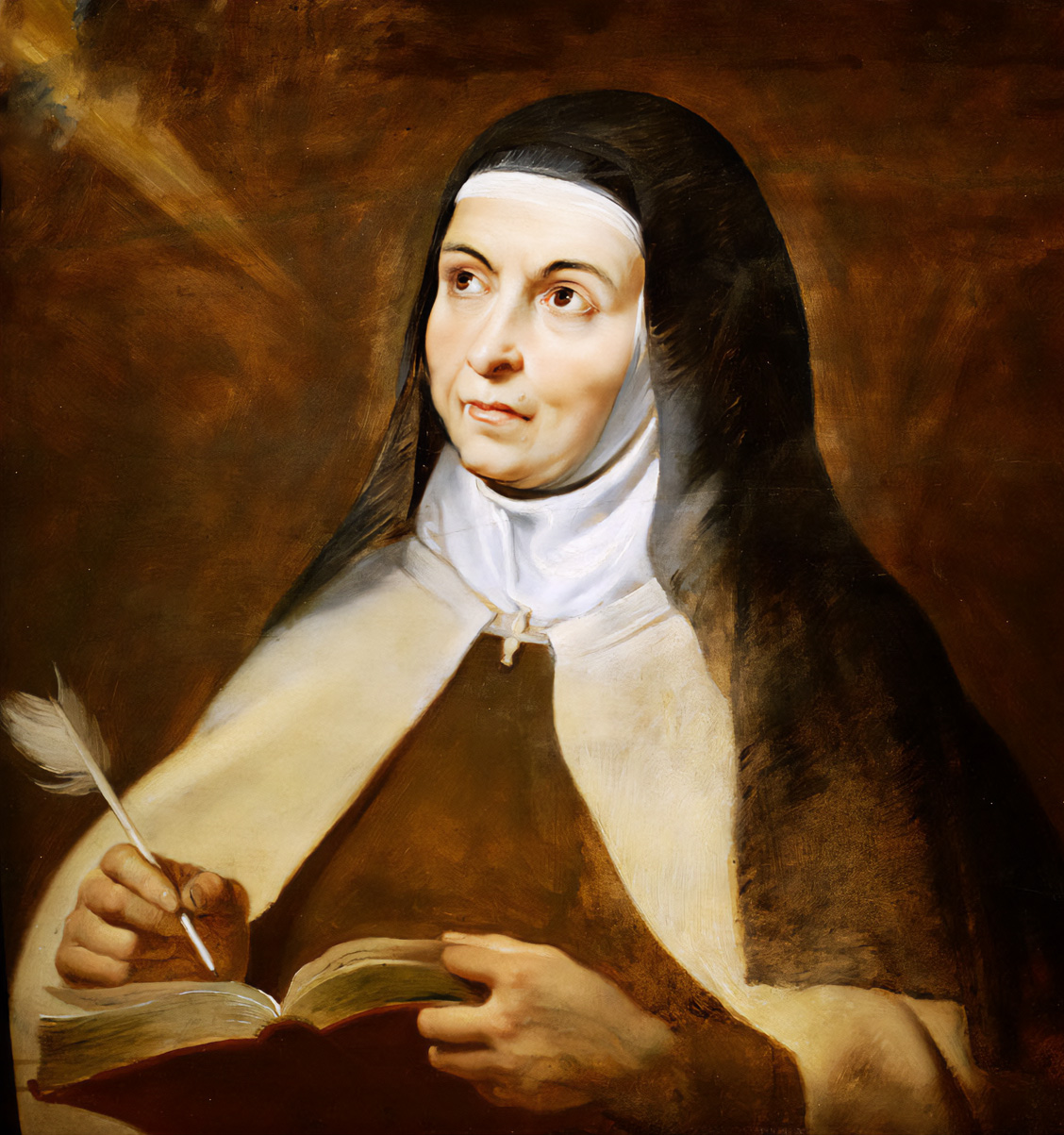
15 OCTOBER – SAINT TERESA OF AVILA (Virgin and Doctor)


Teresa, the daughter of Alphonsus Sanchez de Cepeda, was born at Avila in Spain in 1515. She was brought up by them in the fear of God, and while still very young she gave admirable promise of her future sanctity. While reading the Acts of the holy martyrs, she was so enkindled with the fire of the Holy Spirit that she ran away from home, resolved to cross over to Africa, and there to lay down her life for the glory of Jesus Christ and the salvation of souls. She was brought back by her uncle but her heart still burned with the desire of martyrdom, which she endeavoured to satisfy by alms-deeds and other works of piety, weeping continually to see herself deprived of that happy lot. On the death of her mother she begged the Blessed Virgin to be a Mother to her, and she gained her request, for, ever afterwards the Mother of God cherished her as a daughter. At the age of 20 she joined the Nuns of Saint Mary of Mount Carmel and spent 18 years in that monastery, enduring severe illnesses and many trials. While she was courageously battling in the ranks of Christian penance, she was deprived of the support of heavenly consolations in which the saints usually abound even on Earth.

Teresa was adorned with angelic virtues and her charity made her solicitous not for her salvation only, but for that of all mankind. Inspired by God, and with the approval of Pope Pius IV, she restored the Carmelite Order to its primitive severity and caused it to be so observed first by women and then by men. The all-powerful blessing of God was evident in this work for, although destitute of all human assistance and opposed by many of the powerful in the world, she was able in her poverty to build 32 monasteries. She wept continually over the blindness of infidels and heretics, and offered to God the voluntary maceration of her body to appease the divine anger on their behalf. Her heart burned like a furnace of divine love, so that once she saw an Angel piercing it with a fiery dart and heard Christ say to her, taking her hand in His: “Henceforward, as my true bride, you will be zealous for my honour.” By our Lord’s advice Teresa made the extremely difficult vow always to do what she conceived to be most perfect. She wrote many works full of divine wisdom, which arouse in the minds of the faithful the desire of their heavenly country.

Whereas Teresa was a pattern of every virtue, her desire of bodily mortification was most ardent. And despite the various illnesses that afflicted her, she chastised herself with sharp disciplines, scourged herself with bundles of nettles and sometimes rolled among thorns. She would often speak to God saying: “O Lord, let me either suffer or die.” She considered that as long as she was absent from the fountain of life, she was dying daily and most miserably. She was remarkable for her gift of prophesy and was enriched to such a degree by our Lord with His divine favours that she would often beg Him to set bounds to His gifts, and not to blot out the memory of her sins so quickly. Consumed by the irresistible fire of divine love rather than by disease, she received the last Sacraments and exhorted her children to peace, charity and religious observance. She died at Alba de Tonnes on the day she had foretold, and her pure soul was seen ascending to God in the form of a dove. She died at the age of 67 in 1582.

Jesus was seen present at her deathbed surrounded by Angels and a withered tree near her cell suddenly burst into blossom. Her body has remained incorrupt to the present day, distilling a fragrant liquor. She was made illustrious by miracles both before and after her death, and was canonised by Pope Gregory XV in 1622. She was proclaimed a Doctor of the Church by Pope Paul VI in 1970.

Dom Prosper Guéranger:
“Although the Church Triumphant in Heaven and the Church Militant here on Earth appear to be completely separated,” says Bossuet on this feast, “they are nevertheless united by a sacred bond. This bond is charity, which is found in this land of exile as well as in our heavenly country, which rejoices the triumphant Saints and animates those still militant, which, descending from Heaven to Earth, and from Angels to men, causes Earth to become a Heaven, and men to become Angels. For, O holy Jerusalem, happy Church of the first-born whose names are written in Heaven, although the Church your dear sister, who lives and combats here below, ventures not to compare herself with you, she is not the less assured that a holy love unites her to you. It is true that she is seeking and you possess, that she labours and you are at rest, that she hopes and you rejoice. But among all these differences which separate the two so far asunder, there is this at least in common: that what the blessed spirits love, the same we mortals love. Jesus is their life, Jesus is our life. And and amid their songs of rapture and our sighs of sorrow, everywhere are heard to rebound these words of the sacred Psalmist: It is good for me to adhere to my God.”
Of this sovereign good of the Church Militant and Triumphant, Teresa, in a time of decadence, was commissioned to remind the world from the height of Carmel restored by her to its pristine beauty. After the cold night of the fourteenth and fifteenth centuries, the example of her life possessed a power of irresistible attraction which survives in her writings drawing predestined souls after her in the footsteps of the Divine Spouse. It was not, however, by unknown ways that the Holy Spirit led Teresa. Neither did she, the humble Teresa, make any innovations. Long before the Apostle had declared that the Christian’s conversation is in Heaven. And we saw a few days ago how the Areopagite formulated the teaching of the first century. After him we might mention Saint Ambrose, Saint Augustine, Saint Gregory the Great, Saint Gregory Nazianzen, and many other witnesses from all the churches. It has been said, and proved far more ably than we could prove it, that “no state seems to have been more fully recognised by the Fathers than that of perfect union which is achieved in the highest contemplation, and in reading their writings we cannot help remarking the simplicity with which they treat of it. They seem to think it frequent and simply look upon it as the full development of the Christian life” (Spiritual Life and Prayer according to holy Scripture and monastic tradition. Chap. xix Translated by the Benedictines of Stanbrook).
In this, as in all else, Scholasticism followed the Fathers. It asserted the doctrine concerning these summits of Christian life even at a time when the weakness of faith in the people scarcely ever left full scope to divine charity, save in the obscurity of a few unknown cloisters. In its own peculiar form the teaching of the School was unfortunately not accessible to all, and moreover the abnormal character of that troubled epoch affected even the mystics that still remained. It was then that the Virgin of Avila appeared in the Catholic kingdom. Wonderfully gifted by grace and by nature, she experienced the resistances of the latter, as well as the calls of God, and the purifying delays and progressive triumphs of love. The Holy Ghost, who intended her to be a mistress in the Church, led her, if one may so speak, by the classical way of the favours He reserves for the perfect. Having arrived at the mountain of God, she described the road by which she had come, without any pretension but to obey Him who commanded her in the name of the Lord. With exquisite simplicity and unconsciousness of self, she related the works accomplished for her Spouse, made over to her daughters the lessons of her own experience, and described the many mansions of that castle of the human soul in the centre of which he that can reach it will find the holy Trinity residing as in an anticipated heaven. No more was needed: withdrawn from speculative abstractions and restored to her sublime simplicity, the Christian mystic again attracted every mind. Light re-awakened love. The virtues flourished in the Church, and the baneful effects of heresy and its pretended reform were counteracted.
Doubtless Teresa invited no one to attempt, as presumptuously as vainly, to force an entrance into the uncommon paths. But if passive and infused union depends entirely on God’s good pleasure, the union of effective and active conformity to the divine Will, without which the other would be an illusion, may be attained with the help of ordinary grace by every man of good will. Those who possess it “have obtained,” says the Saint, “what it was lawful for them to wish for. This is the union I have all my life desired, and have always asked of our Lord. It is also the easiest to understand, and the most secure.” She added however: “Beware of that excessive reserve which certain persons have, and which they take for humility. If the king deigned to grant you a favour, would it be humility to meet him with a refusal? And when the sovereign Lord of Heaven and Earth deigns to honour my soul with His visit, and comes to load me with graces, and to rejoice with me, should I prove myself humble if I would not answer Him, nor keep Him company, nor accept His gifts, but fled from His presence and left Him all alone? A strange sort of humility is that! Look upon Jesus Christ as a Father, a Brother, a Master, or a Spouse. And treat Him in one or other of these ways. He Himself will teach you which is the one that best pleases Him and that it behoves you to choose. And then, be not so simple as to make no use of it.”
But it is said on all sides: “This way is beset with snares: such a soul was lost in it. Such an one went astray. And another, who ceased not to pray, could not escape a fall... See the inconceivable blindness of the world. It has no anxiety about those thousands of unfortunate creatures who, entirely strangers to the path of prayer, live in the most horrible excess. But if it happens, by a misfortune deplorable no doubt but very rare, that the tempter’s artifices seduce a soul that prays, they take advantage of this to inspire others with the greatest terror, and to deter them from the holy practices of virtue. Is he not the victim of a most fatal error who believes it necessary to abstain from doing good in order to avoid doing evil? You must rise above all these fears. Endeavour to keep your conscience always pure. Strengthen yourself in humility. Tread under foot all earthly things. Be inflexible in the faith of our mother the holy Church, and doubt not, after that, that you are on the right road.” It is too true that “when a soul finds not in herself that vigorous faith, and her transports of devotion do not strengthen her attachment to holy Church, she is in a way full of perils. The Spirit of God never inspires anything that is not conformable to holy Scripture. If there were the slightest divergence, that of itself alone would suffice to prove so evidently the action of the evil spirit, that were the whole world to assure me it was the divine Spirit, I would never believe it.”
But the soul may escape so great a danger by questioning those who can enlighten her. “Every Christian must, when he is able, seek out a learned guide, and the more learned the better. Such a help is still more necessary to persons given to prayer, and in the highest states, they have most need of it. I have always felt drawn to men eminent for doctrine. Some, I grant, may not have experimental knowledge of spiritual ways. But if they have not an aversion for them, they do not ignore them, and by the assistance of holy Scripture, of which they make a constant study, they always recognise the true signs of the good Spirit. The spirit of darkness has a strange dread of humble and virtuous science. He knows it will find him out and thus his stratagems will turn to his own loss... I, an ignorant and useless creature, bless you, O Lord, for these faithful servants of yours who give us light. I have no more knowledge than virtue. I write by snatches, and even then with difficulty. This prevents me from spinning, and I live in a poor house where I have no lack of occupations. The mere fact of being a woman and one so imperfect is sufficient to make me lay down the pen.”
As you will, O Teresa: deliver your soul. Pass beyond that, and with Magdalene, at the recollection of what you call your infidelities, water with your tears the feet of our Lord, recognise yourself in Saint Augustine’s Confessions! Yes, in those former relations with the world, although approved by obedience. In those conversations which were honourable and virtuous: it was a fault in you, who were called to something higher, to withhold from God so many hours which he was inwardly urging you to reserve for Him alone. And who knows where your soul might have been led had you continued longer thus to wound your Spouse? But we, whose tepidity can see nothing in your great sins but what would be perfection in many of us, have a right to appreciate, as the Church does, both your life and your writings. And to pray with her on this joyful day of your feast that we may be nourished with your heavenly doctrine and kindled with your love of God.
According to the word of the divine Canticle, in order to introduce Teresa into His most precious stores the Spouse had first to set charity in order in her soul. Having, therefore, claimed His just and sovereign rights, He at once restored her to her neighbour, more devoted and more loving than before. The Seraph’s dart did not wither nor deform her heart. At the highest summit of perfection she was destined to attain, in the very year of her blessed death, she wrote: “If you love me much, I love you equally, I assure you. And I like you to tell me the same. Oh how true it is that our nature inclines us to wish for return of love! It cannot be wrong, since our Lord Himself exacts a return from us. It is an advantage to resemble Him in something, were it only in this.” And elsewhere, speaking of her endless journeys in the service of her divine Spouse, she says: “It cost me the greatest pain when I had to part from my daughters and sisters. They are detached from everything else in the world, but God has not given them to be detached from me. He has perhaps done this for my greater trial, for neither am I detached from them.” No, grace never depreciates nature which, like itself, is the Creator’s work. It consecrates it, makes it healthy, fortifies it, harmonises it, causes the full development of its faculties to become the first and most tangible homage, publicly offered by regenerated man to Christ His Redeemer. Let any one read that literary masterpiece, the Book of the Foundations, or the innumerable letters written by the seraphic Mother amid the devouring activity of her life. There he will see, whether the heroism of faith and of all virtues, whether sanctity in its highest mystical expression, was ever prejudicial —we will not say to Teresa’s constancy, devotedness or energy — but to that intelligence which nothing could disconcert, swift, lively and pleasant; to that even character, which shed its peaceful serenity on all around; to the delicate solicitude, the moderation, the exquisite tact, the amiable manners, the practical good sense, of this contemplative, whose pierced heart beat only by miracle, and whose motto was: “To suffer or to die.”
To the benefactor of a projected foundation she wrote: “Do not think, sir, that you will have to give only what you expect. I warn you of it. It is nothing to give money. That does not cost us much. But when we find ounelves on the point of being stoned, you, and your son-in-law, and as many of us as have to do with this affair, (as it nearly happened to us at the foundation of Saint Joseph’s at Avila), Oh! then will be the good time!” It was on occasion of this same foundation at Toledo, which was in fact very stormy, that the Saint said: “Teresa and three ducats are nothing. But God, Teresa, and three ducats, there you have everything.”
Teresa had to experience more than mere human privations: there came a time when God Himself seemed to fail her. Like Philip Benizi before her, and after her Joseph Calasanctius and Alphonsus Liguori, she saw herself, her daughters and her sons condemned and rejected in the name and by the authority of the Vicar of Christ. It was one of three occasions long before prophesied when it is “given to the beast to make war with the saints and to overcome them” (Apocalypse xiii. 7). We have not space to relate all the sad circumstances, and why should we do so? The old enemy had then one manner of acting, which he repeated in the sixteenth, seventeenth and eighteenth centuries, and will always repeat. In like manner, God has but one aim in permitting the evil, viz: to lead His chosen ones to that lofty summit of crucifying union where He who willed to be first to taste the bitter dregs of the chalice, could say more truly and more painfully than any other: “My God, my God, why have you forsaken me!” (Matthew xxvii. 46).
The Beloved, who revealed Himself to you, O Teresa, at death, you had already found in the sufferings of this life. If anything could bring you back to earth, it would be the desire of suffering yet more. “I am not surprised,” says Bossuet speaking in your honour on your feast, “that Jesus willed to die: He owed that sacrifice to His Father. But why was it necessary that He should spend His days, and finally close them, in the midst of such great pains? It is because, being the Man of sorrows, as the Prophet calls Him, He would live only to endure. Or, to express it more forcibly by a beautiful word of Tertullian’s: He wished to be satiated, before dying, with the luxury of suffering: Saginari voluptate patientiae dicessurus volebat. What a strange expression! One would think, according to this Father, that the whole life of our Saviour was a banquet where all the dishes consisted of torments. A strange banquet in the eyes of men, but which Jesus found to His taste! His death was sufficient for our salvation, but death was not enough to satisfy His wonderful appetite for suffering for us. It was needful to add the scourges, and that blood-stained crown that pierced His head, and all the cruel apparatus of terrible tortures. And wherefore living only to endure, He wished to be satiated, before dying, with the luxury of suffering for us. In so far that upon His Cross, seeing in the eternal decrees that there was nothing more for Him to suffer, ‘Ah’ said He, ‘it is done, all is consummated. Let us go forth, for there is nothing more to do in this world,’ and immediately he gave up His soul to His Father.”
If such is the mind of Jesus our Saviour, must it not also be that of His bride, Teresa of Jesus? “She too wished to suffer or to die, and her love could not endure that any other cause should retard her death, save that which deferred the death of our Saviour.” Let us warm our hearts at the sight of this great example. “If we are true Christians, we must desire to be ever with Jesus Christ. Now, where are we to find this loving Saviour of our souls? In what place may we embrace Him? He is found in two places: in His glory and in His sufferings, on His throne and on His Cross. We must, then, in order to be with Him, either embrace Him on His throne, which death enables us to do, or else share in His Cross, and this we do by suffering. Hence we must either suffer or die, if we would never be separated from our Lord. Let us suffer then, O Christians; let us suffer what it pleases God to send us: afflictions, sicknesses, the "miseries of poverty, injuries, calumnies. Let us try to carry, with steadfast courage, that portion of His Cross with which He is pleased to honour us.'”
* * * * *
O you, whom the Church proposes to her children as a mistress and mother in the paths of the spiritual life, teach us this strong an true Christianity. Perfection, doubtless, cannot be acquired in a day and you did say: “We should be much to be pitied, if we could not seek and find God till we were dead to the world. God deliver us from those extremely spiritual people who, without examination or discretion, would refer everything to perfect contemplation!” But God deliver us also from those mistaken devotions which you called puerile and foolish, and which were so repugnant to the uprightness and dignity of your generous soul. You desired no other prayer than that which would make you grow in virtue. Convince us of the great principle in these matters, that “the prayer best made and most pleasing to God is that which leaves behind it the best results proved by works, and not those sweetnesses which end in nothing but our own satisfaction.” He alone will be saved who has kept the commandments and fulfilled the law, and Heaven, your Heaven, O Teresa, is the reward of the virtues you practised, not of the revelations and ecstasies with which you were favoured.
May your sons be blessed with increase in members, in merit, and in holiness. In all the lands where the Holy Ghost has multiplied your daughters, may their hallowed homes recall those first dove-cotes of the Blessed Virgin where the Spouse delighted to show forth the miracles of His grace. To the triumph of the faith, and the support of its defenders, you directed their prayers and fasts. What an immense field now lies open to their zeal! With them and with you, we ask of God two things: first, that among so many men and so many religious, some may be found having the necessary qualities for usefully serving the cause of the Church, on the understanding that one perfect man can render more services than a great many who are not perfect. Secondly, that in the conflict our Lord may uphold them with His hand, enabling them to escape all dangers, and to close their ears to the songs of sirens... O God, have pity on so many perishing souls. Stay the course of so many evils which afflict Christendom, and without further delay, cause your light to shine in the midst of this darkness!
Also on this day according to the ROMAN MARTYROLOGY:

At Rome, on the Via Aurelia, St. Fortunatus, martyr.

At Cologne, the birthday of three hundred holy martyrs who terminated their combat in the persecution of Maximian.

At Carthage, St. Agileus, martyr, on whose birthday St. Augustine preached his panegyric.

In Prussia, St. Bruno, bishop of the Euthenians and martyr, who, preaching the Gospel in that region, was arrested by impious men, had his hands and feet cut off and was beheaded.

At Lyons, St. Antiochus, bishop, who entered the heavenly kingdom after having courageously fulfilled the duties of the high station to which he had been called.

At Treves, St. Severus, bishop and confessor.

At Strasburg, St. Aurelia, virgin.

At Cracow, St. Hedwiges, duchess of Poland, who devoted herself to the service of the poor, and was renowned for miracles. She was inscribed among the saints by Pope Clement IV, and Pope Innocent XI permitted her feast to be celebrated on the seventeenth of this month.

In Germany, St. Thecla, abbess.

And in other places, many other holy martyrs, confessors and virgins.

Thanks be to God.

Tuesday, 14 October 2025

14 OCTOBER – SAINT CALLIXTUS (Pope and Martyr)


Pope Saint Zephyrinus (202‒219 AD) entrusted his deacon Callixtus with the government of the clergy and the administration of the papal catacombs (the Catacombs of Saint Callixtus). When Pope Saint Zephyrinus died Callixtus succeeded him as Bishop of Rome. Pope Callixtus is credited with the institution of Ember Days of abstinence, fasting and prayer. He built the basilica of Santa Maria in Trastevere and enlarged the Catacombs which bear his name. The body of the blessed Calepodius, priest and martyr, having been thrown into the Tiber, Callixtus in his piety caused it to be diligently sought for, and when found to be honourably buried. He baptised Palmatius, Simplioius, Felix and Blanda, the first of whom was of consular rank, and the others of senatorial rank, and who all afterwards suffered martyrdom. For this he was cast into prison where he miraculously cured a soldier named Privatus, who was covered with ulcers, and in consequence of which converted to Christianity. Though so recently converted, Privatus died for the faith, being beaten to death with scourges tipped with lead. Callixtus was Pope 5 years, 1 month and 12 days. He held five ordinations in the month of December in which he ordained 16 priests, 4 deacons and 8 bishops. He was tortured for a long while by starvation and frequent scourgings, and finally, he was thrown out of a window of his house in the Trastevere and, tied to an anchor, his body was cast into a well. It was later recovered and initially interred in the Catacombs of Octavilla on the Via Aurelia, but later his body was translated back to the Trastevere and interred in the Basilica of Santa Maria in Trastevere. Pope Saint Callixtus is the patron of cemetery workers.

Dom Prosper Guéranger:
He was a sign of contradiction in Israel. In his own time, Christians were ranged either around him or against him. The trouble excited by his mere name [seventeen] hundred years ago was renewed in the middle of the nineteenth century by the discovery of a famous book which gave an occasion to the sectaries of our own days to stand with those of old against Callixtus and the Church. The book, entitled LOSOPHUMENA or refutation of heresies, was composed in the third century. It represented Callixtus, whose life and charaoter were painted in the darkest colours, as one of the worst corrupters of doctrine. In that third century, however, the author of the Philosophumena, attacking the Pontiff he wished to supplant, and setting up in Rome, as he himself acknowledges, Chair against Chair, did but publish to the Church his own shame by ranging himself among those very dissenters of whom his book professed to be the refutation and the history. The name of this first Antipope has not come down to us. But behold his punishment! The work of his envious pen, despised by his contemporaries, was to reappear at the right moment to awaken the slumbering attention of a far-off posterity.
The impartial criticism of these latter ages, setting aside the insinuations, took up the facts brought forward by the accuser, and with the aid of science, disentangling the truth from among his falsehoods, rendered the most unexpected testimony to his hated rival. Thus once more iniquity lied to itself (Psalm xxvi. 12) and this word of today’s Gospel was verified: “Nothing is covered that will not be revealed; nor hid that will not be known” (Matthew x. 26).
Let us listen to the greatest of Christian archaeologists whose mind, so sure and so reserved, was overcome with enthusiasm on finding so much light springing from such a source. “All this,” said the Commandant de Rossi on studying the odious document, “gives me clearly to understand why the accuser said ironically of Callixtus that he was reputed most admirable; why, though all knowledge of his acts was lost, his name has come down to us with such great veneration; and lastly, why, in the third and fourth centuries when the memory of his government was still fresh, he was honoured more than any of his predecessor, or of his successors, since the ages of persecution. Callixtus ruled the Church when she was at the term of the first stage in her career, and was marching forward to new and greater triumphs. The Christian faith hitherto embraced only by individuals, had then become the faith of families, and fathers made profession of it in their own and their children’s name. These families already formed almost the majority in every town. The religion of Christ was on the eve of becoming the public religion of the nation and the empire. How many new problems concerning Christian social rights, ecclesiastical law, and moral discipline, must have daily arisen in the Church, considering the greatness of her situation at the time, and the still greater future that was opening before her! Callixtus solved all these doubts. He drew up regulations concerning the deposition of clerics, took the necessary measures against the deterring of catechumens from Baptism, and of sinners from repentance, and defined the notion of the Church which St. Augustine was afterwards to develop. In opposition to the civil laws, he asserted the Christian’s right over his own conscience and the Church’s authority with regard to the marriage of the faithful. He knew no distinction of slave and freeman, great and lowly, noble and plebeian, in that spiritual brotherhood that was undermining Roman society and softening its inhuman manners. For this reason his name is so great at the present day. For this reason, the voice of the envious, or of those who measured the times by the narrowness of their own proud mind, was lost in the cries of admiration, and was utterly despised.”
We have not space to develop, as it deserves, this masterly exposition. We have already seen how, when the virgin martyr Caecilia yielded to the Popes the place of her first sepulture, Callixtus, then deacon of Zephyrinus, arranged the catacomb of the Caecilii for its new destiny. Venerable crypt, in which the State for the first time recognised the Church’s right to earthly possessions: sanctuary, no less than necropolis in which, before the triumph of the Cross, Christian Rome laid up her treasures for the resurrection day. Our great martyr-Pontiff was deemed the most worthy to give his name to this the principal cemetery although Providenoe had disposed that he should never rest in it. Under the benevolent reign of Alexander Severus, he met his death in the Trastevere in a sedition raised against him by the pagans. The cause of the tumult appears to have been his having obtained possession of the famous Taberna meritoria from the floor of which, in the days of Augustus, a fountain of oil had sprung up and had flowed for a whole day. The Pontiff built a church on the spot and dedicated it to the Mother of God. It is the basilica of Santan Maria in Trastevere. Its ownership was contended for, and the case was referred to the emperor, who decided in favour of the Christians. We may attribute to the vengeance of his adversaries the Saint’s violent death which took place close to the edifice his firmness had secured to the Church. The mob threw him into a well which is still to be seen in the church of San Callisto, a few paces from the Santa Maria basilica. For fear of the sedition, the martyr’s body was not carried to the Via Appia, but was laid in a cemetery already opened on the Via Aurelia, where his tomb originated a new historic centre of subterranean Rome.
* * * * *
THE Holy Ghost, the protector of the Church, prepared you, by suffering and humiliation, to become His chosen auxiliary. You were born a slave. While still young you were condemned to the mines of Sardinia for the Name o£ our Lord. You were a bond-slave, it is true, but not now for your former master. And when delivered from the mines at the time appointed by Him who regulates circumstances according to His good pleasure, you were ennobled by the title of Confessor, which recommended you to the maternal attention of the Church. Such were your merits and virtues, that Zephyrinus, entering upon the longest pontificate of the persecution period, chose you for the counsellor, support and coadjutor of his old age. And after the experience of those eighteen years, the Church elected you for her supreme Pastor. At the hour of your death, how prosperous did you leave this Bride of Our Lord! All the nobility of ancient days, all the moral worth and intellectual eminence of the human race seemed to be centred in her. Where was then the contempt of old, where the calumnies of a while ago. The world began to recognise in the Church the queen of the future. If the pagan state was yet to inflict cruel persecutions on her, it would be from the conviction that it must struggle desperately for its very existence. It even hesitated, and seemed, for ·the moment, more inclined to make a compact with the Christians.
You opened to the Church new paths, full of peril, but also of grandeur. From the absolute and brutal Non licet vos esse (“It is not lawful for you to exist”) of the lawyer-executioners, you were the first to bring the empire to recognise officially, to a certain extent, the rights of the Christian community. Through you Caecilia assured to them the power of assembling together and making collections to honour their dead. You consecrated to Mary, fons olei, the first sanctuary legally acquired by the Christians in Rome, and you were rewarded for the act by martyrdom. Now, far from compromising the least of God’s rights in coming to terms with Caesar, you did, at that very time, oppose the latter, asserting as no other had yet done the absolute independence of the Church with regard to marriage which Christ had withdrawn from the jurisdiction of the civil power. Already, would not one be inclined to say that we have a nation within the nation? Yes. And it will continue to be so until the whole nation itself have passed into the ranks of this new people.
Within the bosom of the Church, you had other cares. Doctrinal contests were at their height, and attacked the first of our mysteries: Sabellius condemned for his audacity in declaring that the real distinction of Persons in the most Holy Trinity is incompatible with the unity of God, left the field open to another sect, who so separated the Three Divine Persons as to make them three Gods. Again, there was Montanus whose disciples, enemies of the Sabellian theories even before Sabellius appeared, courted the favour of the Holy See for their system of false mysticism and extravagant reformation. But as an experienced pilot avoids the rocks and shoals, between the subtilities of dogmatisers, the pretensions of rigorists and the utopias of politicians, you, under the infallible guidance of the Holy Spirit, did, with a sure hand, steer the barque of Peter towards its glorious destination. The more Satan hates you and pursues you even to the present day, the more may you be glorified forever. Give your blessing to us, who are your sons and your disciples.
Also on this day according to the ROMAN MARTYROLOGY:

At Caesarea in Palestine, St. Fortunata, virgin and martyr, during the persecution of Diocletian. After having been subjected to the rack, to fire, to the teeth of beasts and other torments, she gave up her soul to God. Her body was afterwards conveyed to Naples in Campania.

Also the Saints Carponius, Evaristus and Priscian, brothers of the said blessed Fortunata, who having their throats cut, obtained likewise the crown of martyrdom.

Also the Saints Saturninus and Lupus.

At Rimini, St. Gaudentius, bishop and martyr.

At Todi, St. Fortunatus, bishop, who, as mentioned by Pope St. Gregory, was endowed with an extraordinary gift for casting out unclean spirits.

At Wurtzburg, St. Burchard, first bishop of that city.

At Bruges in Belgium, St. Donatian, bishop of Rheims.

At Treves, St. Rusticus, bishop.

The same day, the departure out of this world of St. Dominic Loricatus.

In Italy, St. Bernard, confessor.

And in other places, many other holy martyrs, confessors and virgins.

Thanks be to God.

Monday, 13 October 2025

13 OCTOBER – SAINT EDWARD (King and Confessor)

Richard II of England with his patron saints King Edmund the Martyr (left), King Edward the Confessor (middle) and St John the Baptist (right).

Edward, surnamed the Confessor, was the nephew of King Edward the Martyr, and was himself the last Anglo-Saxon King. Our Lord had revealed that he would one day be king, to a holy man named Brithwald. When Edward was 10 years old the Danes, who were devastating England, sought his life. He was therefore obliged to go into exile to the court of his uncle, Richard II, the Duke of Normandy. Amid the vices and temptations of the Norman court, he grew up pure and innocent, a subject of admiration to all. His pious devotion towards God and holy things was most remarkable. He was of a very gentle disposition, free from lust of power, and was a burning and shining light for love of God and the things of God. Of him the saying is preserved that he would prefer not to be a king of a kingdom won by slaughter and bloodshed. When the Danish rulers who had murdered his brothers Edmund and Alfred passed away, Edward returned to England and in 1042 assumed the kingship of his native country.

Edward applied himself to remove all traces of the havoc wrought by the enemy. To begin at the sanctuary, he built many churches and restored others, endowing them with rents and privileges, for he was very anxious to see religion, which had been neglected, flourishing again. All writers assert that, though compelled by his nobles to marry, both he and his bride preserved their virginity intact. Such were his love of Christ and his faith, that he was one day permitted to see our Lord in the Mass, shining with heavenly light and smiling upon him. His lavish charity won him the name of the lather of orphans and of the poor. He was never so happy as when he had exhausted the royal treasury on their behalf. He was honoured with the gift of prophecy, and foresaw much of Englands future history. A remarkable instance is, that when Sweyn, king of Denmark, was drowned in the very act of embarking on his fleet to invade England, Edward was supernaturally aware of the event the very moment it happened.

Edward had a special devotion to Saint John the Evangelist, and was accustomed never to refuse anything asked in his name. One day Saint John appeared to him as a poor man begging an alms in this manner. The king, having no money about him, took off his ring and gave it to him. Soon afterwards the Saint sent the ring back to Edward, with a message that his death was at hand. The king then ordered prayers to be said for himself. He died most piously on the day foretold by Saint John, the Nones (5th) of January 1066. He was canonised by Pope Alexander III in 1161. Pope Innocent XI ordered his memory to be celebrated with a public Office throughout the whole Church on the 13th of October, the day on which in 1102 his body, which was found to be incorrupt and sweet-smelling, was translated by Saint Thomas Becket, Bishop of Canterbury, in the presence of King Henry II.

Dom Prosper Guéranger:
This glorious Saint was like a beautiful lily, crowning the ancient branch of the king of Wessex. The times had progressed since that eleventh century when the pagan Cerdic and other pirate chiefs from the North Sea scattered with ruins the Island of Saints. Having accomplished their mission of wrath, the Anglo-Saxons became instruments of grace to the land they had conquered. Evangelised by Rome, even as before them the Britons they had just chastised, they remembered, better than the latter from where their salvation had come: a spring-tide blossoming of sanctity showed the pleasure God took once more in Albion, for the constant fidelity of the princes and people of the heptarchy towards the See of Peter. In 800 Egbert, a descendant of Cerdic, had gone on pilgrimage to Rome when a deputation from the West Saxons offered him the crown beside the tomb of the Prince of the Apostles, at whose feet Charlemagne, at that very time, was restoring the Empire. As Egbert united under one sceptre the power of the seven kingdoms, so Saint Edward, his last descendant, represents today in his own person the glorious holiness of them all. Nephew to Saint Edward the Martyr, our holy king is known to God and man by the beautiful title of the Confessor. The Church, in her account of his life, sets forth more particularly the virtues which won him so glorious an appellation. But we must remember moreover that his reign of twenty-four years was one of the happiest England has ever known. Alfred the Great had no more illustrious imitator. The Danes, so long masters, now entirely subjugated within the kingdom, and without, held at bay by the noble attitude of the prince. Macbeth, the usurper of the Scotch throne, vanquished in a campaign that Shakespeare has immortalised. Saint Edwards Laws, which remain to this day the basis of the British Constitution, the Saints munificence towards all noble enterprises, while at the same time he diminished the taxes: all this proves with sufficient clearness that the sweetness of virtue, which made him the intimate friend of Saint John the Beloved disciple, is not incompatible with the greatness of a monarch.
You represent on the sacred Cycle the nation which Gregory the Great foresaw would rival the Angels. So many holy kings, illustrious virgins, grand bishops, and great monks who were its glory, now form your brilliant court. Where are now the unwise in whose sight you and your race seemed to die? History must be judged in the light of Heaven. While you and your reign there eternally, judging nations and ruling over peoples, the dynasties of your successors on Earth, ever jealous of the Church and long wandering in schism and heresy, have become extinct one after another, sterilised by Gods wrath and having none but that vain renown of which no trace is found in the book of life. How much more noble and more durable, O Edward, were the fruits of your holy virginity! Teach us to look upon the present world as a preparation for another, an everlasting world, and to value human events by their eternal results. Our admiring worship seeks and finds you in your royal Abbey of Westminster, and we love to contemplate, by anticipation, your glorious resurrection on the day of judgement when all around you so many false grandeurs will acknowledge their shame and their nothingess. Bless us, prostrate in spirit or in reality, beside your tomb where heresy, fearful of the result, would fain forbid our prayer. Offer to God the supplications rising today from all parts of the world, for the wandering sheep whom the Shepherds voice is now so earnestly calling back to the one Fold!
Also on this day according to the ROMAN MARTYROLOGY:

At Troas in Asia Minor, the birthday of St. Carpus, a disciple of the blessed Apostle St. Paul.

At Cordova in Spain, the birthday of the holy martyrs Faustus, Januarius and Martial. First tortured on the rack, then having their eyelashes shaven, their teeth plucked out, their ears and noses cut off, they finished their martyrdom by fire.

At Thessalonica, St. Florentius, a martyr, who, after enduring various torments, was burned alive.

In Austria, St. Colman, martyr.

At Ceuta in Morocco, seven martyrs of the Order of Friars Minor, Daniel, Samuel, Angelus, Domnus, Leo, Nicholas and Hugolinus. For preaching the Gospel and refuting the errors of Muhammed, they were reviled, bound and scourged by the Saracens, and finally won the palm of martyrdom by being beheaded.

At Antioch, the holy bishop Theophilus, who held the pontificate in that church, the sixth after the blessed Apostle St. Peter.

At Tours, St. Venantius, abbot, and confessor.

At Subiaco in Italy, St. Chelidonia, virgin.

And in other places, many other holy martyrs, confessors and virgins.

Thanks be to God.


Saturday, 11 October 2025

11 OCTOBER – THE MATERNITY OF THE BLESSED VIRGIN MARY


This feast commemorates the dignity of the Mary as Mother of God (Theotokos), the title of Mary ratified by the Council of Ephesus in 431 AD. The feast was first granted to the dioceses of Portugal and to Brasil and Algeria in 1751. In 1752 it was granted to the province of Venice, in 1778 to the kingdom of Naples and in 1807 to Tuscany.

Eighth Lesson from the Roman Breviary:

Marvel at both these things, and choose whether to marvel most at the sublime condescension of the Son, or at the sublime dignity of Mary. Either is amazing, either marvellous. That God should obey this woman, is a lowliness without parallel; that this woman should rule over God, an exaltation without match. In praise of virgins, and of virgins only, is it sung that “These are they which follow the Lamb wherever He goes” (Apocalypse xiv. 4). Of what praise then think you that she must be worthy who even leads the Lamb. “O man, learn to obey. O earth, learn to submit. O dust, learn to keep down. It is of your Maker that the Evangelist said: ‘And He was subject to them.’ Blush, O proud ashes! God humbles Himself; and you exalt yourself? God is subject to men; and will you, by striving to rule over men, set yourself before your Maker?
O happy Mary, lowly and virgin; and wondrous virginity, which motherhood destroyed not, but exalted; and wondrous lowliness, which the fruitful virginity took not away, but ennobled; and wondrous motherhood, which was both virgin and lowly. Which of them is not wondrous? which of them is not unexampled, and which of them does not stand alone? The wonder would be if you were not puzzled at which to wonder most — motherhood in a virgin, or virginity in a mother; a motherhood so exalted, or lowliness in such exaltation. But indeed more marvellous than any one of these things is the combination of them all, and without all comparison, it is more excellent and more blessed to have received them all, than to have received any one of them alone. What wonder is it that God, of Whom we see and read, that “He is wonderful in His holy places” (Psalm lxvii. 36), should have shown Himself wonderful in His Mother? O you that be married, honour this incorruption in corruptible flesh; O, holy maidens, gaze in wonder at motherhood in a maid; O, all mankind, take pattern by the lowliness of the Mother of God.
O God, who willed that your Word should take flesh at the message of an angel in the womb of the Blessed Virgin Mary, grant to us, we beseech you, that we who believe her to be indeed the Mother of God may be aided by her intercession with you. Through the same our Lord Jesus Christ your Son, who lives and reigns with you, in the unity of the Holy Spirit, one God, world without end. Amen.
Also on this day according to the ROMAN MARTYROLOGY:

At Tarsus in Cilicia, the birthday of the holy martyrs Tharacus, Probus and Andronicus, who endured a long and painful imprisonment, during the persecution of Diocletian, and being three times subjected to diverse punishments and tortures, finally obtained a glorious triumph for the confession of Christ by having their heads struck off.

In Vexin, in the time of the governor Fescenninus, the passion of the holy martyrs Nicasiuc, bishop of
Rouen, Quirinus, priest, Scubiculus, deacon, and Pientia, virgin.

Also the martyrdom of the Saints Anastasius, priest, Placidus, Genesius, and their companions.

In Thebais, St. Sarmata, a disciple of the blessed abbot Anthony, who was put to death for Christ by the Saracens.

At Besançon in France, St. Germanus, bishop and martyr.

At Uzes in Narbonese Gaul, St. Firminus, bishop and confessor.

In Ireland, St. Kenny, abbot.

At Lier in Belgium, the departure from this life of St. Gummarus, confessor.

At Eennes, St. Æmilian, confessor.

At Tarsus in Cilicia, the holy women Zenaides and Philonilla, sisters, who were relatives of the blessed Apostle St. Paul, and his disciples in the faith.

At Verona, St. Placidia, virgin.

At Calotium, a place now in the diocese of Asti, but formerly in that of Pavia, St. Alexander Sauli, bishop and confessor, of the congregation of Barnabites, a man illustrious by birth, learning and miracles.

And in other places, many other holy martyrs, confessors and virgins.

Thanks be to God.

Friday, 10 October 2025

10 OCTOBER – SAINT FRANCIS BORGIA (Confessor)


Francis was born in Valencia, Spain, in 1510 to Juan Borgia, who was the third Duke of Gandía and the son of Giovanni Borgia, the son of Pope Alexander VI (Rodrigo Borgia). His mother was Juana, the daughter of Alonso de Aragón, Archbishop of Saragossa, who was the illegitimate son of King Ferdinand II of Aragon. He passed his childhood in his father’s house in innocence and piety, but appeared still more admirable when he showed himself a pattern of Christian virtue and austerity, first at the court of Emperor Charles V and afterwards as viceroy of Catalonia. He was charged to convey the body of the Empress Isabella to her tomb at Granada. Seeing the horrible change in her features, he understood how fleeting are all earthly things and vowed to renounce everything as soon as possible and devote himself to the service of the King of kings. From that day forward he made such progress in virtue that in the midst of overwhelming occupations his life was a faithful copy of religious perfection, so that he was called the miracle of princes.

Francis married Eleonora de Castro and had five children. On her death he entered the Society of Jesus so that he be more hidden. Many princes followed him in embracing a severe way of life. Charles V himself acknowledged that his advice and example had led him to abdicate the throne. Francis devoted himself to the exercises of a penitential life and macerated his body by fasting, iron chains, a rough hair-shirt and long and bloody disciplines. He allowed himself very little sleep. He spared no effort to gain souls. Saint Ignatius appointed him Commissioner General for Spain and soon afterwards, against his will, he was elected third General of the Order. In this position his prudence and holiness endeared him to Popes and also temporal rulers. He founded and enlarged many houses of his Order and introduced the Order into Poland, the islands of the Atlantic, Mexico and Peru. He sent apostles into other regions to spread the Catholic faith by their peaching and labours and their blood.

Francis had a low opinion of himself. He always called himself a sinner. This humility led him to persistently refuse the office of bishop. Filled with contempt for the world and himself, he delighted in sweeping away dirt, begging from door to door and serving the sick in hospitals. He devoted many hours every day to heavenly contemplation, spending 8-10 hours praying, and genuflecting in adoration a hundred times in the day. He never omitted to say Mass. While offering the divine Victim or preaching, the heavenly ardour which consumed him was manifested in the radiance of his countenance. He knew by heavenly instinct where the most holy Body of Christ, hidden in the Eucharist, was kept. Pope Saint Pius V appointed Francis companion to Cardinal Alessandrino, in an embassy for uniting the Christian princes against the Turks.

Francis died in Ferrara in 1572 while travelling on an embassy from Pope Saint Pius V to the kings of France and Spain. He was canonised by Pope Clement X in 1670 and his relics were translated to Madrid, Spain, in 1901.

Dom Prosper Guéranger:
“Vanity of vanities and all is vanity” (Ecclesiastes i. 2) No argument was needed to impress this truth upon the Saint of today when the coffin was opened which contained all that Spain had admired of faith and loveliness, and death suddenly revealed to its awful reality. O ye beauties of all times, death alone never dies. It invites itself to your dances and pleasures, it assists at all your triumphs, it hears promises said to be eternal: and how quickly it can scatter your adorers! A few years, a few days, perhaps even less, and all your borrowed sweetness will be decaying in the tomb!
“Enough of vain phantoms, enough of serving mortal kings. Awaken, O my soul!” Such was Francis Borgia’s reply to the teachings of death. The friend of Charles V, the great lord unequalled for nobility, fortune and brilliant qualities, quitted the court as soon as possible. Ignatius, the soldier of the siege of Pampeluna, beheld at his feet the viceroy of Catalonia, begging to be protected against the honours which pursued him even under the poor habit of a Jesuit, which was now his glory.
O LORD Lord Jesus Christ, the pattern and reward of true humility, we beseech you, that as you made blessed Francis a glorious follower of you in the contempt of worldly honour, so you would grant us to be partakers of the same imitation and glory.” Such is the prayer the Church offers through you to her divine Spouse. She knows that the Saints always have great power with God, but especially when they would obtain for their devout clients the virtues they themselves more particularly cultivated when on Earth. How precious is this prerogative in thy case, O Francis, for it concerns the virtue which attracts God’s grace in this life, and wins such glory hereafter! Since pride has hurled Lucifer into the abyss and the self-abasement of the Son of God has led to His exaltation above the heavens, humility, whatever men may now say, has lost nothing of its inestimable value. It is still the indispensable foundation of every durable edifice, whether spiritual or social: the basis without which the other virtues, and even charity the Queen of them all, could not subsist a single day. Therefore, O Francis, obtain for us this humility. Thoroughly convince us of the vanity of this world’s honours and false pleasures. May the holy Society, which you after Saint Ignatius rendered still more valuable to the Church, cherish this spirit of yours so that it may deserve more and more the esteem of Heaven and the gratitude of Earth.
Also on this day according to the ROMAN MARTYROLOGY:

On the island of Crete, blessed Pinytus, most noble among the bishops. He was bishop of Gnosia, and flourished under Marcus Antoninus Verus and Lucius Aurelius Commodus. He left in his writings, as in a mirror, a vivid delineation of himself.

At Cologne, in the persecution of Maximian, St. Gereon, martyr, with three hundred and eighteen others who patiently bowed their necks to the sword for the true religion.

In the neighbourhood of the same city, the holy martyrs Victor and his companions.

At Bonn in Germany, the holy martyrs Cassius and Florentius, with many others.

At Nicomedia, the holy martyrs Eulampius, and his sister, the virgin Eulampia, who, hearing that her brother was tortured for Christ, rushed through the crowd, embraced him and became his companion. Both were cast into a cauldron of boiling oil, but being quite uninjured, they terminated their martyrdom by decapitation with two hundred others, who, impressed by the miracle, had believed in Christ.

At York in England, the holy bishop Paulinus, a disciple of Pope St. Gregory. Being sent there by that pope with others to preach the Gospel, he converted king Edwin and his people to the faith of Christ.

At Piombino in Tuscany, St. Cerbonius, bishop and confessor, who, as Pope St. Gregory related, was renowned for miracles, both during life and after death.

At Verona, another St. Cerbonius, bishop.

At Capua, St. Paulinus, bishop.

And in other places, many other holy martyrs, confessors and virgins.

Thanks be to God.

Thursday, 9 October 2025

9 OCTOBER – SAINT JOHN LEONARD (Confessor)


Giovanni Leonardi was born in Lucca, Tuscany, in 1541 and was ordained as a priest in 1572. In 1574 he founded the Congregation of the Regular Clergy of the Mother of God and worked to spread devotion to the Blessed Virgin Mary, frequent reception of the Holy Eucharist and the devotion of the Forty Hours. In Rome he met Saint Philip Neri who entrusted him with the task of reforming the Benedictine Congregation of Montevergine. John co-founded the great Roman College of Propaganda Fide. He died in Rome in 1609, was beatified by Blessed Pope Pius IX in 1861 and was canonised by Pope Pius XI in 1938.
O God, who for the propagation of the faith among the nations was pleased in a wondrous manner to raise up blessed John your confessor, and through him gathered together in your Church a new family for the instruction of the faithful, grant to us your servants that we may so profit by his teaching as to attain everlasting rewards. Through our Lord...
Also on this day according to the ROMAN MARTYROLOGY:

At Paris, the birthday of the holy martyrs Denis the Areopagite, bishop, Rusticus, priest, and Eleutherius, deacon. Denis was baptised by the blessed Apostle St. Paul, and consecrated first bishop of Athens. Then going to Rome, he was sent to Gaul by Pope St. Clement to preach the Gospel. He proceeded to Paris, and after having for some years faithfully filled the office entrusted to him, he was subjected to the severest kinds of torments by the prefect Fescenninus, and at length, being beheaded with his companions, completed his martyrdom.

The same day, the commemoration of the holy patriarch Abraham, father of all believers.

At Julia (now Borgo-San-Donnino) near Parma, on the Via Claudia, St. Domninus, martyr, under the emperor Maximian. As he was trying to escape the raging persecution, he was overtaken by his pursuers, and being transpierced with a sword, died gloriously.

At Cassino, St. Deusdedit, abbot, who was cast into prison by the tyrant Sicardus, and being there consumed with hunger and misery, yielded up his soul.

In Hainaut, St. Gislenus, bishop and confessor, who, resigning his See, led the monastical life in a monastery built by himself and was distinguished by many virtues.

At Valencia in Spain, St. Louis Bertrand, of the Order of Preachers, who, being filled with the apostolic spirit, confirmed, by the innocence of his life and the working of many miracles, the Gospel which he had preached in America.

At Jerusalem, the Saints Andronicus, and Athanasia, his wife.

At Antioch, St. Publia, abbess, who, while Julian the Apostate was passing by, sang with her religious these words of David: “The idols of the Gentiles are silver and gold” and “Let them that make them, become like unto them.” By the command of the emperor she was struck on the face and severely rebuked.

And in other places, many other holy martyrs, confessors and virgins.

Thanks be to God.

Wednesday, 8 October 2025

8 OCTOBER – SAINT SIMEON THE JUST (Prophet)

Gospel – Luke ii. 25–35
Behold there was a man in Jerusalem named Simeon, and this man was just and devout, waiting for the consolation of Israel; and the Holy Ghost was in him. And he had received an answer from the Holy Ghost, that he should not see death, before he had seen the Christ of the Lord. And he came by the Spirit into the temple. And when his parents brought in the child Jesus, to do for him according to the custom of the law, He also took him into his arms, and blessed God, and said: “Now dismiss your servant, O Lord, according to your word in peace: because my eyes have seen your salvation, which you have prepared before the face of all peoples: A light to the revelation of the Gentiles, and the glory of your people Israel.” And his father and mother were wondering at those things which were spoken concerning him. And Simeon blessed them, and said to Mary His mother: “Behold this child is set for the fall, and for the resurrection of many in Israel, and for a sign which will be contradicted. And your own soul a sword will pierce, that, out of many hearts, thoughts may be revealed.”
Praise be to you, O Christ.
Saint Adamnan and Saint Gregory of Tours said that holy Simeon was buried on Mount Olivet. In the sixth century his relics were translated to Constantinople by Justin the Younger. Since the thirteenth century the body of the holy prophet has rested in a great silver ark in the Church of Saint Simeon in Zadar, Croatia (formerly Zara):
“After various vicissitudes and removals this magnificent piece of silversmith's work, the largest it is said, in the churches of the Austrian Empire, is now to be seen above and behind the high altar, supported by two bronze angels, and reached by a narrow flight of stairs from each side, so that the faithful who come to adore the saint may ascend on one side to see the relic and kiss the shrine, and descend on the other.
This they may be seen doing all day long, but on the feast of St. Simeon, October 8th, they come in enormous numbers, and each pilgrim receives a bombace, or little tuft of cotton-wool in a paper envelope, which has been shut up in the ark and has thereby imbibed virtues which are miraculous in cases of toothache or earache or other minor ills to which cotton wool is applicable... For three months beforehand the business of making these bombaci goes on...
 
Either in 1213 or 1273 a ship was driven to Zara by a tempest, having on board a nobleman who during his stay deposited in the cemetery the body as he said of his brother, which he was taking home for burial. The nobleman however died at Zara, and from his papers it was discovered that the body was none other than that of Simeon the Just, who had held Christ in his arms in the Temple. Dreams and portents were not long wanting to confirm the discovery, and the body was taken to the collegiate Church of Sainta Maria, where, by the expulsion of devils from demoniacs and other satisfactory miracles of the same kind, it sufficiently asserted its sanctity. In 1371 Louis the Great of Hungary with the elder and younger Elizabeth, his mother and wife, visited Zara after his conquest of Dalmatia. The younger queen, so says the legend, was so desirous of possessing a piece of the relic that she broke off a finger and hid it in her bosom, but she instantly lost her senses and only recovered them on restitution of her theft. The finger miraculously attached itself to the body, and the bosom of the queen which had begun to mortify and breed worms was no less miraculously healed. After this we at last touch historical ground. Elizabeth wrote to certain nobles of Zara to have a rich ark of silver made to contain the relic: they entrusted the work to one Francesco d’Antonio di Milano, a goldsmith of Zara, with whom they entered into a contract in 1377, and the ark was finished in 1380, as we know by the inscription on the back, in which Francesco di Milano has recorded his own name as the artificer. The ark is an oblong coffer with a coped roof and a gable at each end, and is long enough to contain a human body at full length... Both within and without the whole ark is covered with silver plates, embossed with figure subjects, and chased with diapers and ornamental borders. The effigy of Simeon lies on the slope of the roof towards the church, and the rest of the surface is occupied with various scenes of the arrival of the relic at Zara, and of the miracles it performed there, the only historical subject being the Presentation in the temple which occupies the central panel of the front” (Thomas Jackson, Dalmatia, the Quarnero and Istria, 1887).

Also on this day according to the ROMAN MARTYROLOGY:

At Caesarea in Palestine, in the reign of Decius, St. Reparata, virgin and martyr, who, refusing to sacrifice to idols, was subjected to various kinds of torments and finally struck with the sword. Her soul was seen to leave her body in the shape of a dove and ascend to heaven.

At Thessalonica, St. Demetrius, a proconsul, who, for having brought many to the faith of Christ, was pierced with spears by order of the emperor Maximian, and thus ended his martyrdom.

In the same place, St. Nestor, martyr.

At Seville in Spain, St. Peter, martyr.

At Laodicea, in the time of Diocletian, St. Artemon, a priest, who gained the crown of martyrdom by fire.

In the diocese of Laon, St. Benedicta, virgin and martyr.

At Ancona, Saints Palatias and Laurentia, who were sent into exile in the persecution of Diocletian under the governor Dion, and sank under the weight of toil and misery.

At Rouen, St. Evodius, bishop and confessor.

At Jerusalem, St. Pelagia, surnamed the Penitent.

And in other places, many other holy martyrs, confessors and virgins.

Thanks be to God.

8 OCTOBER – SAINT BRIDGET OF SWEDEN (Widow)


Bridget (Birgitta) was born in Sweden in 1303 to the pious knight Birger Persson and his wife Ingeborg who was related to Swedish royalty. While she was yet unborn, her mother was saved from shipwreck for her sake. At the age of 10 Bridget heard a sermon on the Passion of our Lord, and the next night she saw Jesus on the Cross, covered with fresh blood and speaking to her about His Passion. From then on meditation on that subject affected her so much that she could never think of His sufferings without tears.

At the age of 13, Bridget married Prince Ulfo Gudmarsson of Nericia and bore four sons and four daughters, including a girl who was to become Saint Catherine of Sweden. She won him by the example and persuasion, to a life of piety. She then devoted herself with maternal love to the education of her children. Bridget was most zealous in serving the poor, especially the sick. She set apart a house for their reception and there she would often wash and kiss their feet. Together with Ulfo, she went on pilgrimage to Santiago de Compostella to visit the tomb of the Apostle Saint James. On the return journey Ulfo became seriously ill at Arras, but Saint Dionysius appeared to Bridget at night and foretold her the restoration of her husband’s health and other future events.

Ulfo became a Cistercian monk but died soon afterwards. Bridget then having heard the voice of Christ calling her in a dream, she embraced a more austere way of life and entered the Third Order of Saint Francis. Bridget was blessed by God with celestial visions and revelations. She founded the Order of the Most Holy Saviour (the “Bridgetines”) and the monastery of Vadstena on the banks of Lake Wetten. At our Lord’s command she went to Rome where she kindled the love of God in the hearts of many people. She also made a pilgrimage to Jerusalem but on her return to Rome suffered a fever and died on the 23rd of July 1373. She was canonised in 1393 by Pope Boniface IX and her feast is kept on the anniversary of the translation of her relics to Sweden. Saint Bridget is the patroness of Sweden and widows.

Dom Prosper Guéranger:
“Who, O Lord, has treated you thus?” “They that despise me and forget my love.” This was the first revelation of the Son of God to Bridget of Sweden. Francis of Assisi, raising before the world the standard of the Cross, had announced that Christ was about to recommence the Dolorous Way: not now in His own Person, but in the Church, who is flesh of His flesh. The truth of this declaration Bridget experienced from the very opening of that fatal fourteenth century during which such innumerable disasters, the results of crime, fell at once upon the West.
Born in the year when Sciarra Colonna, a new Pilate’s servant, dared to strike the Vicar of Christ, Bridget's childhood was contemporaneous with those sad falls which caused the Church to be despised by her enemies. There were no Saints in Christendom comparable to the great ones of old. In the preceding age the Latin races had exhausted their vitality in producing flowers, but where were the promised fruits? Ancient Europe had nothing but affronts for the Word of God. This feast, this apparition of Jesus in cold Scandinavia, seems to point to His flight from the habitual centre of His predilection. Bridget was ten years old, when the Man of Sorrows sought a resting-place in her heart: and at that very time the death of Clement V and the election of John XXII in a foreign land fixed the Papacy in its seventy years’ exile.
Rome meanwhile, widowed of her Pontiff, appeared the most miserable of cities: “The ways of Sion mourn, because there are none that come to the solemn feast.” Sacked by her own sons, she was daily losing some remnant of her ancient glory. Her public roads were scenes of bloodshed. Solitude reigned amid the ruins of her crumbling basilicas. Sheep grazed in Saint Peter’s and the Lateran. From the Seven Hills anarchy had spread throughout Italy, transforming the towns into haunts of brigands, and the country parts into deserts. France was doomed to expiate, in the horrors of a hundred years’ war, the captivity of the Sovereign Pontiff.
Unfortunately, the captivity was loved. The Court of Avignon did not mourn like the Hebrews by the rivers of Babylon. Richer in gold than in virtues, it were well, had they not, for a long time, shaken the influence of the Holy See over the nations. The German Empire and Louis of Bavaria could easily refuse obedience to the ward of the Valois. The Fratricelli accused the Pope of heresy while, countenanced by the doctors of the law, Marsillus of Padua attacked the very principle of the Papacy. Benedict XII, discouraged by the troubles in Italy, abandoned his design of returning to Rome and built upon the rook of Doms the famous castle, at once fortress and palace, which seemed to fix the residence of the Popes forever on the banks of the Rhone.
The misery of Rome and the splendour of Avignon reached their height under Clement VI who entered into a contract with Jane of Naples, Countess of Provence, securing to the Church the definitive possession of Avignon. At that time the Papal court surpassed all others in luxury and worldliness. God in His justice visited the nations with the scourge of the Black Death, while in His mercy He sent warnings from Heaven to Pope Clement: “Arise. Make peace between the kings of France and England, and go into Italy to preach the year of salvation, and to visit the places watered by the blood of Saints. Consider how, in the past, you have provoked my anger, doing your own will and not your duty. And I have held my peace. But now my time is at hand. If you will not obey, I will require of you an account of the unworthiness with which you have passed through all the degrees by which I permitted you to be exalted in glory. You will be answerable for all the avarice and ambition that have been rife in the Church in thy days. You could have done much towards a reformation, but being carnal-minded you would not. Repair the past by zeal during the rest of your life. Had not my patience preserved you, you would have fallen lower than any of your predecessors. Question your conscience, and you will see that I speak the truth.”
The severe message dictated by the Son of God to the prophetess Bridget of Sweden came from that Northern land where sanctity seemed to have taken refuge during the past half century. Though incurring such reproaches, the Pope still had great faith, and he accordingly received with generous courtesy the messengers from the Princess of Nericia. But though he promulgated the celebrated Jubilee of the half-century, Clement VI allowed the holy year to pass away without going himself to prostrate at the tombs of the Apostles, to which he convoked the entire world. The patience of God was at an end. The judgement of that soul was revealed to Bridget. She saw its terrible chastisement, which however was not eternal and was tempered by hope.
Hitherto wholly engaged with the supernatural interests of her own country, Bridget suddenly found her mission embrace the whole world. In vain, by her prayers to God, by her warnings to princes, had the Saint striven to avert from Sweden the trials that were to end in the union of Calmar. Neither Magnus II nor his consort Blanche of Dampierre took to heart the menaces of their noble relative: “I saw the sun and the moon shining together in the heavens until both having giving their power to the dragon, the sky grew pale, reptiles filled the earth, the sun sank into the abyss, and the moon disappeared, leaving no trace behind.”
The criminal coldness of the South had been the occasion of grace for the North. But the latter in its turn did not profit by the time of its visitation and Bridget quitted it forever. She herself was a city of refuge to our Lord. Taking up her abode in Rome, she there, by her holiness, prepared the way for the return of Christ’s Vicar. There for twenty years she, as it were, personified the Eternal City, enduring all its bitter sufferings, knowing all its moral miseries, presenting its tears and prayers to our Lord, continually visiting the tombs of Apostles and martyrs throughout the peninsula, and at the same time never ceasing to transmit to Pontiffs and Kings the messages dictated to her by God.
At length the horizon appeared to be brightening: while the just and inflexible Innocent VI reformed the Papal court, Albornoz was restoring peace in Italy. In 1367 Bridget had the great joy of receiving in the Vatican the blessing of Urban V. Unhappily, in three short years Urban quitted the threshold of the Apostles to return to his native land, but as Bridget foretold, he re-entered Avignon only to die. He was succeeded by the nephew of Clement VI, Roger de Beaufort under the name of Gregory XI who was destined to put an end to the exile and break the chains of the Roman Pontiffs.
But Bridget’s hour had come. Another was to reap in joy what she had sown in tears. Catherine of Siena was to bring back to the Holy City the Vicar of Our Lord. As to the valiant Scandinavian who had never lost courage nor faltered in faith through the failures of her missions, she was inspired by her divine Spouse to visit the holy places, the scenes of His Passion. It was on her return from this last pilgrimage that, far from her native land, in that desolate Rome whose widowhood she had striven in vain to terminate, she was called to her heavenly reward. Her body was carried back to Scandinavia by her daughter Saint Catherine of Sweden. It was laid in the yet unfinished monastery of Vadstena, mother-house of that projected Order of our Saviour, the foundation of which, like all the undertakings imposed by God on Bridget, was not to be completed until after her death. Twenty-five years before she had received almost simultaneously the command to found, and the command to quit, this holy retreat, as though our Lord would give her a glimpse of its blessed peace only to crucify her the more in the very different path into which He immediately led her. Such is God’s severity towards His dear ones, and such His sovereign independence with regard to His gifts. In the same manner He had allowed the Saint, in her early years, to be attracted by the beautiful lily of virginity, and had then signified His Will that the flower should not be hers. “When I cry,” said the Prophet, in a captivity figurative of that of which Bridget felt all the bitterness, “when I cry and entreat, he has shut out my prayer. He has shut up my ways with square stones, he has turned my paths upside down.”
Let us call to mind that St. Bridget died on the 23rd of July 1373. The 8th October is the anniversary of the first Mass celebrated in her honour by Pope Boniface IX on the day following her canonisation. Martin V confirmed the Acta of Boniface IX in her honour and approved her Revelations which had been violently attacked in the Councils of Constance and Basle, only to come forth with a higher recommendation to the piety of the faithful. Many indulgences are attached to the Rosary which bears the Saint’s name. These are now, by the favour of the Apostolic See, frequently applied to ordinary Rosaries. But it must be remembered that the true Rosary of Saint Bridget is composed of the Ave Maria recited sixty-three times, the Pater Noster seven times, and the Credo seven times, in honour of the supposed number of our Lady’s years on Earth, and of her joys and sorrows. It was also from a desire of honouring our Lady that the Saint vested in the Abbess the superiority over the double monasteries in the Order of our Saviour.
* * * * *
O valiant woman, support of the Church in most unhappy times, may you now be blessed by all nations! When the Earth, grown poor in virtue, no longer paid its debts to the Lord, you were the treasure discovered and brought from the uttermost coasts to supply for the indigence of many. You earned the good will of Heaven for the until then despised North. Then the Holy Spirit was moved by the prayers of Apostles and Martyrs to lead you to the land which their blood had not sufficed to render fruitful for the Spouse. You appeared as the merchant ship bringing bread from afar to countries wasted and barren. At your voice Rome took heart again. After your example she expiated the faults which had wrought her ruin. Your prayers and hers won back to her the heart of her Spouse and of His Vicar.
Your own portion was one of suffering and labour. When to the joy of all your work was consummated, you had already quitted this world. You resembled the heroes of the Old Testament, saluting from afar the promises that others were to see fulfilled, and acknowledging themselves to be strangers and pilgrims on the Earth. Like them you sought not the fatherland you had abandoned and to which you could have returned, but the only true home which is Heaven. Moreover, God made it a glory to be called your God.
From the eternal city where your exile is at an end, preserve in us the fruit of your example and teachings. Your Order of our Saviour perpetuates them in the countries where it still exists though so much diminished. May it revive at Vadstena in its primitive splendour! By it and its rivals in holiness, bring back Scandinavia to the faith, now so unhappily lost, of its apostle Anscharius, and of Eric and Olaf its martyr kings. Lastly, protect Rome whose interests were so specifically confided to you by our Lord. May she never again experience the terrible trial which cost you a lifetime of labour and suffering.

Tuesday, 7 October 2025

7 OCTOBER – SAINT MARK (Pope and Confessor)


Mark, a native of Rome, was the son of Priscus. Mark succeeded Pope Saint Silvester as Bishop of Rome on 18 January 336 AD.

During his short pontificate of eight months he founded the Basilica of San Marco Evangelista al Campidoglio (Titulus Pallacinae) at the Capitol, and dedicated it to his namesake, the Apostle and Evangelist, Saint Mark. He also founded the Basilica of Saint Balbina, erected over the cemetery of that saint. Pope Mark died on 7 October 336 and was buried in the Catacombs of Saint Balbina. Many centuries later his relics were translated to the Basilica of San Marco.

Dom Prosper Guéranger:

Mark, successor to Sylvester, the Pontiff of peace, has been honoured on this day from time immemorial. According to the testimony of Saint Damasus, his virtues no less than his name recalled Saint Mark the Evangelist. He occupied the supreme See only eight months but in that short time he followed up the recent triumph of the Church by wise organisations. He built two new sanctuaries in Rome. He gave the Pallium, of which this is the first mention in history, to the Bishop of Ostia, to enhance his high privilege of being the appointed consecrator of the Roman Pontiffs.
This Pontificate witnessed the awful death of Arius. Constantine had been deceived into ordering the re-instatement of this wicked man who taught that the Word Incarnate was a mere creature. The heresiarch, followed by his partisans, was proceeding in triumph through the streets of Constantinople intending to force open the doors of the Basilica where the faithful, with their Bishop St. Alexander, were beseeching God with fasting and tears, to avert the profanation. Suddenly, seized with an ignominious trembling, Arius was obliged to retire to a secret place, where his flatterers soon afterwards found him stretched on the floor with his bowels cast out. He had merited the death of a Judas for having delivered up the Son of God to the disputes of the people, to the mockeries of the proud, to the contradictions of the Praetorium.
Also on this day according to the ROMAN MARTYROLOGY:

In the province of the Euphrates, the holy martyrs Sergius and Bacchus, noble Romans, in the time of the emperor Maximian. Bacchus, being scourged with rough whips until his body was completely mangled, breathed his last in the confession of Christ. Sergius had his feet forced into shoes full of sharp-pointed nails, and, remaining unshaken in the faith, he was sentenced to undergo capital punishment. The place where he reposes is called after him Sergiopolis, and, on account of the signal miracles wrought in it, is honoured by a great concourse of Christians.

At Rome, the holy martyrs Marcellus and Apuleius, who at first followed Simon Magus, but seeing the wonders which the Lord performed by the blessed Apostle St. Peter, abandoned Simon and embraced the apostolic doctrine. After the death of the Apostles, under the ex-consul Aurelian, they won the crown of martyrdom and were buried near the city.

Also in the province of the Euphrates, St. Julia, virgin, who endured martyrdom under the governor Marcian.

At Padua, St. Justina, virgin and martyr, who was baptised by the blessed Prosdocimus, a disciple of the blessed Apostle St. Peter. As she remained firm in the faith of Christ, she was put to the sword by order of the governor Maximus and thus went to God.

At Bourges, St. Augustus, priest and confessor.

In the diocese of Rheims, St. Helanus, priest.

In Sweden, the translation of the body of St. Bridget, widow.

And in other places, many other holy martyrs, confessors and virgins.

Thanks be to God.

7 OCTOBER – OUR LADY OF THE ROSARY


The Battle of Lepanto, 7th October 1571
 
Dom Prosper Guéranger:
It is customary with men of the world to balance their accounts at the end of the year, and ascertain their profits. The Church is now preparing to do the same. We will soon see her solemnly numbering her elect, taking an inventory of their holy relics, visiting the tombs of those who sleep in the Lord, and counting the sanctuaries, both old and new, that have been consecrated to her divine Spouse. But today’s reckoning is a more solemn one, the profits more considerable: she opens her balance-sheet with the gain accruing to our Lady from the mysteries which compose the Cycle. Christmas, the Cross, the triumph of Jesus, these produce the holiness of us all. But before and above all, the holiness of Mary. The diadem which the Church thus offers first to the august Sovereign of the world is rightly composed of the triple crown of these sanctifying mysteries, the causes of her joy, of her sorrow, and of her glory. The joyful mysteries recall the Annunciation, the Visitation, the Birth of Jesus, Mary’s Purification and the Finding of our Lord in the Temple. The sorrowful mysteries bring before us the Agony of our blessed Lord, His being scourged, and crowned with thorns, the carrying of the Cross, and the Crucifixion. While, in the glorious mysteries, we contemplate the Resurrection and Ascension of our Saviour, Pentecost, and the Assumption and Coronation of the Mother of God. Such is Mary’s Rosary: a new and fruitful vine which began to blossom at Gabriel’s salutation, and whose fragrant garlands form a link between Earth and Heaven.
In its present form the Rosary was made known to the world by Saint Dominic at the time of the struggles with the Albigensians, that social war of such ill-omen for the Church. The Rosary was then of more avail than armed forces against the power of Satan. It is now the Church’s last resource. It would seem that the ancient forms of social prayer being no longer relished by the people, the Holy Spirit has willed by this easy and ready summary of the Liturgy to maintain, in the isolated devotion of these unhappy times, the essential of that life of prayer, faith and Christian virtue which the public celebration of the Divine Office formerly kept up among the nations. Before the thirteenth century popular piety was already familiar with what was called the psalter of the laity, that is, the Angelical Salutation repeated one hundred and fifty times. It was the distribution of these Hail Marys into decades, each devoted to the consideration of a particular mystery, that constituted the Rosary. Such was the divine expedient, simple as the Eternal Wisdom that conceived it and far-reaching in its effects, for while it led wandering man to the Queen of mercy, it obviated ignorance which is the food of heresy, and taught him to find once more “the paths consecrated by the Blood of the Man-God, and by the tears of his Mother.”
Thus speaks the great Pontiff who, in the universal sorrow of these days, has again pointed out the means of salvation more than once experienced by our fathers. Leo XIII in his Encyclicals has consecrated the present month to this devotion as dear to Heaven. He has honoured our Lady in her Litanies with a new title, Queen of the most holy Rosary, and he has given the final development to the solemnity of this day by raising it to the rank of a second class Feast, and by enriching it with a proper Office explaining its permanent object. Besides all this, the Feast is a memorial of glorious victories which do honour to the Christian name. Soliman II, the greatest of the Sultans, taking advantage of the confusion caused in the West by Luther, had filled the sixteenth century with terror by his exploits. He left to his son, Selim II the prospect of being able at length to carry out the ambition of his race: to subjugate Rome and Vienna, the Pope and the Emperor, to the power of the Crescent. The Turkish fleet had already mastered the greater part of the Mediterranean, and was threatening Italy when, on the 7th October 1571, it came into action in the Gulf of Lepanto with the pontifical galleys supported by the fleets of Spain and Venice. It was Sunday. Throughout the world the confraternities of the Rosary were engaged in their work of intercession. Supernaturally enlightened, Saint Pius V watched from the Vatican the battle undertaken by the leader he had chosen, Don John of Austria, against the three hundred vessels of Islam. The illustrious Pontiff, whose life’s work was now completed, did not survive to celebrate the anniversary of the triumph, but he perpetuated the memory of it by an annual commemoration of our Lady of Victory. His successor, Gregory XIII, altered this title to our Lady of the Rosary, and appointed the first Sunday of October for the new Feast, authorising its celebration in those churches which possessed an altar under that invocation.
A century and a half later, this limited concession was made general. As Innocent XI in memory of the deliverance of Vienna by Sobieski had extended the Feast of the most holy Name of Mary to the whole Church, so in 1716 Clement XI inscribed the Feast of the Rosary on the universal Calendar in gratitude for the victory gained by Prince Eugene at Peterwardein on the 5th August under the auspices of Our Lady of the Snow. This victory was followed by the raising of the siege of Corfu, and completed a year later by the taking of Belgrade.
[Note: In 1913 Pope Saint Pius X moved the Feast of Our Lady of the Most Holy Rosary to the 7th of October]
The joys experienced on the other Feasts of the Mother of God are all gathered up and resumed in this one for us, for the Angels, and for our Lady herself. Like the Angels, then, let us offer, together with Mary, the homage of our just delight to the Son of God, her Son, her King and ours.
Lesson – Proverbs viii. 22‒24; 32‒35
The Lord possessed me in the beginning of His ways, before He made any thing from the beginning. I was set up from eternity, and of old before the earth was made. The depths were not as yet, and I was already conceived. Now therefore, you children, hear me: Blessed are they that keep my ways. Hear instruction and be wise, and refuse it not. Blessed is the man that hears me, and that watches daily at my gates, and waits at the posts of my doors. He that will find me, will find life, and will have salvation from the Lord.
Thanks be to God.

Dom Prosper Guéranger:
Our Lady’s mysteries are before all time in God’s sight, like those of her divine Son. Like these they will endure for all eternity. Like them they rule the ages which circle round the Word and Mary, preparing for both in the days of figures, perpetuating their presence by the incessant glorification of the most holy Trinity in whose name all Christians are baptised. Now the Rosary honours all this series of mysteries. Today’s Feast is a glance back upon the Cycle as it draws to its close. From these mysteries, from this view of them, we must draw the conclusion formulated by our Lady herself in this passage from Proverbs which the Church applies to her: “Now therefore, my children, consider my ways. Imitate me, that you may find happiness.” Blessed is he that watches at her gate! Let us pray to her, rosary in hand, considering her at the same time, meditating on her life and her greatness, and watching, were it but for a quarter of an hour, at the entrance to the palace of this incomparable Queen. The more faithful we are, the more assured will be our salvation and our progress in true life.
Gospel – Luke i. 26‒38
At that time the angel Gabriel was sent from God into a city of Galilee called Nazareth, to a virgin espoused to a man whose name was Joseph, of the house of David. And the virgin’s name was Mary. And the Angel being come in, said to her: “Hail, full of grace, the Lord is with you. Blessed are you among among women.” Who having heard, was troubled at his saying, and thought with herself what manner of salutation this should be. And the Angel said to her: “Fear not, Mary, for you have found grace with God. Behold you will conceive in your womb, and will bring forth a son and you will call his name Jesus. He will be great, and will be called the Son of the Most High, and the Lord God will give to him the throne of David his father: and he will reign in the house of Jacob forever. And of his kingdom there will be no end.” And Mary said to the Angel: “How will this be done, because I know not man?” And the Angel answering, said to her, “The Holy Ghost will come upon you, and the power of the Most High will overshadow you. And therefore also the Holy which will be born of you, will be called the Son of God. And behold your cousin Elizabeth, she also has conceived a son in her old age. And this is the sixth month with her that is called barren: because no word will be impossible with God.” And Mary said: “Behold the handmaid of the Lord, be it done to me according to your word.”
Praise be to you, O Christ.

Dom Prosper Guéranger:
The Gospel is the same as on the Feast of the Most Holy Name of Mary. “At that time, the Angel Gabriel was sent from God into a city of Galilee called Nazareth, to a Virgin espoused to a man whose name was Joseph, of the house of David. And the Virgin’s name was Mary. And the Angel being come in, said to her: Hail, full of grace! The Lord is with you. Blessed are you among women.” “Blessed are you among women,” repeated Elizabeth a few days later, “and blessed is the fruit of your womb.” These two salutations, with the name of Mary added to the Angel’s greeting and the name of Jesus to Elizabeth’s, constituted the Ave Maria in the time of Saint Dominic, the promulgator of the Rosary. The prayer, “Holy Mary Mother of God” which now so beautifully completes the formula of praise received the sanction of the Church in the sixteenth century. No better Gospel could then have been chosen for today, for it gives the original text of the Rosary and describes the first of its mysteries.