Friday, 8 May 2026

9 MAY – SAINT GREGORY NAZIANZEN (Bishop and Doctor of the Church)

 
Gregory, a Cappadocian nobleman surnamed the Theologian on account of his extraordinary learning in the sacred sciences, was born at Nazianzum in Cappadocia. Together together with Saint Basil, Gregory went through a complete course of studies at Athens after which he applied himself to the study of the Sacred Scriptures. The two friends retired to a monastery where they spent several years over the Scripture, interpreting it not according to their own views, but by the sense and authority of the earlier Fathers. Owing to their reputation for learning and virtue, they were called to the ministry of preaching the Gospel and became the spiritual Fathers of many souls. After Gregory had returned home he was made Bishop of Sasima and afterwards administered the Church of Nazianzum. Being called later on to govern the Church of Constantinople which was infected with heresy, he converted it to the Catholic Faith. This success, far from gaining him everyones love, excited the envy of a great many. This caused a great division among the bishops which led the Saint to resign his See. He said to them those words of the Prophet: “If this tempest be stirred up on my account, cast me into the sea that you may cease to be tossed.”

He then returned to Nazianzum and, having got Eulalius made Bishop of that Church, he devoted his whole time to the contemplation of divine things and to the writing treatises upon them. Gregory wrote much, both in prose and verse, and in all there is admirable piety and eloquence. In the opinion of learned and holy men, there is nothing to be found in his writings which is not conformable to true piety and Catholic truth, or which anyone could reasonably call in question. He was a most vigorous defender of the Consubstantiality of the Son of God. No-one ever led a more saintly life than he. No-one was to be compared to him for eloquence. He led the life of a monk, spending his whole time in solitude, occupied in writing and reading. Having reached a venerable old age, he died during the reign of the emperor Theodosius, and entered into the blessed life of Heaven.

Dom Prosper Guéranger:
Side-by-side with Athanasius, a second Doctor of the Church comes forward at this glad Season, offering to the Risen Jesus the tribute of his learning and eloquence. It is Gregory of Nazianzam — the friend of Basil, the great Orator, the admirable Poet, whose style combines energy of thought with a remarkable richness and ease of expression, the one among all the Gregories who has merited and received the glorious name of Theologian on account of the soundness of his teachings, the sublimity of his ideas and the magnificence of his diction. Holy Church exults at being able to offer us so grand a Saint during Easter Time, for no one has spoken more eloquently than he on the Mystery of the Pasch. Let us listen to the commencement of his second Sermon for Easter, and then judge for ourselves:
“‘I will stand upon my watch, says the admirable Prophet Habacuc (Habacuc ii. 1). I, also, on this day, will imitate him. I will stand on the power and knowledge granted me by the favour of the Holy Ghost, that I may consider and know what is to be seen, and what will be told to me. And I stood and I watched, and lo! a man ascending to the clouds. And he was of exceeding high stature, and his face was the face of an Angel, and his garment was dazzling as a flash of lightning. And he lifted up his hand towards the East and cried out with a loud voice. His voice was as the voice of a trumpet, and around him stood, as it were, a multitude of the heavenly host, and he said: Today is salvation given to both the visible and the invisible world. Christ has risen from the dead: do ye also rise. Christ has returned to himself: do ye also return. Christ has freed Himself from the tomb: be ye set free from the bonds of sin. The gates of Hell are opened and death is crushed. The old Adam is laid aside and the new one is created. Oh if there be a new creature formed in Christ, be ye made new!
Thus did he speak. Then did the other Angels repeat the hymn they first sang when Christ was born on this Earth and appeared to us men: Glory be to God in the highest, and peace on earth, in men of good will! I join my voice with them, and speak these things to you —oh that I could have an Angels voice to make myself heard throughout the whole Earth! It is the Pasch of the Lord! The Pasch! — in honour of the Trinity, I say it a third time: the Pasch! This is our Feast of Feasts, our Solemnity of Solemnities. It is as far above all the rest — not only of those which are human and earthly, but of those even which belong to Christ and are celebrated on His account — yes, it as far surpasses them all as the sun surpasses the stars. Commencing with yesterday, how grand was the Day with its torches and lights!... But how grander and brighter is all on this morning! Yesterdays light was but the harbinger of the great Light that was to rise. It was but as foretaste of the joy that was to be given to us. But today we are celebrating the Resurrection itself, not merely in hope, but as actually risen, and drawing the whole Earth to itself.”
This is a sample of the fervid eloquence with which our Saint preached the Mysteries of Faith. He was a man of retirement and contemplation. The troubles of the world in which he had been compelled to live damped his spirits. The duplicity and wickedness of men fretted his noble heart. And leaving to another the perilous honour of the See of Constantinople which he had reluctantly accepted a very short time previously, he flew back to his dear solitude, there to enjoy his God and the study of holy things. And yet, during the short period of his episcopal government, notwithstanding all the obstacles that stood in his way, he confirmed the Faith that had been shaken and left behind him a track of light, which continued even to the time when Saint John Chrysostom was chosen to fill the troubled Chair of Byzantium.
* * * * *
We salute you, glorious Doctor of the Church, on whom both East and West have conferred the title of Theologian! Illumined by the rays of the glorious Trinity, you gave us to share in the light thus imparted to you, and a brighter was never granted to mortal eye. In you was verified that saying of our Saviour: “Blessed are the clean of heart, for they will see God” (Matthew v. 8). The purity of your soul prepared you to receive the divine light, and your inspired pen has transmitted to your fellow-men something of your own souls enraptured knowledge. Obtain for us the gift of Faith which puts the creature in communication with its God. Obtain for us the gift of Understanding, which makes the creature relish what it believes. The object of all your labours was to guard the Faithful against the seductive wiles of heresy by putting before them the magnificence of the divine dogmas. Oh pray for us that we may avoid the snares of false doctrines and have our eye ever fixed on the ineffable light of the Mysteries of Faith, for, as Saint Peter tells us, it is as a lamp in a dark place, that shines until the day dawn, and until the Day-Star arises in our hearts (2 Peter i. 19).
Both East and West honour you as one of the sublimest preachers of divine Truth. Obtain, by your powerful intercession, that East and West may be once more united in the one Fold and under the one Shepherd, before our Risen Jesus returns to our Earth to separate the cockle from the good seed, and lead back to Heaven the Church, His Spouse and our Mother, out of whose pale there is no salvation.
Help us, during this Season, to contemplate the glories of our dearest Resuscitated. Oh for something of the holy enthusiasm for this Pasch which inebriated you with its joys and inspired you with such glowing eloquence! Jesus, the Conqueror of Death, was the object of your fervent affections even from your childhood. And when old age came, your heart beat with love for Him. Pray for us that we too may persevere in His service, that His divine Mysteries may ever be our grandest joy, that this years Pasch may ever abide in our souls, that the renovation it has brought us may be visible in the rest of our lives, and that it may, in each successive year of its return, find us attentive and eager to receive its graces until the eternal Easter comes with its endless joy.
Also on this day according to the ROMAN MARTYROLOGY:

At Rome, St. Hermas, mentioned by the blessed Apostle St. Paul in his Epistle to the Romans. Generously sacrificing himself, he became an offering acceptable to God and adorned with virtues took his departure for the heavenly kingdom.

In Persia, three hundred and ten holy martyrs.

At Caglio, on the Via Flaminia, the passion of St. Gerontius, bishop of Cervia.

In the castle of Windisch, the decease of St. Beatus, confessor.

At Constantinople, the translation of the Apostle St. Andrew and the Evangelist St. Luke, out of Achaia, and of Timothy, a disciple of the blessed Apostle St. Paul, from Ephesus. The body of St. Andrew, long after, was conveyed to Amalfi where it is honoured by the pious concourse of the faithful. From his tomb continually issues a liquid which heals diseases.

At Rome, also the translation of St. Jerome, priest and doctor of the Church, from Bethlehem of Judaea to the Basilica of St. Mary of the Manger.

At Bari in Apulia, the translation likewise of the holy bishop Nicholas, from Myra, a town of Lycia.

And in other places, many other holy martyrs, confessors and virgins.

Thanks be to God.

Thursday, 7 May 2026

7 MAY – SAINT STANISLAUS OF CRACOW (Bishop and Martyr)

 
Stanislaus was born at at Szczepanówin the diocese of Cracow, Poland, in 1030 to the pious Catholic couple Belislaus and Bogna. His parents (who were of a noble family) after being 30 years without children, obtained him from God by prayer. He gave promise, even from his infancy, of future sanctity. While young he applied hard to study, and made great progress in Canon Law and Theology. After the death of his parents he wished to embrace the monastic life and therefore distributed his rich fortune among the poor. But divine Providence willing otherwise, he was made a Canon and Preacher of the Cathedral of Cracow by Bishop Lampert, whose successor he afterwards became. In the duties thus imposed upon him, he shone in every pastoral virtue, especially in that of charity to the poor.

Boleslaus was the then King of Poland. The Saint incurred his grave displeasure for having publicly reprimanded his notorious immorality. In a solemn meeting of the grandees of his kingdom the King summoned him to appear in judgement, to answer the accusation of his having appropriated to himself some land purchased in the name of his Cathedral. The bishop not being able to produce the deeds of sale and the witnesses being afraid to speak the truth, he promised to bring before the court within three days the seller of the land (Peter) who had died three years previously. His proposition excited laughter but was accepted. For three days did the man of God apply himself to fasting and prayer. And on the day appointed, after offering up the sacrifice of the Mass, he commanded Peter to rise from his grave who, there and then, returned to life and followed the Bishop to the King’s tribunal. There, to the bewilderment of the King and the audience, he gave his testimony regarding the sale of the land, and the price duly paid him by the Bishop. This done, he again slept in the Lord.

After several times admonishing Boleslaus, but all to no purpose, Stanislaus separated him from communion with the Faithful. Maddened with anger, the King sent soldiers into the Church that they might put the holy Bishop to death. They thrice endeavoured to do so but were each time repelled by the hidden power of God. The impious King himself then went, and finding the priest of God offering the unspotted victim at the Altar, he beheaded him with his own hand in 1079. The corpse was then cut in pieces and thrown into a field, but it was miraculously defended from wild beasts by eagles. During the night the Canons of Cracow, aided by a heavenly light, collected the scattered members, and having placed them in their natural position, they found that they were immediately joined to each other so as that not a single mark of a wound was traceable. God manifested the sanctity of his servant by many other miracles which occurred after his death, and which induced Pope Innocent IV to proceed to his canonisation in 1253.

Dom Prosper Gueranger:

The eleventh century — the century of contest between the priests of the Church and barbarism — deputes today another martyr to our Risen Jesus. It is Stanislaus, loved by noble Poland as one of her chief protectors. He was slain at the altar by a Christian prince whom he had reproved for his crimes. The blood of the courageous pontiff was mingled, and in the same sacrifice, with that of our Redeemer. What an invincible energy there is in these lambs whom Jesus has sent amid the wolves! They seem to be changed, all at once, into lions, like Jesus Himself was, at His Resurrection. There is not a century that has not had its martyrs: some for the faith, others for the unity of the Church, others for her liberty, others for justice, others for charity, and others, like our great saint of today, for the maintenance of morals.
*****
You were powerful in word and work, Stanislaus, and our Lord rewarded you with a martyr’s crown. From your throne of glory, cast a look of pity on us. Obtain for us from God that gift of fortitude, which was so prominent in you, and which we so much need in order to surmount the obstacles which impede our progress. Our Risen Lord must have no cowards among his soldiers. The kingdom into which He is about to enter — He took it by assault, and He tells us plainly that if we would follow Him there, we must prepare to use violence. Brave soldier of the living God, get us brave hearts. We need them for our combat, whether that be one of open violence for the faith or unity of the Church, or one which is to be fought with the invisible enemies of our salvation. You were indeed a good shepherd, for the presence of the world neither made you flee nor fear. Ask our Heavenly Father to send us shepherds like you. Succour Holy Church, for she has to contend with enemies in every part of the world. Convert her persecutors, as you converted Boleslaus. He was your murderer, but your martyrdom won mercy for him.
Also on this day according to the ROMAN MARTYROLOGY:

At Terracina in Campania, the birthday of blessed Flavia Domitilla, virgin and martyr, niece of the Consul Flavius Clemens. She received the religious veil at the hands of St. Clement, and in the persecution of Domitian was exiled with many others to the island of Pontia where she endured a long martyrdom for Christ. Taken afterwards to Terracina, she converted many to the faith of Christ by her teaching and miracles. The judge ordered the chamber in which she was with the virgins Euphrosina and Theodora to be set on fire, and she thus consummated her glorious martyrdom. She is also mentioned with the holy martyrs Nereus ad Achilleus on the twelfth of this month.

The same day, St. Juvenal, martyr.

At Nicomedia, the holy martyrs Flavius, Augustus, and Augustine, brothers.

In the same city, St. Quadratus, martyr, who was frequently tortured in the persecution of Decius, and at last decapitated.

At Rome, St. Benedict, pope and confessor.

At York in England, St. John, bishop renowned for his saintly life and miracles.

At Pavia, the bishop St. Peter.

At Rome, the translation of the body of St. Stephen, the first martyr, which was brought from Constantinople to Rome and laid in the sepulchre of the martyr St. Lawrence in the Campo Verano, where it is honoured with great devotion by the pious faithful.

And in other places, many other holy martyrs, confessors and virgins.

Thanks be to God.

Wednesday, 6 May 2026

6 MAY – SAINT JOHN AT THE LATIN GATE

Dom Prosper Guéranger:
The Beloved Disciple John whom we saw standing near the Crib of the Babe of Bethlehem comes before us again today. And this time he is paying his delighted homage to the glorious Conqueror of death and Hell. Like Philip and James, he too is clad in the scarlet robe of martyrdom. The Month of May, so rich in Saints, was to be graced with the palm of Saint John.
Salome one day presented her two sons to Jesus and, with a mother’s ambition, had asked Him to grant them the highest places in His kingdom. The Saviour, in His reply, spoke of the Chalice which He Himself had to drink, and foretold that these two disciples would also drink of it. The elder, James the Greater, was the first to give his Master this proof of his love. We will celebrate his victory when the sun is in Leo. It was today that John, the younger brother, offered his life in testimony of Jesus’ divinity.
But the martyrdom of such an Apostle called for a scene worthy the event. Asia Minor, which his zeal had evangelised, was not a sufficiently glorious land for such a combat. Rome, to which Peter had transferred his Chair and where he died on his cross and where Paul had bowed down his venerable head beneath the sword, Rome alone deserved the honour of seeing the Beloved Disciple march on to martyrdom with that dignity and sweetness which are the characteristics of this veteran of the Apostolic College.
Domitian was then Emperor — the tyrant over Rome and the world. Whether it were that John undertook this journey of his own free choice and from a wish to visit the Mother-Church, or that he was led there bound with chains in obedience to an imperial edict — John, the august founder of the Seven Churches of Asia Minor, appeared before the tribunal of pagan Rome. He was convicted of having propagated, in a vast province of the Empire, the worship of a Jew that had been crucified under Pontius Pilate. He was a superstitious and rebellious old man, and it was time to rid Asia of his presence. He was therefore sentenced to an ignominious and cruel death. He had somehow escaped Nero’s power, but he should not elude the vengeance of Caesar Domitian!
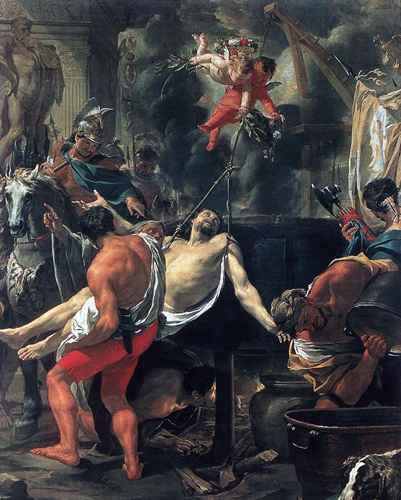
A huge cauldron of boiling oil is prepared in front of the Latin Gate. The sentence orders that the preacher of Christ be plunged into this bath. The hour is come for the second son of Salome to partake of his Master’s Chalice. John’s heart leaps with joy at the thought that he, the most dear to Jesus and yet the only Apostle that has not suffered death for Him, is at last permitted to give Him this earnest of his love. After cruelly scourging him, the executioners seize the old man and throw him into the cauldron. But, lo! the boiling liquid has lost all its heat. The Apostle feels no scalding. On the contrary, when they take him out again, he feels all the vigour of his youthful years restored to him. The praetor’s cruelty is foiled, and John, the Martyr in desire, is to be left to the Church for some few years longer. An imperial decree banishes him to the rugged Island of Patmos where God reveals to him the future of the Church, even to the end of time.
The Church of Rome, which counts the abode and martyrdom of Saint John as one of her most glorious memories, has marked, with a Basilica, the spot where the Apostle bore his noble testimony to the Christian Faith. This Basilica stands near the Latin Gate, and gives a Title to one of the Cardinals.
*****
We are delighted to meet you again, dear Disciple of our Risen Jesus! The first time we saw you was at Bethlehem, where you were standing near the Expected of Nations, the promised Saviour, who was sweetly sleeping in His crib. We then thought on all your glorious titles: Apostle, Evangelist, Prophet, high-soaring Eagle, Virgin, Doctor of Charity and, above all, Jesus’ Beloved Disciple. Today we greet you as Martyr, for if the ardour of your love quenched the fire prepared for your torture, your devotedness to Christ had honestly and willingly accepted the Chalice of which He spoke to you in your younger years. During these days of Paschal Time, which are so rapidly fleeting by, we behold you ever close to this divine Master who treats you with every mark of affection. Who could be surprised at His partiality towards you? Were you not the only one of all the Disciples who stood at the foot of the Cross? Was it not to you that He gave the care of His Mother and made her yours? Were you not present when His Heart was opened on the Cross by a spear? When, on the morning of the great Sunday, you repaired with Peter to the tomb, were you not, by your faith, the first of all the Disciples to honour Jesus’ Resurrection? Oh, yes, you have a right to all the special love with which Jesus treats you. But pray to Him, for us, O blessed Apostle.
We ought to love Him for all the favours He has bestowed on us. And yet we are tepid in His love — we humbly confess it. You have taught us to know the infant Jesus, you have described to us the Crucified Jesus. Show us now the Risen Jesus, that we may keep close to Him during these last few days of His sojourn on Earth. And when He has ascended into Heaven, get us brave hearts that, like you, we may be prepared to drink the Chalice of trials which He has destined for us.
Rome was the scene of your glorious confession, O holy Apostle! She is most dear to you. Unite, then, with Peter and Paul in protecting her. If the palm of martyrdom be in your hand as well as the pen of the Evangelist, remember it was at the Latin Gate that you obtained it. It was in the East you passed the greater part of your life, but the West claims the honour of counting you as one of her grandest martyrs. Bless our Churches, re-animate our Faith, re-kindle our Love, and deliver us from the Antichrists against whom you warned the Faithful of your own times, and who are causing such ravages among us. Adopted son of Mary! You are now enjoying the sight of your Mother’s glory. Present to her the prayers we are offering to her during this Month which is consecrated to her, and obtain for us the petitions which we presume to make to her.
Also on this day according to the ROMAN MARTYROLOGY:

At Antioch, St. Evodius, who, as the blessed Ignatius wrote to the people of Antioch, was consecrated first bishop of that city by the blessed Apostle St. Peter and ended his life by a glorious martyrdom.

At Cyrene, St. Lucius, bishop, who is mentioned by St. Luke in the Acts of the Apostles.

In Africa, the holy martyrs Heliodorus and Venustus, with seventy-five others.

In Cyprus, St. Theodotus, bishop of Cyrinia, who having undergone grievous afflictions under the emperor Licinius, at length yielded his soul to God when peace was restored to the Church.

At Damascus, the birthday of the blessed John Damescene, renowned for sanctity and learning, who, by both the written and the spoken word, courageously resisted Leo the Isaurian in defending the worship paid to sacred images. By order of this emperor his right hand was cut off, but commending himself to an image of the Blessed Virgin Mary which he had defended, his hand was immediately restored to him entire and sound.

At Carrhae in Mesopotamia, St. Protogenes, bishop.

In England, St. Eadbert, bishop of Lindisfarne, eminent for doctrine and piety.

At Rome, St. Benedicta, virgin.

At Salerno, the Translation of St. Matthew, apostle. His sacred body previously transferred from Ethiopia to various countries, was finally taken to Salerno and there with great pomp placed in a church dedicated under his invocation.

And in other places, many other holy martyrs, confessors and virgins.

Thanks be to God.
Tuesday, 5 May 2026

5 MAY – SAINT PIUS V (Pope and Confessor)


Michele Ghislieri was born at Bosco, near Alexandria in Lombardy in 1504 to the poor but noble Bolognese family of the Ghislieri. At the age of 14 he entered the Order of Friar Preachers and became remarkable for his patience, deep humility, great mortifications, love of prayer and religious discipline, and most ardent zeal for the honour of God. He applied himself to the study of philosophy and theology with so much success that for many years he taught them in a manner that gained him universal praise. He preached the word of God in many places, and produced much fruit. For a long period he held with dauntless courage the office of Inquisitor and, at the risk of his life, preserved many cities from the then prevalent heresy.

After ordination as a priest in 1528 taught theology and philosophy and became distinguished as a preacher. Pope Paul IV who esteemed and loved Pius on account of his great virtues, made him bishop of Nepi and Sutri and, two years later, numbered him among the Cardinal Priests of the Roman Church. Having been translated by Pius IV to the Church of Mendovi in Piedmont, and finding that many abuses had crept in, he made a visitation of the whole diocese. Having put all things in order he returned to Rome where he was entrusted with matters of the gravest importance, all of which he transacted with an apostolic impartiality and firmness. At the death of Pius IV he was, contrary to everyone’s expectation, chosen Pope in 1565. With the exception of his outward garb, he changed nothing of his manner of life. The following are the virtues in which he excelled: unremitting zeal for the propagation of the Faith, untiring efforts for the restoration of ecclesiastical discipline, assiduous vigilance in extirpating error, unfailing charity in relieving the necessities of the poor, and invincible courage in vindicating the rights of the Apostolic See.

As Pius V he implemented the decisions of the Council of Trent (1545-1563) which resulted in the publication of a new Roman Breviary, Roman Missal and Catechism of the Catholic Church. A powerful fleet having been equipped at Lepanto against Selimus, the emperor of the Turks who was flushed with the many victories he had gained, the Pontiff won the battle, not so much by arms as by prayers. Pius instituted the feast of Our Lady of Victories on the 7th of October each year, which became the feast of the Most Holy Rosary. Pope Pius V added the supplication “Help of Christians, pray for us” to the Litany of the Blessed Virgin Mary (the Litany of Loreto). He was beatified by Pope Clement X in 1672 and was canonised by Pope Clement XI in 1712. His body lies in a chapel in the Basilica di Santa Maria Maggiore in Rome.

Dom Prosper Gueranger:

We have already met with the names of several Pontiffs on the Paschal Calendar. They form a brilliant constellation around our Risen Jesus who, during the period between His Resurrection and Ascension, gave to Peter, their predecessor, the Keys of the kingdom of Heaven. Anicetus, Soter. Caius, Cletus and Marcellinus held in their hands the palm of martyrdom: Leo was the only one that did not shed his blood in the cause of his Divine Master. Today, there comes before us a holy Pope who governed the Church in these latter times. He is worthy to stand amidst the Easter group of Pontiffs. Like Leo, Pius Vwas zealous in combating heresy. Like Leo, he saved his people from the barbarian yoke.
The whole life of Pius V was a combat. His pontificate fell during those troubled times when Protestantism was leading whole countries into apostasy. Italy was not a prey that could be taken by violence: artifice was therefore used in order to undermine the Apostolic See, and thus envelope the whole Christian world in the darkness of heresy. Pius, with untiring devotedness, defended the Peninsula from the danger that threatened her. Even before he was raised to the papal throne he frequently exposed his life by his zeal in opposing the preaching of false doctrines. Like Peter the Martyr, he braved every danger and was the dread of the emissaries of heresy. Placed upon the Chair of Peter, he kept the innovators in check by fear, he roused the sovereigns of Italy to energy, and, by measures of moderate severity, he drove back beyond the Alps the torrent that would have swept Christianity from Europe, had not the Southern States thus opposed it.
From that time forward, Protestantism has never made any further progress: it has been wearing itself out by intestine anarchy of doctrines. We repeat it: this heresy would have laid all Europe waste, had it not been for the vigilance of the Pastor who animated the defenders of Truth to resist it where it already existed, and who set himself as a wall of brass against its invasion in the country where he himself was the Master.
Another enemy, taking advantage of the confusion caused in the West by Protestantism, organised an expedition against Europe. Italy was to be its first prey. The Ottoman fleet started from the Bosphorus. Here again, there would have been the ruin of Christendom, but for the energy of the Roman Pontiff, our Saint. He gave the alarm and called the Christian Princes to arms. Germany and France, torn by domestic factions that had been caused by heresy, turned a deaf ear to the call. Spain alone, together with Venice and the little Papal fleet, answered the Pontiff’s summons. The Cross and Crescent were soon face to face in the Gulf of Lepanto. The prayers of Pius V decided the victory in favour of the Christians, whose forces were much inferior to those of the Turks. We will have to return to this important event when we come to the Feast of the Rosary in October. But we cannot omit mentioning, today, the prediction uttered by the holy Pope on the evening of the great day of October 7th, 1571. The battle between the Christian and Turkish fleets lasted from six o’clock in the morning till late in the afternoon. Towards evening, the Pontiff suddenly looked up towards Heaven and gazed upon it in silence for a few seconds. Then turning to his attendants he exclaimed: “Let us give thanks to God! The Christians have gained the victory!” The news soon arrived at Rome and thus Europe once more owed her salvation to a Pope! The defeat at Lepanto was a blow to the Ottoman Empire from which it never recovered: its fall dates from that glorious day.
The zeal of this holy Pope for the reformation of Christian morals, his establishing the observance of the laws of discipline prescribed by the Council of Trent, and his publishing the new Breviary and Missal, have made his six years’ pontificate to be one of the richest periods of the Church’s history. Protestants themselves have frequently expressed their admiration of this vigorous opponent of the so-called Reformation. “I am surprised,” said Bacon, “that the Church of Rome has not yet canonised this great man.” Pius V did not receive this honour till about a hundred and thirty years after his death. So impartial is the Church when she has to adjudicate this highest of earthly honours even to her most revered Pastors!
Of the many miracles which attested the merits of this holy Pontiff, even during his life, we select the two following. As he was one day crossing the Vatican Piazza which is on the site of the ancient Circus of Nero, he was overcome with a sentiment of enthusiasm for the glory and courage of the martyrs who had suffered on that very spot in the first Persecution. Stooping down, he took up a handful of dust from the hallowed ground, which had been trodden by so many generations of the Christian people since the peace of Constantine. He put the dust into a cloth, which the Ambassador of Poland, who was with him, held out to receive it. When the Ambassador opened the cloth after returning to his house, he found it all saturated with blood, as fresh as though it had been that moment shed: the dust had disappeared. The faith of the Pontiff had evoked the blood of the martyrs, which thus gave testimony against the heretics that the Roman Church, in the sixteenth century, was identically the same as that for which those brave heroes and heroines laid down their lives in the days of Nero.
The heretics attempted, more than once, to destroy a life which baffled all their hopes of perverting the Faith of Italy. By a base and sacrilegious stratagem, aided as it was by an odious treachery, they put a deadly poison on the feet of the Crucifix which the Saint kept in his Oratory, and which he was frequently seen to kiss with great devotion. In the fervour of prayer, Pius was about to give this mark of love to the image of his Crucified Master when suddenly the feet of the Crucifix detached themselves from the Cross, and eluded the proffered kiss of the venerable old man. The Pontiff at once saw through the plot by which his enemies would fain have turned the life-giving Tree into an instrument of death.
In order to encourage the Faithful to follow the sacred Liturgy, we will select another interesting example from the life of this great Saint. When, lying on his bed of death and just before breathing his last, he took a parting look at the Church on Earth which he was leaving for that of Heaven. He wished to address a final prayer for the Flock which he knew was surrounded by danger. He therefore recited, but with a voice that was scarcely audible, the following stanza of the Paschal Hymn: “We beseech you, Creator of all things, that in these days of Paschal joy, you defend your people from every assault of death.”
*****
Pontiff of the living God, you were, while on Earth, the pillar of iron and wall of brass spoken of by the Prophet (Jeremias i. 18). Your unflinching firmness preserved the flock entrusted to you from the violence and snares of its many enemies. Far from desponding at the sight of the dangers, your courage redoubled, just as men raise the embankments higher when they see the torrent swell. By you was the spread of Heresy checked. By you was the Mussulman invasion repelled and the haughty Crescent humbled. God honoured you by choosing you as the avenger of His glory and the deliverer of the Christian people: receive our thanks and the homage of our humble praise! By you were repaired the injuries done to the Church during a period of unusual trial. The true reform — the reform that is wrought by authority — was vigorously applied by your strong and holy hand. To you is due the restoration of the Divine Service by the publication of the Books of holy Liturgy. And all these glorious deeds were done in the six short years of your laborious pontificate!
Hear, now, the prayers addressed to you by the Church Militant whose destinies were once in your hands. When dying, you beseeched our Risen Jesus to grant her protection against the dangers which were then threatening her: oh! see the state to which licentious error has now reduced almost the whole Christian world! The Church has nothing left to her with which to make head against her countless enemies, save the promises of her Divine Founder. All visible support is withdrawn from her. She has been deprived of everything except the merit of suffering and the power of prayer. Unite, holy Pontiff, your prayers to hers, and show how unchanged is your love of the Flock of Christ. Protect, in Rome, the Chair of your Successor, attacked as it now is by open violence and astute hypocrisy. Princes and Peoples seem to have conspired against God and His Christ. Disconcert the schemes of sacrilegious ambition and the plots of impiety which would fain give the lie to the word of God. Avert, by your intercession, the scourges which are threatening Europe, that has become ungrateful to the Church and indifferent to the attempts made against her to whom they owe all they have. Pray that the blind may see, and the wicked be confounded. Pray that the True Faith may enlighten those numberless souls that call error truth, and darkness light. In the midst of this dark and menacing night, your eyes, holy Pontiff, discern them that are the faithful sheep of Christ: bless them, aid them, increase their number. Graft them to the venerable Tree which dies not, that so they may not be drifted by the storm. Get them docility to the Faith and traditions of holy Church. It is their only stay amid the tide of error which is now threatening to deluge the whole world. Preserve to the Church the holy Order in which you were trained for the high mission destined for you. Keep up within her that race of men, powerful in work and word, zealous for the Faith and sanctification of souls of which we read in her Annals, and which has yielded Saints such as yourself. And lastly, O Pius, remember that you were once the Father of the Faithful: continue to be so by your powerful intercession till the number of the elect be filled up!
Also on this day according to the ROMAN MARTYROLOGY:

At Rome, St. Crescentiana, martyr.

In the same city, St. Sylvanus, martyr.

At Alexandria, St. Euthymius, deacon, who died in prison for Christ.

At Thessalonica, the birthday of the holy martyrs Irenseus, Peregrinus and Irenes who were burned alive.

At Auxerre, the martyrdom of St. Jovinian, lector.

At Leocata in Sicily, St. Angelus, a priest of the Order of Carmelites, who was murdered by the heretics for defending the Catholic faith.

At Jerusalem, St. Maximus, bishop and confessor, who the Caesar Maximian Galerius condemned to work in the mines after having plucked out one of his eyes and branded him on the foot with hot iron.

At Edessa in Syria, St. Eulogius, bishop and confessor.

At Arles in France, St. Hilary, bishop, noted for his learning and holiness.

At Vienne, the bishop St. Nicetus, a man venerable for his sanctity.

At Bologna, St. Theodore, a bishop who was eminent for merits.

The same day, St. Sacerdos, bishop of Saguntum.
 
At Milan, St. Geruntius, bishop. In the same city, the conversion of St. Augustine, bishop and doctor of the Church, who the blessed bishop Ambrose instructed in the Catholic faith and baptised on this day.

And in other places, many other holy martyrs, confessors and virgins.

Thanks be to God.

Monday, 4 May 2026

4 MAY – SAINT MONICA (Widow)


Monica was born to Christian parents at Tagaste in North Africa in 333 AD. At a young age she was married to a pagan official named Patritius and had three children, Augustine, Navigius and Perpetua. Patritius later converted to Christianity, but he died shortly after being received into the Church and Monica resolved not to re-marry. Monica signed her sons with the cross and enrolled them as catachumens. Augustine deferred being baptised into the faith. He moved to Carthage to study there, took a mistress who bore him a son and embraced Manichaeism, a Persian gnostic religion. But after writing a work on aesthetics he began to doubt and repudiate Manichaeism which claimed that the Christian scriptures had been falsified. Augustine failed to find in it the science of the laws of nature which he he had sought. In 383 he secretly travelled to Rome and set up a school of rhetoric but gave up the venture when his students defrauded him of his tuition fees. Attracted by a vacant teaching position in Milan, he moved there and came under the influence of Ambrose, Bishop of Milan.

Monica, having followed Augustine to Rome, joined him in Milan and continued to pray earnestly for his conversion. On the eve of Easter in 387, Augustine was baptised by Ambrose in the Cathedral of Milan. It was on this occasion, so it is said, that the solemn hymn Te Deum was composed and chanted for the first time. Later that year Augustine and Monica left Milan and travelled to Ostia. There they took lodgings and were preparing to leave for their African homeland when Monica took ill with a fever and died. Saint Augustine later wrote:

She and I stood alone, leaning in a certain window, from which the garden of the house we occupied at Ostia could be seen; at which place, removed from the crowd, we were resting ourselves for the voyage after the fatigues of a long journey. We then were conversing alone very pleasantly... Scarcely five days after, or not much more, she was prostrated by fever; and while she was sick, she one day sank into a swoon, and was for a short time unconscious of visible things. We hurried up to her; but she soon regained her senses, and gazing on me and my brother as we stood by her, she said to us inquiringly, “Where was I?” Then looking intently at us stupefied with grief, “Here,” says she, “will you bury your mother”... On the ninth day, then, of her sickness, the fifty-sixth year of her age, and the thirty-third of mine, was that religious and devout soul set free from the body.

Monica was laid to rest in Ostia but in the sixth century her relics were translated to the nearby Basilica of Saint Aurea and were placed in a hidden crypt.In the thirteenth century a cult of Saint Monica began to develop and a feast in her honour was established on the 4th of May. In 1430 Pope Martin V ordered her relics to be brought to Rome. They were initially kept at the Chiesa di San Trifone in Posterula (which was demolished in 1746). On the 9th of April 1432 they were placed in a chapel in the Basilica of Sant’Agostino (now the Basilica dei SS. Trifone e Agostino) in the Campo Marzio.

Dom Prosper Gueranger:
In the company of our Risen Lord there are two women, two mothers, of whom we have often had to speak during the last few weeks. They are Mary, mother of James the Less, Thaddeus and Salome, mother of James the Greater and John the beloved disciple. They went with Magdalene to the Sepulchre on the Resurrection morning. They carried spices to anoint the body of Jesus. They were spoken to by Angels and, as they returned to Jerusalem, our Lord appeared to them, greeted them, and allowed them to kiss His sacred feet. Since that day He has repaid their love by frequently appearing to them, and on the day of His Ascension from Mount Olivet, they will be there, together with our Blessed Lady and the Apostles, to receive his farewell blessing. Let us honour these faithful companions of Magdalene, these models of the love we should show to our Lord in His Resurrection. Let us also venerate them as mothers who gave four Apostles to the Church.
But lo! on this fourth morning of beautiful May, there rises, near to Mary and Salome, another woman, another mother. She too is fervent in her love of Jesus. She too gives to holy Church a treasure: the child of her tears, a Doctor, a Bishop, and one of the grandest Saints of the New Law. This woman, this mother, is Monica, twice mother of Augustine. This masterpiece of God’s grace was produced on the desert soil of Africa. Her virtues would have been unknown till the Day of Judgement had not the pen of the great Bishop of Hippo, prompted by the holy affection of his filial heart, revealed to us the merits of this woman whose life was humility and love, and who now, immortalised in men’s esteem, is venerated as the model and patroness of Christian mothers.
One of the great charms of the book of Confessions is Augustine’s fervent praise of Monica’s virtues and devotedness. With what affectionate gratitude he speaks throughout his whole history of the untiring constancy of this mother who, seeing the errors of her son, “wept over him more than other mothers weep over the dead body of their children!” Our Lord who, from time to time, consoles with a ray of hope the souls he tries, had shown to Monica, in a vision, the future meeting of the son and mother. She had even heard a holy bishop assuring her that the child of so many tears could never be lost. Still, the sad realities of the present weighed heavily on her heart and both her maternal love and her faith caused her to grieve over this son who kept away from her, yes, who kept away from her, because he was unfaithful to his God. The anguish of this devoted heart was an expiation which would at a future period be applied to the guilty one. Fervent and persevering prayer, joined with suffering, prepared Augustine’s second birth and, as he himself says, “she went through more when she gave me my spiritual, than when she gave me my corporal, birth.”
At last, after long years of anxiety, the mother found at Milan this son of hers who had so cruelly deceived her when he fled from her roof to go and risk his fortune in Rome. She found him still doubting the truth of the Christian religion, but tired of the errors that had misled him. Augustine was not aware of it, but he had really made an advance towards the true Faith. “She found me,” says he, “in extreme danger, for I despaired of ever finding the truth. But when I told her, that I was no longer a Manichean, and yet not a Catholic Christian, the announcement did not take her by surprise. She leaped for joy at being made sure that one half of my misery was gone. As to the other, she wept over me as dead indeed, but to rise again. She turned to you, O my God, and wept and, in spirit, brought me and laid the bier before you that you might say to the widow’s son: Young man! I say to you, arise! Then would he come to life again, and begin to speak, and you could give him back to his mother!... Seeing, then, that although I had not yet found the truth, I was delivered from error, she felt sure that you would give the other half of the whole you had promised. She told me in a tone of gentlest calm, but with her heart full of hope, that she was confident, in Christ, that before leaving this world she would see me a faithful Catholic.”
At Milan Monica formed acquaintance with the great Saint Ambrose who was the instrument chosen by God for the conversion of her son. “She,” says Augustine, “had a very great affection for Ambrose because of what he had done for my soul. And he equally loved her because of her extraordinary piety which led her to the performance of good works, and to fervent assiduity in frequenting the Church. Hence, when he saw me, he would frequently break out in her praise, and congratulate me on having such a mother.” The hour of grace came at last. The light of Faith dawned upon Augustine, and he began to think of enrolling himself a member of the Christian Church. But the pleasures of the world, in which he had so long indulged, held him back from receiving the holy sacrament of Baptism. Monica’s prayers and tears won for him the grace to break this last tie. He yielded and became a Christian.
But God would have this work of His divine mercy a perfect one. Augustine, once converted, was not satisfied with professing the true Faith. He aspired to the sublime virtue of continence. A soul, favoured as his then was, could find no further pleasure in anything that this world could offer him. Monica, who was anxious to guard her son against the dangers of a relapse into sin, had been preparing an honourable marriage for him, but Augustine came to her one day accompanied by his friend Alypius, and told her that he was resolved to aim at what was most perfect. Let us listen to the Saint’s account of this interview with his mother. It was immediately after he had been admonished by the voice from Heaven: “We (Augustine and Alypius) go at once to my mother’s house. We tell her what had taken place she is full of joy. We tell her all the particulars. She is overpowered with feelings of delight and exultation. She blessed you, O my God, who can do beyond what we ask or understand. She saw that you had done more for me than she had asked of you with her many piteous and tearful sighs... You had changed her mourning into joy, even beyond her wishes, yes, into a joy far dearer and chaster than she could ever have had in seeing me a father of children.” A few days after this, and, in the Church of Milan, a sublime spectacle was witnessed by Angels and men: Ambrose baptising Augustine in Monica’s presence.
The saintly mother had fulfilled her mission: her son was regenerated to truth and virtue and she had given to the Church the greatest of her Doctors. The evening of her long and tried life was approaching and she was soon to find eternal rest in the God, for whose love she had toiled and suffered so much. The son and mother were at Ostia, waiting for the vessel that was to take them back to Africa. “I and she were alone,” says Augustine, “and were standing near a window of our lodging which commanded a view of the garden. We were having a most charming conversation. Forgetting the past, and stretching forward to the things beyond, we were talking about the future life of the saints, which eye has not seen, nor ear heard, nor has it ascended into man’s heart... And while thus talking about it and longing for it, our hearts seemed to bound forward and reach it. We sighed, and left the first-fruits of our spirit there, and returned to the sound of our own voice... Then my mother said to me: My son! As far as I am concerned, there is nothing now that can give me pleasure in this life. I know not what I can do, or why I should be here, now that I have nothing to hope for in this world. There was one thing for which I desired to live somewhat longer, and it was to see you a Catholic Christian before my death. My God has granted me this and more, for I see that you have despised earthly pleasures and become His servant. What do I here?” She had not long to wait for the divine invitation. She breathed forth her pure soul a few days after this interview, leaving an indelible impression upon the heart of her son, to the Church a name most dear and honoured, and to Christian mothers a perfect example of the purest and holiest maternal affection.
*****
O thou model of mothers! Christendom honours you as one of the most perfect types of human nature regenerated by Christ. Previous to the Gospel, during those long ages when woman was kept in a state of abjection, a mother’s influence on her children was feeble and insignificant. Her duties were generally limited to looking after their bodily well-being. And if some mothers of those times have handed their names down to posterity, it is only because they taught their sons to covet and win the passing glory of this world. But we have no instance in pagan times of a mother training her son to virtue, following him from city to city that she might help him in the struggle with error and the passions, and encourage him to rise after a fall. We do not meet with one who devoted herself to continual prayer and tears with a view to obtain her son’s return to truth and virtue. Christianity alone has revealed a mother’s mission and power.
What forgetfulness of yourself, Monica, in your incessant endeavour to secure Augustine’s salvation! After God, it is for him you live. And to live for your son in such a way as this, is it not living for God who deigns to use you as the instrument of His grace? What care you for Augustine’s glory and success in this world when you think of the eternal dangers to which he is exposed, and of his being eternally separated from God and you? There is no sacrifice or devotedness which your maternal heart is not ready to make in order to satisfy the Divine justice. It has its rights, and you are too generous not to satisfy them. You wait patiently day and night for God’s good time to come. The delay only makes your prayer more earnest. Hoping against all hope, you at length feel within your heart the humble but firm conviction that the object of all these tears can never be lost. Moved with mercy towards you, as He was for the sorrowing mother of Naim, He speaks with that voice which nothing can withstand: “Young man! I say to you, arise!” and He gives him to his mother (Luke vii. 14, 15). He gives you the dear one whose death you had so bitterly bewailed, but from whom you could not tear thyself.
What a recompense of your maternal love is this! God is not satisfied with restoring you Augustine full of life. From the very depths of error and sin, this son of thine rises and, at once, to the highest virtue. Thy prayers were that he might become a Catholic and break certain ties which were both a disgrace and danger to him when lo! one single stroke of grace has raised him to the sublime state of the Evangelical Counsels. Your work is more than done, O happy mother! Speed thee to Heaven where, till your Augustine joins you, you are to gaze on the saintly life and works of this son whose salvation is due to you, and whose bright glory, even while he sojourns here below, sheds the sweetest halo over your venerated name.
From the eternal home where you are now happy with this son of yours who owes to you his life both of Earth and Heaven, cast a loving look, O Monica, on the many Christian mothers who are now fulfilling on Earth the hard but noble mission which was once yours. Their children are also dead with the death of sin, and they would restore them to true life by the power of their maternal love. After the Mother of Jesus, it is to you that they turn, O Monica, you whose prayers and tears were once so efficacious and so fruitful. Take their cause in hand. Your tender and devoted heart cannot fail to compassionate them in the anguish which was once your own. Keep up their courage. Teach them to hope. The conversion of these dear ones is to cost them many a sacrifice. Get them the generosity and fortitude needed for their paying the price thus asked of them by God. Let them remember that the conversion of a soul is a greater miracle than the raising a dead man to life, and that Divine Justice demands a compensation which they, the mothers of these children, must be ready to make. This spirit of sacrifice will destroy that hidden egotism which is but too frequently mingled with what seems to be affection of the purest kind. Let them ask themselves, if they would rejoice, as you did, O Monica, at finding that a vocation to the religious life were the result of the conversion they have so much at heart? If they are thus disinterested, let them not fear. Their prayers and sufferings must be efficacious. Sooner or later the wished-for grace will descend upon the prodigal, and he will return to God and his mother.
Also on this day according to the ROMAN MARTYROLOGY:

At the metal mines of Phennes in Palestine, the birthday of the blessed Silvanus, bishop of Gaza, who was crowned with martyrdom with many of his clerics by the command of Caesar Galerius Maximian in the persecution of Diocletian. Also thirty nine holy martyrs who were beheaded together after having been condemned to work in the same mines, to be branded with a hot iron, and to undergo other torments.

At Jerusalem, in the reign of Julian the Apostate, St. Cyriacus, bishop, who was murdered as he was visiting the holy places.

In Umbria, St. Porphyry, martyr.

At Nicomedia, the birthday of St. Antonia, martyr, who, for the confession of Christ, was cruelly tortured, subjected to diverse torments, suspended by one arm for three days, kept two years in prison, and finally delivered to the flames by the governor Priscillian.

At Lorch in Austria, under the emperor Diocletian and the governor Aquilinus, the martyr St. Florian, who was precipitated into the river Enns with a stone tied to his neck.

At Tarsus, St. Pelagia, virgin, who endured martyrdom under Diocletian by being shut up within a red-hot brazen ox.

At Cologne, St. Paulinus, martyr.

At Milan, St. Venerius, bishop, whose virtues are attested by St. John Chrysostom in the Epistle which he wrote to him.

In the province of Perigord, St. Sacerdos, bishop of Limoges.

At Hildesheim in Saxony, St. Godard, bishop and confessor, ranked among the saints by Pope Innocent II.

At Auxerre, St. Curcodomus, deacon.

And in other places, many other holy martyrs, confessors and virgins.

Thanks be to God.

Sunday, 3 May 2026

3 MAY – SAINTS ALEXANDER (Pope and Martyr), EVENTIUS AND THEODULUS (Priests and Martyrs) and JUVENAL (Bishop)

Alexander, a native of Rome, governed the Church during the reign of the emperor Hadrian and converted a great portion of the Roman nobles to Christ. He decreed that only bread and wine should be offered in the Mystery, but that water should be mingled with the wine in memory of the Blood and Water which flowed from the side of Jesus. He added to the Canon of the Mass these words: Qui pridie quam pateretur (On the day before he suffered). He also decreed that holy water with salt in it should always be kept in a Church, and that it should be used in the dwellings of the Faithful for the purpose of driving away evil spirits. He governed the Church 10 years, 5 months and 20 days. He was illustrious for the holiness of his life, and the useful laws which he made. He was crowned with martyrdom under Trajan together with the priests Eventius and Theodulus, and was buried on the Via Nomentana, three miles out of Rome, and on the very spot where he had been beheaded. He ordained, in the December of various years, 6 priests, 2 deacons and 5 bishops for various places. The bodies of these saints were afterwards translated to the Basilica of Santa Sabina in Rome. On this same day occurred the death of blessed Juvenal, Bishop of Narni, who, after having, by his learning and virtue, converted many persons of that city to Christ, and being celebrated for the miracles he wrought, he slept in peace and was honourably buried in the same city.

Dom Prosper Guéranger:

A holy Pope and Martyr comes today, laying his bright crown at the foot of the triumphant Cross by which he won his victory. It is Alexander, the fifth successor of Saint Peter. Let us honour this venerable witness of the Faith who is now receiving the devout homage of the Church Militant, he who for these long ages past has been enjoying in Heaven the company of our Risen Jesus. The Passion of his Divine Master was ever present to his mind while here on Earth, and the Church has registered in her annals his adding four words to the Canon of the Mass, in which he expresses the fact of our Lord’s having instituted the august mystery of the Eucharist the day before He suffered.
We owe to the same holy Pontiff another institution most dear to Catholic piety. It is by him that the Church received the sacramental which is such an object of terror to Satan and which sanctifies everything it touches: Holy Water. This is an appropriate day for our renewing our faith in what regards this powerful element of blessing which heretics and infidels have so frequently made the subject of their blasphemies, but whose use will ever serve as one of the distinguishing marks between them that are, and them that are not, Children of the Church. Water, the instrument of our regeneration, and salt, the symbol of immortality form, under the Church’s blessing, this Sacramental in which we should have the greatest confidence. The Sacramentals, like the Sacraments, derive their efficacy from the Blood of our Redeemer, the merits of which are applied to certain material objects by the power of the Priesthood of the New Law. Indifference for these secondary means of salvation would be not only an indiscretion but a sin, and yet, in these days of weak faith, nothing is so common as this indifference. There are Catholics for whom Holy Water is as though there were no such thing in existence. The continual use made of it by the Church is a lesson lost to them. They deprive themselves, without a single regret, of the help with which God has thus provided them, both to strengthen their weakness and to purify their souls. May the holy Pontiff Alexander pray for them that their faith may become more what it ought to be, and that they begin to value the supernatural aids which God, out of pure mercy to them, Has so profusely bestowed on His Church.
* * * * *
Receive, holy Pontiff, on this day, sacred as it is to the Cross of your Divine Master, the devout homage of the Christian people. It was by the way of the Cross that you, this day, ascended to Heaven. It is but just that your praise should be mingled with those which we are giving to the sacred instrument of our Redemption. Intercede for us with Him who shed His Blood for us upon this Tree of Life: may He graciously accept our celebration of His triumphant Resurrection, and the hymns we sing in honour of His Cross. Pray for us that our Faith may increase, that thus we may appreciate the divine economy of the Redemption by which Our Lord Jesus Christ deigned to employ, for our salvation, those very elements which the enemy had perverted to our destruction. Drive far from us that wretched rationalism, which while approving of certain usages of the Church because they happen to fit in with its fancies, presumes to treat all the rest with disdain. Pray also for the holy Church of Rome. She invokes your name on this your feast. Prove to her that she is still dear to you.

3 MAY – THE INVENTION (FINDING) OF THE TRUE CROSS


After the great victory gained over Maxentius by the Emperor Constantine under the standard of our Lords Cross which had been miraculously shown to him, his mother Helen was told in a dream to repair to Jerusalem and search for the true Cross. Upon her arrival she ordered to be taken down a marble statue of Venus which had been erected by the pagans some 108 years earlier in order that all memory of our Lords Passion might be obliterated. She did the same for the place where there reposed the Saviours crib, as also for the site of the Resurrection, removing from the former an idol of Adonis, and from the latter an idol of Jupiter.

The place where the Cross was supposed to be having been excavated, three crosses were discovered at a great depth below the surface, and with them, though not attached, the Title that had been fastened to our Lords Cross. The doubt as to which of the three crosses the Title belonged was removed by a miracle. After having prayed to God, Macarius, the Bishop of Jerusalem, applied each of the crosses to a woman who was afflicted with a dangerous malady. The first two produced no result. The third was then applied and the woman was restored to perfect heath.

The Holy Cross being thus found, Helen built a magnificent Church in Jerusalem, in which she placed a portion of the Cross enshrined in a silver case. The remaining part she took to her son Constantine, and it was put in the Church called Holy Cross in Jerusalem, which was built on the site of the Sessorian palace. She also took to her son the nails with which the most holy Body of Christ Jesus had been fastened to the Cross. Constantine passed a law that from that time forward a cross should never be used as an instrument of punishment, and thus what hitherto had been an object of reproach and derision, became one of veneration and glory.

Dom Prosper Guéranger:
It was most just that our Divine King should show Himself to us with the sceptre of His power to the end that nothing might be wanting to the majesty of His empire. This sceptre is the Cross, and Paschal Time was to be the Season for its being offered to Him in glad homage. A few weeks back, and the Cross was shown to us as the instrument of our Emmanuel’s humiliation, and as the bed of suffering on which He died. But has he not, since then, conquered death? And what is His Cross now but a trophy of His victory? Let it then be brought forth to our gaze, and let every knee bend before this sacred Wood by which our Jesus won the honour and praise we now give Him!
On the day of His birth at Bethlehem we sang these words of the Prophet Isaias: “A child is born to us, and a Son is given to us, and his government is upon his shoulder” (Isaias ix. 6). We have seen Him carrying this Cross upon His shoulder, as Isaac carried the wood for his own immolation. But now, it is no longer a heavy burden. It is shining with a brightness that ravishes the eyes of the Angels. And, after having received the veneration of man as long as the world lasts, it will suddenly appear in the clouds of Heaven near the judge of the living and the dead — a consolation to them that have loved it, but a reproach to such as have treated it with contempt or forgetfulness.
Our Saviour did not think the time between His Resurrection and Ascension a fitting one for glorifying the Instrument of His victory. The Cross was not to be brought into notice until it had subjected the world to Him whose glory it so eloquently proclaimed. Jesus was three days in the tomb. His Cross is to lie buried unknown to men for three centuries. But it is to have its Resurrection, and the Church celebrates this Resurrection today. Jesus would, in His own good time, add to the joy of Easter by miraculously revealing to us this sacred monument of His love for mankind. He entrusts it to our keeping — it is to be our consolation — as long as this world last. Is it not just that we should love and venerate it?
Never had Satan’s pride met with a humiliation like that of his seeing the instrument of our perdition made the instrument of our salvation. As the Church expresses it in her Preface for Passiontide: “He that overcame mankind by a Tree, was overcome by a Tree.” Thus foiled, he vented his fury upon this saving Wood which so bitterly reminded him, both of the irresistible power of his conqueror, and of the dignity of man who had been redeemed at so great a price. He would fain have annihilated the Cross, but knowing that this was beyond his power, he endeavoured to profane it and hide it from view. He therefore instigated the Jews to bury it. At the foot of Calvary, not far from the Sepulchre, was a deep hole. Into this was the Cross thrown, together with those of the two Thieves, the Nails, the Crown of Thorns, and the Inscription or Title written by Pilate. The hole was then filled up with rubbish and earth, and the Sanhedrim exulted in the thought of its having effaced the memory of the Nazarene who could not save himself from the ignominious death of the Cross.
Forty years after this Jerusalem was destroyed by the Romans, the instruments of God’s vengeance. The Holy Places were desecrated by the idolators. A small temple to Venus was erected on Calvary and another to Jupiter over the Holy Sepulchre. By this the pagans intended derision, whereas they were perpetuating the knowledge of two spots of most sacred interest. When peace was restored under Constantine, the Christians had but to remove these pagan monuments and their eyes beheld the holy ground that had been bedewed with the Blood of Jesus — and the glorious Sepulchre. As to the Cross, it was not so easily found. The sceptre of our Divine King was to be raised up from its tomb by a royal hand. The saintly Empress Helen, Constantine’s mother, was chosen by Heaven to pay to Jesus — and that too on the very spot where He had received His greatest humiliations — the honours which are due to him as the King of the world. Before laying the foundations of the Basilica of the Resurrection, this worthy follower of Magdalene and the other holy women of the Sepulchre was anxious to discover the Instrument of our Salvation. The Jews had kept up the tradition of the site where it had been buried. The Empress had the excavations made accordingly. With what holy impatience must she not have watched the works, and with what ecstasy of joy did she not behold the Redeeming Wood which, though not, at first, distinguishable, was certainly one of the three crosses that were found! She addressed a fervent prayer to the Saviour, who alone could reveal to her which was the trophy of His victory. The Bishop Macarius united his prayers with hers, and their faith was rewarded by a miracle that left them no doubt as to which was the true Cross.
The glorious work was accomplished and the Church was put in possession of the instrument of the world’s Redemption. Both East and West were filled with joy at the news of this precious discovery which Heaven had set on foot, and which gave the last finish to the triumph of Christianity. Christ completed His victory over the pagan world by raising thus His Standard — not a figurative one, but His own real Standard — His Cross which, up to that time, had been a stumbling-block to the Jews and foolishness to the Gentiles, but before which every Christian is, henceforth, to bend his knee. Helen placed the Holy Cross in the Basilica that had been built by her orders, and which covered both the glorious Sepulchre and the hill of the Crucifixion. Another Church was erected on the site where the Cross had lain concealed for three hundred years, and the faithful are enabled, by long flights of steps, to go down into the deep grotto which had been its tomb. Pilgrims came from every part of the world to visit the hallowed places where our Redemption had been wrought, and to venerate the sacred Wood of the Cross. But God’s merciful providence willed not that the precious pledge of Jesus’ love for mankind should be confined to one only Sanctuary, however venerable it might be. Immediately after its discovery, Helen had a very large piece cut from the Cross, and this fragment she destined for Rome, the new Jerusalem. The precious gift was enshrined in the Basilica built by her son Constantine in the Sessorian garden, and which was afterwards called the Basilica of Holy Cross in Jerusalem.
By degrees, other places were honoured by the presence of the Wood of the Holy Cross. So far back as the fourth century we have Saint Cyril of Jerusalem attesting that many of the pilgrims used to obtain small pieces of it, and thus carried the precious treasure into their respective countries. And Saint Paulinus of Nola, who lived in the same century, assures us that these many gifts lessened not the size of the original Relic. In the sixth century the holy Queen Saint Radegonde, obtained from the Emperor Justin II a large piece from the fragment that was in the imperial treasury of Constantinople. It was for the reception of this piece of the True Cross into France that Venantius Fortunatus composed the Vexilla Regis, that beautiful hymn which the Church uses in her Liturgy as often as she celebrates the praises of the Holy Cross. After several times losing and regaining it, Jerusalem was at length forever deprived of the precious Relic. Constantinople was a gainer by Jerusalem’s loss. From Constantinople, especially during the Crusades, many Churches of the West procured large pieces. These again supplied other places until, at length, the Wood of the Cross was to be found in almost every town of any importance. There is scarcely to be found a Catholic who some time or other in his life has not had the happiness of seeing and venerating a portion of this sacred object. How many acts of love and gratitude have not been occasioned by this? And who could fail to recognise, in this successive profusion of our Jesus’s Cross, a plan of divine providence for exciting us to an appreciation of our Redemption on which rest all our hopes of eternal happiness?
How dear, then, to us should not this day be which blends together the recollection of the Holy Cross and the joys of the Resurrection of that Jesus who, by the Cross, has won the throne to which we will soon see Him ascend! Let us thank our Heavenly Father for His having restored to mankind a treasure so immensely precious as is the Cross. Until the day comes for its appearing with Himself in the clouds of Heaven, Jesus has entrusted it to His Spouse as a pledge of His Second Coming. On that day, He by His divine power, will collect together all the fragments. And the Tree of Life will then gladden the Elect with its dazzling beauty and invite them to eternal rest beneath its refreshing shade.
* * * * *
“Christ Crucified is the power and wisdom of God” (1 Corinthians i. 24). Thus spoke your Apostle, Jesus, and we are witnesses of the truth of his words. The Synagogue thought to dishonour you by nailing you to a Cross, for it was written in the Law: “Cursed is he that hangs on a tree” (Deuteronomy xxi. 23). But, lo! This gibbet, this Tree of infamy, is become the trophy of your grandest glory! Far from dimming the splendour of your Resurrection, the Cross enhances the brilliancy of your magnificent triumph. You were attached to the Wood — you took on yourself the curse that was due to us. You were crucified between two thieves. You were reputed as an impostor, and your enemies insulted you in your agony on this bed of suffering. Had you been but man, O Son of David, all this would have disgraced your name and memory. The Cross would have been the ruin of your past glory. But you are the Son of God, and it is the Cross that proves it. The whole world venerates your Cross. It was the Cross that brought the world into submission to you. The honours that are now paid it more than make amends for the insults that were once offered it. Men are not wont to venerate a Cross. But if they do, it is the Cross on which their God died. Oh blessed be He that hung upon the Tree! And do thou, dearest Crucified Jesus, in return for the homage we pay to your Cross, fulfil the promise you made us: “And I, if I be lifted up from the Earth, will draw all things to myself” (John xii. 32).
That you might the more effectually draw us, you this day permit us to find the very Wood on which you stretched forth your divine arms to embrace us. You deigned to give us this holy instrument of your victory, and which is to shine near you in the heavens on the day of judgement. You mercifully confided it to our keeping in order that we might thence derive a salutary fear of Divine Justice which demanded your death on this Wood so to atone for our sins. You also gave us this most precious relic that it might excite us to a devoted love for you, O Divine Victim who, that we might be blessed, took upon yourself the maledictions due to our sins. The whole world is offering you today its fervent thanks for so inestimable a gift. Your Cross, by being divided into countless fragments, is in all places, consecrating and protecting, by its presence, every country of the Christian world.
Oh that we had Saint Helen’s spirit, dear Jesus, and knew, as she did, “the breadth and length, and height and depth, of the mystery of your Cross (Ephesians iii. 18). Her love of the mystery made her so earnest in her search for the Cross. And how sublime is the spectacle offered to us by this holy Empress! She adorns your glorious Sepulchre. She unburies your Cross from its grave — who was there that ever proclaimed with such solemnity as this the Paschal Mystery? The Sepulchre cries out to us: “He is risen: He is not here!” The Cross exclaims: “I held him captive but for a few passing hours: He is not here! He is resplendent in the glory of His Resurrection!” Cross! Sepulchre! How brief was the period of His humiliation, and how grand the kingdom He won by you! We will adore in you where His feet stood (Psalm cxxxi. 7) making you the instruments of our Redemption, and thereby endearing you ever to our respectful love. Glory, then, be to you, O Cross, dear object of this day’s festival! Continue to protect this world where our Jesus has left you. Be its shield against Satan. Keep up within us the twofold remembrance which will support us in all our crosses — the remembrance of Sacrifice united with Triumph, for it is by you, O Cross, that Christ conquers, and reigns, and commands. CHRISTUS VINCIT, CHRISTUS REGNAT, CHRISTUS IMPERAT.
* * * * *
VEXILLA REGIS

The Standard of our King comes forth: the mystery of the Cross shines upon us — that Cross on which Life suffered death, and by his Death gave life.

He was pierced with the cruel Spear, that, by the Water and the Blood, which flowed from the wound, he might cleanse us from sin.

Here, on the Cross was fulfilled the prophecy foretold in David’s truthful words: “God has reigned from the Tree.”

O fair and shining Tree! beautified by the scarlet of the King, and chosen as the noble trunk that was to touch such sacred limbs.

Blessed Tree! on whose arms hung the ransom of the world! It was the balance wherein was placed the Body of Jesus, and thereby Hell lost its prey.

Hail, O Cross! our only hope, that brings us the Paschal joy. Increase to the good their grace, and cleanse sinners from their guilt.

May every spirit praise you, Holy Trinity, you Fount of salvation! and by the Cross, by which you gave us victory, give us, too, our recompense. Amen.

Also on this day according to the ROMAN MARTYROLOGY:

At Rome, on the Via Nomentana, the holy martyrs Alexander, pope, Eventius and Theodulus, priests. Alexander was bound, imprisoned, racked, lacerated with hooks, burned, pierced in all his limbs with pointed instruments, and finally put to death under the emperor Hadrian and the judge Aurelian. Eventius and Theodulus, after a long imprisonment were exposed to the flames and then beheaded.

At Xarni, St. Juvenal, bishop and confessor.

At Constantinople, the holy martyrs Alexander, soldier, and Antonina, virgin. In the persecution of Maximian under the governor Festus, Antonina, having been condemned to remain in a house of debauchery was delivered by Alexander who, secretly exchanging garments with her, took her place. They were tortured together, and both having their hands cut off, and being cast into the fire, were crowned at the end of their noble combat for the faith.

In Thebais, the holy martyrs Timothy and his wife Manra. The Arian prefect caused them to be tortured, and then fastened to a cross on which they remaining suspended and alive for nine days, and encouraging each other to persevere in the faith they consummated their martyrdom.

At Aphrodisia in Caria, the holy martyrs Diodorus and Rodopian, who were stoned to death by their fellow citizens in the persecution of Diocletian.

On Mount Senario near Florence, the blessed Sostenaeus and Uguccio, confessors, who responding to a voice from heaven, departed this life on the same day and at the same hour while reciting the angelical salutation.

And in other places, many other holy martyrs, confessors and virgins.

Thanks be to God.

3 MAY – FOURTH SUNDAY AFTER EASTER


Dom Prosper Gueranger:

Our Jesus has organised His Church and confided to His Apostles the sacred deposit of the truths which are to form the object of our faith. We must now follow Him in another work, of equal importance to the world, and to which He gives His divine attention during these forty days: it is the institution of the Sacraments. It is not enough that we believe. We must, moreover, be made just, that is, we must bear on us the likeness of God’s holiness. We must receive, we must have incorporated within us, that great fruit of the Redemption which is called Grace, that thus being made living members of our divine Head, we may be made joint-heirs with Him of the Kingdom of heaven. Now, it is by means of the Sacraments that Jesus is to produce in us this wondrous work of our justification. He applies to us the merits of His Incarnation and Sacrifice but He applies them by certain means which He Himself, in His power and wisdom, has instituted.
Being the sovereign Master of His own gifts, He can select what means He pleases by which to convey grace to us. All we have to do is to conform to His wishes. Thus, each of the Sacraments is a law so that it is in vain that we hope for a Sacrament to produce its effects, unless we fulfil the conditions specified by our Redeemer. And here, at once, we cannot but admire that infinite goodness which has so mercifully blended two such widely distinct operations in one and the same act, namely, on the one side, the humble submission of man, and, on the other, the munificent generosity of God.
We were showing, a few days back how the Church, though a spiritual society, is also visible and exterior, because man, for whose sake the Church was formed, is a being composed of body and soul. When instituting the Sacraments our Lord assigned to each an essential rite, and this rite is outward and sensible. He made the Flesh, which He had united to His Divine Person, become the instrument of our salvation by His Passion and Death on the Cross. He redeemed us by shedding His Blood for us. So is it in the Sacraments: He follows the same mysterious plan, taking physical things as His auxiliaries in effecting the work of our justification. He raises them to a supernatural state, and makes them the faithful and all-powerful conductors of His grace, even to the most intimate depths of our soul. It is the continuation of the mystery of the Incarnation, the object of which is to raise us, by visible things, to the knowledge of things invisible. Thus is broken the pride of Satan. He despised man because he is not purely a spirit, but is spirit and matter unitedly, and he refused to pay adoration to the Word made Flesh.
Moreover, the Sacraments, being visible signs, are an additional bond of union between the members of the Church: we say additional, because these members have the two other strong links of union — submission to Peter and to the Pastors sent by him, and profession of the same faith. The Holy Ghost tells us in the Sacred Volume that a threefold cord is not easily broken (Ecclesiasticus iv. 12.). Now, we have such a one, and it keeps us in the glorious unity of the Church: — Hierarchy, Dogma and Sacraments, all contribute to make us One Body. Everywhere, from north to south, and from east to west, the Sacraments testify to the fraternity that exists amongst us. By them we know each other, no matter in what part of the globe we may be, and by the same we are known by heretics and infidels. These divine Sacraments are the same in every country, however much the liturgical formulae of their administration may differ. They are the same in the graces they produce, they are the same in the signs by which grace is produced, in a word, they are the same in all the essentials.
Our Risen Jesus would have the Sacraments be Seven. As, at the beginning, He stamped the Creation of the visible world with this sacred number, giving six days to work and one to rest — so, too, would He mark the great spiritual creation. He tells us in the Old Testament that Wisdom (that is, Himself — for He is the Eternal Wisdom of the Father), will build to Himself a House, which is the Church. And He adds that He will make it rest on seven pillars (Proverbs ix. 1) He gives us a type of this same Church in the Tabernacle built by Moses, and he orders a superb Candlestick, to be provided for the giving light, by day and night, to the holy place. But there were to be seven branches to the Candlestick, and on each branch were to be graven flowers and fruits (Exodus xxv. 37). When He raises His beloved Disciple to Heaven, He shows Himself to him surrounded by seven candlesticks, and holding seven stars in His right hand (Apocalypse i. 12, 16.) He appears to him as a Lamb, bearing seven horns (which are the symbol of strength), and having seven eyes (which signify His infinite wisdom) (Apocalypse v. 6) Near Him lies a Book in which is written the future of the world. The Book is sealed with seven seals, and none but the Lamb is able to loose them (Apocalypse v. 1, 5). The Disciple sees seven Spirits, burning like lamps, before the throne of God, (Apocalypse viii. 2) ready to do His biddings, and carry His word to the extremities of the earth.
Turning our eyes to the kingdom of Satan, we see him mimicking God’s work and setting up a seven of his own. Seven capital and deadly sins are the instruments by which he makes man his slave, and our Saviour tells us that when Satan has been defeated, and would regain a soul, he brings with him seven of the wickedest spirits of Hell. We read in the Gospel that Jesus drove seven devils out of Mary Magdalene. When God’s anger bursts upon the world immediately before the coming of the dread Judge, He will announce the approach of His chastisements by seven trumpets sounded by seven Angels, (Apocalypse iv. 5) and seven other Angels will then pour out upon the guilty earth seven vials filled with the wrath of God (Apocalypse xvi. 1).
We, therefore, who are resolved to make sure our election. Who desire to possess the grace of our Risen Jesus in this life, and to enjoy His vision in the next, oh! let us reverence and love this merciful Seven-fold, these admirable Sacraments! Under this sacred number, He has included all the varied riches of His grace. There is not a want or necessity, either of souls individually, or of society at large, for which our Redeemer has not provided by these seven sources of regeneration and life. He calls us from death to life by Baptism and Penance. He strengthens us in that supernatural life by Confirmation, the Eucharist and Extreme Unction. He secures to His Church both Ministry and increase by Holy Orders and Matrimony. The seven Sacraments supply everything needed. Take one away, and you destroy the harmony. The Churches of the East — though severed, now for long ages, from Catholic unity — retain all seven: and when Protestantism broke the sacred number, it showed in this, as in all its other pretended reformations, that it was estranging itself from the spirit of the Christian Religion. No: the doctrine of the Sacraments is one that cannot be denied without denying the true Faith. If we would be members of God’s Church, we must receive this doctrine as coming from Him, who has a right to insist on our humble submission to His every word. It is to the soul which thus believes, that the Sacraments appear in all their divine beauty and power: we understand, because we believe. Credite, et intelligetis! It is the fulfilment of the text from Isaias, as rendered by the Septuagint: “Unless you believe, you will not understand! (Isaias vii. 9).
Let us confine our considerations for today to the first of the Sacraments — Baptism. It is during Paschal Time that we have it brought before us in all its glory. We remember how on Holy Saturday it filled the hearts of the Catechumens with joy, giving them a right to heaven. But the great Sacrament had had its preparations. On the feast of the Epiphany we adored our Emmanuel as we beheld Him descending into the river Jordan and, by this contact with His sacred Body, communicating to the element of water the power of purifying men’s souls from sin. The Holy Ghost, in the form of a dove, rested on Jesus’ head, and, by His divine influence, gave fecundity to the life-giving element. The voice of the Eternal Father was heard in a cloud, announcing His adoption of all such as should receive Baptism. He adopted them in Jesus, His eternally well-beloved Son.
During His sojourn on Earth, our Redeemer thus explained the mystery of Baptism to Nicodemus, who was a ruler among the Jews, and a master in Israel: “Unless a man be born again of water and the Holy Ghost, he cannot enter into the Kingdom of God” (John iii. 5). Here, as in so many other instances, He foretells what He intends to do at a future time: He prepares us for the mystery by telling us that, as our first birth was not pure, He is preparing a second for us. that this second birth will be holy, and that water is to be the instrument of so great a grace. But, after His Resurrection our Emmanuel openly announced His having given to water the power of producing the sublime adoption to which mankind was invited by the Eternal Father. Speaking to His Apostles, He thus gives them the fundamental law of the Kingdom He had come from Heaven to establish: “Going, teach all nations, baptising them in the name of the Father, and of the Son, and of the Holy Ghost” (Matthew xxviii. 19) This is the master-gift bestowed on the world by its Redeemer: salvation by water and the invocation of the Blessed Trinity, for He adds: “He that believes and is baptised will be saved” (Mark xvi. 16).
What a revelation was here! It told us of the infinite mercy with which our Creator loved us: it was the inauguration of the Sacraments by the announcement of the first of the Seven — of that one which, according to the expression of the Holy Fathers, is the Gate to the rest. Let us love this august mystery of Baptism to which we are indebted for the life of our souls, and for the indelible character which makes us members of our divine Head, Jesus. The holy King of France, Saint Louis, who was baptised in the humble village of Poissy, loved to sign himself “Louis of Poissy.” He looked upon the baptismal font as the mother who had given him a life incomparably superior to that which made him the son of an earthly monarch: she gave him to be the child of God, and heir to the kingdom of Heaven. We should imitate this saintly King.
But, observe the exceeding considerateness of our Risen Jesus when He instituted this the most indispensable of the Sacraments. He chose for its matter the commonest that could be, and the most easily to be had. Bread, wine and oil are not so plentiful as water, which is to be found in every place: God made it thus plentiful, that, when the appointed time came, the fount of regeneration might be within everyone’s reach. In His other Sacraments our Saviour would have Priests alone to be the ministers: not so with Baptism. Any one of the Faithful, whatever may be his or her condition, may administer Baptism. Nay more: an infidel can, by water and the invocation of the Blessed Trinity, confer on others the baptismal grace which he or she themselves do not possess, provided only that they really intend to do what holy Church does when she administers the sacrament of Baptism.
Nor is this all. An unbaptised man or woman may be dying, and no one near them to administer this Sacrament. They are on the brink of eternity, and there is no hand nigh them to pour the water of regeneration on them — our Saviour has lovingly provided for this necessity. Let this man or woman believe in Baptism. Let them desire it in all the sincerity of their souls. Let them entertain sentiments of compunction and love, such as are required of an adult when receiving Baptism — they are baptised in desire, and Heaven is open to them.
But what if it be a child, that has not come to the use of reason? Our Saviour’s words are plain: “He that believes and is baptised will be saved.” How, then, can this child be saved? The guilt of original sin is upon it, and it is incapable of making an act of faith? Fear not: the power of holy Baptism extends even so far as this. The faith of the Church will be imputed to this child, which the Church is about to adopt as her own: let water be but poured on the child in the name of the three Divine Persons, and it is a Christian forever. Baptised in the faith of the Church, this child now possesses (and, as we say, personally), Faith, Hope and Charity: the sacramental water has achieved this wondrous work. If the little innocent die, it goes straight to heaven.
These, Jesus, are the admirable effects of the first of your Sacraments. How truly does the Apostle say of you, that you will all men to be saved! (1 Timothy ii. 4) If this your will be in some without its fulfilment so that some children die without Baptism, it is because of the consequences which sin produces in the parents, and which your Justice is not bound to prevent. And yet, how frequently does not your mercy intervene and procure the grace of Regeneration for children who, naturally, would have been excluded! Thus, the water of Baptism has been poured upon countless babes who were dying in the arms of their pagan parents, and the Angels received these little ones into their choirs. Knowing this, dear Saviour, we are forced to exclaim with the Psalmist: “Let us that live bless the Lord!” (Psalm cxiii. 8).
Epistle – James i. 17‒21
Dearly beloved, every best gift and every perfect gift is from above, coming down from the Father of lights, with whom there is no change nor shadow of alteration. For of His own will He has begotten us by the word of truth that we might be some beginning of His creatures. You know, my dearest brethren. Now let every man be swift to hear, but slow to speak, and slow to anger. For the anger of man works not the justice of God. Wherefore, casting away all uncleanness and abundance of naughtiness, with meekness receive the engrafted word which is able to save your souls.
Thanks be to God.

Dom Prosper Gueranger:
The favours bestowed on the Christian people proceed from the goodness of our Heavenly Father. He is the source of everything in the order of nature and if, in the order of grace, we have become His children, it is because He sent us His Consubstantial Word — the Word of Truth — by which, by means of Baptism, we were made children of God. Hence, we ought to imitate, as far as our weakness will permit, the divine calm of our Father who is in Heaven. We ought to avoid that state of passionate excitement which savours of a terrestrial life, whereas ours should be of the Heaven to which God calls us. The Apostle bids us receive, with meekness, the Word, which makes us what we are. He tells us that this Word is a germ of salvation grafted into our souls: only let us put no obstacle to its growth, and we will be saved.
Gospel – John xvi. 5‒14
At that time Jesus said to His disciples, “I go to Him who sent me and none of you ask me, Where do you go? But because I have spoken these things to you, sorrow has filled your heart. But I tell you the truth: it is expedient to you that I go, for if I do not go, the Paraclete will not come to you. But if I go, I will send Him to you, and when He has come, He will convince the world of sin and of justice, and of judgment. Of sin, because they believed not in me; and of justice, because I go to the Father, and you will see me no longer; and of judgment, because the Prince of this world is already judged. I have yet many things to say to you, but you cannot bear them now: but when He, the Spirit of truth, has come, He will teach you all truth, for He will not speak of Himself, but whatever things He will hear, He will speak, and the things that are to come He will show you. He will glorify me because He will receive of mine, and will show it to you.”
Praise be to you, O Christ.

Dom Prosper Gueranger:
The Apostles were sad at hearing Jesus say to them: “I go.” Are not we so, too? We, who, thanks to the sacred Liturgy, have been in such close company with Him ever since the day of His birth at Bethlehem. Yet a few days, and He is to ascend into Heaven, and our year is to lose the charm it possessed of following, day by day, the actions and words of our Emmanuel. Still, He would have us moderate our sadness. He tells us that in His stead the Paraclete, the Comforter, is about to descend upon the earth and abide with us to the end of time, in order that He may give us light and strength. Let us make good use of these last hours with our Jesus: we will soon have to be preparing for the Divine Guest who is to take His place.
By these words, which were spoken shortly before His Passion, our Saviour does more than tell us of the coming of the Holy Ghost He also shows us how terrible this coming will be to them that have rejected the Messiah. His words are unusually mysterious: let us listen to the explanation given of them by Saint Augustine, the Doctor of Doctors: When the Holy Ghost is come, says our Lord, He will convince the world of sin because they believed not in me. How great must, indeed, be the responsibility of them that have been witnesses of Jesus’ wonderful works, and yet will not receive His teaching! Jerusalem will be told that the Holy Ghost has come down on the disciples, and she will receive the news with the same indifference as she did the miracles which proved Jesus to be her Messiah. The coming of the Holy Ghost will serve as a sort of signal of the destruction of the Deicide City. Jesus adds: “The Paraclete will convince the world of Justice, because I go to the Father, and you will see me no longer.” The Apostles, and they that believe their word, will be just and holy by faith: they will believe in Him that is gone to the Father, in Him whom they are to see no longer in this world. Jerusalem, on the contrary, will remember Him only to blaspheme Him: the holiness, the faith, the justice of them that will believe, will be her condemnation, and the Holy Ghost will leave her to her fate. Jesus continues: “The Paraclete will convince the world of Judgment, because the prince of this world is already judged.” They that follow not Christ Jesus, follow Satan: he is their prince, but his judgment is already pronounced. The Holy Ghost warns the followers of the world that their leader is already in eternal torments. Let them reflect well on this for, as Saint Augustine observes, “the pride of man has no right to reckon on indulgence. Let it but think of the Hell into which even the angels were cast because they were proud.”