Friday, 21 February 2025

21 FEBRUARY – FERIA

On this day according to the ROMAN MARTYROLOGY:

In Sicily, in the reign of Diocletian, the birthday of seventy-nine holy martyrs who deserved by various torments to receive an immortal crown for the confession of their faith.

At Adrumetum in Africa, during the persecution of the Vandals, the holy martyrs Verulus, Secundinus, Syricius, Felix, Servulus, Saturninus, Fortunatus and sixteen others who were crowned with martyrdom for the confession of the Catholic faith.

At Scythopolis in Palestine, St. Severian, bishop and martyr.

At Damascus, St. Peter Mavimenus, who was killed by some Arabs who visited him in his sickness because he said to them, “Whoever does not embrace the Christian and Catholic faith is lost, like your false prophet Muhammed.”

At Ravenna, St. Maximian, bishop and confessor.

At Metz, St. Felix, bishop.

At Brescia, St. Paterius, bishop.

And in other places, many other holy martyrs, confessors and virgins.

Thanks be to God.

Tuesday, 18 February 2025

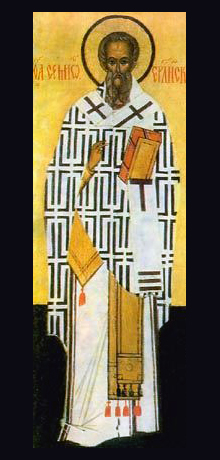
18 FEBRUARY – SAINT SIMEON (Bishop and Martyr)

 
Simeon, the son of Cleophas (Matthew xiii. 55), was ordained Bishop of Jerusalem in 62 AD and was Saint James’ immediate successor in that See. In the reign of the Emperor Trajan he was accused to the Consul Atticus of being a Christian and a relation of Christ for, at this time, all they, that were of the House of David were seized. After having endured various tortures, Simeon was put to death by the same punishment which our Saviour suffered, and all the beholders were filled with astonishment to find how at his age (for he was 120 years old) he could go through the intense pains of crucifixion without showing a sign of fear or irresolution.
Dom Prosper Guéranger:
How venerable our Saint of today, with his hundred and twenty years, and his episcopal dignity, and his Martyr-crown! He succeeded the Apostle Saint James in the See of Jerusalem. He had known Jesus and had been His disciple. He was related to Jesus, for he was of the House of David. His father was Cleophas, and his Mother that Mary whom the tie of kindred united so closely to the Blessed Mother of God that she has been called her sister. What grand titles these of Simeon who comes with all our other Martyrs of Septuagesima to inspirit us to penance! Such a veteran who had been a contemporary of the Saviour of the world and was a Pastor who could repeat to his flock the very lessons this Jesus had given him — such a Saint, we say, could never rejoin His Divine Master save by the path of martyrdom, and that martyrdom must be the Cross. Like Jesus, then, he dies on a Cross and his death, which happened in the year 106, closes the first period of the Christian Era or, as it is called, The Apostolic Age. Let us honour this venerable Pontiff whose name awakens within us the recollection of all that is dear to our Faith. Let us ask him to extend to us that fatherly love which nursed the Church of Jerusalem for so many long years. He will bless us from that throne which he won by the Cross, and will obtain for us the grace we so much need — the grace of conversion.
*****
Receive, most venerable Saint, the humble homage of our devotion. What is all human glory compared with yours! You were of the family of Christ. Your teaching was that which His divine lips had given you. Your charity for men was formed on the model of His Sacred Heart, and your death was the closest representation of His. We may not claim the honour you had of calling ourselves brothers of the Lord Jesus, but pray for us that we may be of those of whom He thus speaks: “Whoever will do the will of my Father that is in Heaven, he is my brother, and sister, and mother” (Matthew xii. 50). We have not, like you, received the doctrine of salvation from the very lips of Jesus, but we have it in all its purity by means of holy Tradition, of which you are one of the earliest links. Obtain for us a docility to this word of God, and pardon for our past disobedience. We have not to be nailed to a cross, as you were, but the world is thickly set with trials to which our Lord Himself gives the name of the Cross. These we must bear with patience, if we would have part with Jesus in His glory. Pray for us, O Simeon, that henceforth we may be more faithful; that we never more become rebels to our duty, and that we may repair the faults we have so often committed by infringing the law of our God.
Also on this day according to the ROMAN MARTYROLOGY:

At Ostia, the holy martyrs Maximus and his brother Claudius, and Praepedigna, the wife of Claudius, with her two sons Alexander and Cutias, all of an illustrious family. By the order of Diocletian, they were apprehended and sent into exile. Afterwards being burned alive, they offered to God the sweet-smelling sacrifice of martyrdom. Their remains were cast into the river, but Christians found them and buried them near that city.

In Africa, the holy martyrs Lucius, Sylvanus, Rutulus, Classicus, Secundinus, Fructulus and Maximus.

At Constantinople, the holy bishop Flavian, who for having defended the Catholic faith at Ephesus, was buffeted and kicked by the partisans of the impious Dioscorus, and being banished, ended his life within three days.

At Toledo, St. Helladius, bishop and confessor.

And in other places, many other holy martyrs, confessors and virgins.

Thanks be to God.

Monday, 17 February 2025

17 FEBRUARY – FERIA

On this day according to the ROMAN MARTYROLOGY:

At Rome, the passion of St. Faustinus, whom forty-four others followed to receive the crown of martyrdom.

In Persia, during the persecution of Decius, the birthday of blessed Polychronius, bishop of Babylon, who, being struck in the mouth with stones, stretched out his hands, lifted up his eyes to heaven and expired.

At Concordia, the holy martyrs Donatus, Secundian, and Romulus, with eighty-six others, partakers of the same crown.

At Caesarea in Palestine, St. Theodulus, an aged man, in the service of the governor Firmilian. Moved by the example of the martyrs, he confessed Christ with constancy, was fastened to a cross, and thus by a noble victory merited the palm of martyrdom.

In the same place, St. Julian, a Cappadocian, who, because he had kissed the relics of the martyrs, was denounced as a Christian and led to the governor who had him consumed with a slow fire.

In the territory of Terouanne, St. Silvinus, bishop of Toulouse.

In Ireland, St. Fintan, priest and confessor.

At Florence, blessed Alexius Falconieri, confessor, one of the seven Founders of the Order of the Servites of the Blessed Virgin Mary, who, in the one hundred and tenth year of his age, terminated his blessed career in the consoling presence of Jesus Christ and the angels.

And in other places, many other holy martyrs, confessors and virgins.

Thanks be to God.

Wednesday, 12 February 2025

12 FEBRUARY – THE SEVEN FOUNDERS OF THE SERVITE ORDER

 
In the thirteenth century when the more cultured parts of Italy were rent by the dread dissension of the Emperor Frederick II and by bloody civil wars, the mercy of God set forth various men eminent for holiness, and among others raised up seven nobles of Florence who were bound one to another in charity and gave an illustrious example of brotherly love. Their names were Bonfiglio Monaldi, Bonajuncta Manetti, Manetto Antalli, Amadeo de’ Amidei, Uguccio de’ Uguccioni, Sosteneo de’ Sostenei and Alexis de’ Falconieri. On the holiday of the Assumption of the Virgin into Heaven in 1233 they were praying in the oratory of a guild called the Guild of Praise when the same Mother of God appeared to each one of them and bade them embrace a life of greater holiness and perfection. These seven men discussed the matter with the Bishop of Florence and then, considering neither the nobility of their birth nor their wealth and clad in haircloth under vile and worn-out garments, they withdrew into a little house in the country on the eighth of September that they might begin their holier life on the same day on which the Mother of God herself had by her birth begun her life of holiness upon Earth.

God showed by a miracle how acceptable in His sight should be their manner of life, for a short while after, when these seven men were begging alms from door to door through Florence, it came to pass that some children, among whom was holy Philip Benizi who had then scarcely entered the fifth month of his age, called them blessed Mary’s servants, by the which name they were called ever after. To avoid meeting people and in the desire to be alone, they all withdrew together to the solitude of Monte Senario, and there began a kind of heavenly life. They lived in caves and on herbs and water only, while they wore out their bodies with watching and other hardships while they contemplated unweariedly the sufferings of Christ and the woes of His most sorrowful Mother. One Good Friday when their thoughts were fixed on it more than ever, the Blessed Virgin Mary appeared to them twice and showed them her garments of mourning as those in which they should clothe themselves. She bade them know that she would take it right well that they should raise up in the Church a new order to recall the memory of the sorrows which she bore beneath the Cross of the Lord. Holy Peter, the illustrious martyr of the Order of Friars Preachers, learnt this not only from his familiar converse with these holy men, but also from a special vision of the Mother of God, and it was on his incitement that they founded the regular Order called that of the Servites, or Servants of the Blessed Virgin Mary, the which Order was afterward approved by the Pope Innocent IV.

These holy men, when they had gathered to themselves some companions, began to go through the cities and towns of Italy, especially of Tuscany, everywhere preaching Christ crucified, stilling contests among the citizens and calling back almost countless backsliders into the path of grace. Neither did they make Italy only the field of their Gospel labours, but also France, Germany and Poland. They passed away to be ever with the Lord when they had spread far and wide a sweet savour of Christ and were famous also for the glory of signs and wonders. As one love of brotherhood and of the monastic life had joined them together upon Earth, so one grave held their dead bodies and one honour was paid them by the people. For this reason the Popes Clement XI and Benedict XIII confirmed the honour which had for centuries been paid to them individually, and Pope Leo XIII, after proof of their miracles which had been wrought by God on the common invocation of these saints, after their veneration had been sanctioned in the jubilee year of his priesthood, decreed to them the honours paid to Saints and ordered that their memory should every year be kept throughout the universal Church with an Office and Mass.

Also on this day according to the ROMAN MARTYROLOGY:

At Barcelona in Spain, in the time of the emperor Diocletian, St. Eulalia, virgin, who, being racked, torn with iron hooks, cast into the fire and crucified, received the glorious crown of martyrdom.

In Africa, St. Damian, soldier and martyr.

At Carthage, the holy martyrs Modestus and Julian.

At Benevento, St. Modestus, deacon and martyr.

At Alexandria, the holy children Modestus and Ammonius.

At Antioch, St. Meletius, a bishop, who often suffered exile for the Catholic faith, and finally died at Constantinople and went to his reward. His virtues have been highly extolled by St. John Chrysostom and St. Gregory of Nyssa.

At Constantinople, St. Anthony, a bishop in the time of the emperor Leo VI.

At Verona, St. Gaudentius, bishop and confessor.

And in other places, many other holy martyrs, confessors and virgins.

Thanks be to God.
Sunday, 9 February 2025

9 FEBRUARY – FIFTH SUNDAY AFTER EPIPHANY

Epistle – Colossians iii. 12‒17

Brethren, put on therefore, as the elect of God, holy and beloved, the bowels of mercy, benignity, humility, modesty, patience; bearing with one another, and forgiving one another, if any have a complaint against another, even as the Lord has forgiven you, so do you also. But above all these things have charity, which is the bond of perfection. And let the peace of Christ rejoice in your hearts, wherein also you are called in one body; and be thankful. Let the word of Christ dwell in you abundantly, in all wisdom, teaching and admonishing one another in psalms, hymns and spiritual canticles, singing in grace in your hearts to God. Whatever you do in word or in work, do all in the name of the Lord Jesus Christ, giving thanks to God and the Father by Him.

Thanks be to God.

Gospel – Matthew xiii. 24‒30

At that time, Jesus spoke another parable to the multitudes: The kingdom of heaven is like a man who sowed good seed in his field. But while men were asleep, his enemy came and over-sowed cockle among the wheat and went his way. And when the blade had sprung up, and had brought forth fruit, then appeared also the cockle. And the servants of the good man of the house coming said to him: “Sir, did you not sow good seed in your field? From where then has it cockle?” And he said to them: “An enemy has done this.” And the servants said to him: “Do you want us to go and gather it up?” And he said: “No, lest perhaps gathering up the cockle, you root up the wheat also together with it. Suffer both to grow until the harvest, and in the time of the harvest I will say to the reapers: Gather up first the cockle, and bind it into bundles to burn, but the wheat gather into my barn.”

Praise to you, O Christ.

Saturday, 8 February 2025

8 FEBRUARY – SAINT JOHN OF MATHA (Confessor)


John of Matha, the institutor of the Order of the Most Holy Trinity for the Ransom of Captives, was born at Fancon in Provence, France, of parents conspicuous for their nobility and virtue. He studied first at Aix, and afterwards at Paris where, after having completed his theological course, he received the degree of Doctor. His eminent learning and virtues induced the Bishop of Paris to promote him in spite of his humble resistance to the holy order of priesthood that, during his sojourn there, he might be a bright example to young students by his talents and piety. While celebrating his first Mass in the Bishop’s chapel in the presence of the Prelate and several assistants, there appeared to John an Angel clad in a white and brilliant robe. He had on his breast a red and blue cross, and his arms were stretched out, crossed one above the other, over two captives, one a Christian, the other a Moor. Falling into an ecstasy at this sight, the John immediately understood that he was called to ransom captives from the infidels. But that he might the more prudently carry out so important an undertaking, he withdrew into a solitude. There, by divine appointment, he met with Felix of Valois who had been living many years in that same desert. They agreed to live together, and for three years John devoted himself to prayer, contemplation and the practice of every virtue.

One day, as they were seated near a fountain, conferring with each other on holy things, a stag came towards them, bearing a red and blue cross between his antlers. John, perceiving that Felix was surprised by so strange an occurrence, told him of the vision he had had in his first Mass. They gave themselves more fervently than ever to prayer, and having been thrice admonished in sleep, they resolved to set out for Rome to obtain permission from the Sovereign Pontiff to found an Order for the ransom of captives. Innocent III who had shortly before been elected Pope received them kindly, and while deliberating on what they proposed it happened that as he was celebrating Mass in the Lateran Church on the second feast of Saint Agnes, there appeared to him, during the elevation of the sacred Host, an Angel robed in white, bearing a two-coloured cross, and in the attitude of one that was rescuing captives. The Pontiff then gave his approbation to the new institute, and would have it called the Order of the Most Holy Trinity for the Ransom of Captives, bidding its members wear a white habit, with a red and blue cross.

The Order being thus established, its holy founders returned to France and erected their first Monastery at Cerfroid in the diocese of Meaux. Felix was left to govern it, and John returned, accompanied by a few of his brethren, to Rome. Innocent III gave them the house, church and hospital of Saint Thomas de Formis, together with various revenues and possessions. He also gave them letters to Miramolin, king of Morocco, and thus was prosperously begun the work of Ransom. John afterwards went into Spain, a great portion of which was then under the Saracen yoke. He stirred up kings, princes and others of the faithful to compassion for the captives and the poor. He built monasteries, founded hospitals and saved the souls of many captives by purchasing their freedom. Having, at length, returned to Rome, he spent his days in doing good. Worn out by incessant labour and sickness, and burning with a most ardent love of God and his neighbour, it was evident that his death was at hand.

Calling his brethren round him, John eloquently besought them to labour in the work of Ransom which Heaven had entrusted to them, and then slept in the Lord on the sixteenth of the Calends of January (December 17th) in 1213. His body was buried with the honour that was due to him in the same Church of Saint Thomas de Formis.

Dom Prosper Guéranger:
We were celebrating, not many days ago, the memory of Peter Nolasco who was inspired by the Holy Mother of God to found an Order for the ransoming of Christian captives from the infidels. Today we have to honour the generous Saint to whom this sublime work was first revealed. He established, under the name of the Most Holy Trinity, a body of religious men who bound themselves by vow to devote their energies, their privations, their liberty, nay, their very life, to the service of the poor slaves who were groaning under the Saracen yoke. The Order of the Trinitarians, and the Order of Mercy, though distinct, have the same end in view, and the result of their labours during the [eight] hundred years of their existence has been the restoring to liberty and preserving from apostasy upwards of a million slaves. John of Matha, assisted by his faithful cooperator, Felix of Valois (whose feast we will keep at the close of the Year) established the centre of his grand work at Meaux in France. We are preparing for Lent when one of our great duties will have to be that of charity towards our suffering brethren: what finer model could we have than John of Matha, and his whole Order, which was called into existence for no other object than that of delivering from the horrors of slavery brethren who were utter strangers to their deliverers, but were in suffering and in bondage. Can we imagine any alms-giving, let it be ever so generous, which can bear comparison with this devotedness of men who bind themselves by their Rule not only to traverse every Christian land begging alms for the ransom of slaves, but to change places with the poor captives, if their liberty cannot be otherwise obtained? Is it not, as far as human weakness permits, following to the very letter, the example of the Son of God Himself who came down from Heaven that He might be our ransom and Redeemer? We repeat it: with such models as these before us we will feel ourselves urged to follow the injunction we are shortly to receive from the Church, of exercising works of mercy towards our fellow-creatures as being one of the essential elements of our Lenten penance.
*****
And now, generous hearted Saint, enjoy the fruits of your devoted charity. Our Blessed Redeemer recognises you as one of His most faithful imitators, and the whole court of Heaven is witness of the recompense with which He loves to honour your likeness to Himself. We must imitate you. We must walk in your footsteps, for we, too, hope to reach the same eternal resting place. Fraternal charity will lead us to Heaven, for the works it inspires us to do have the power of freeing the soul from sin, as our Lord assures us (Ecclesiasticus iii. 33). Your charity was formed on the model of that which is in the heart of God, who loves our soul, yet disdains not to provide for the wants of our body. Seeing so many souls in danger of apostasy, you ran to their aid and men were taught to love a religion which can produce heroes of charity like you. Your heart bled at hearing of the bodily sufferings of these captives, and your hand broke the chains of their galling slavery. Teach us the secret of ardent charity. Is it possible that we can see a soul in danger of being lost, and remain indifferent? Have we forgotten the divine promise, told us by the Apostle: “He that causes a sinner to be converted from the error of his way will save his soul from death and will cover a multitude of his own sins”? (James v. 20). Get us also a tender compassion for such as are in bodily suffering and poverty, so that we may be generous in comforting them under these trials which are but too often an occasion of their blaspheming Providence. Dear friend and Liberator of slaves! Pray, during this holy Season, for those who groan under the captivity of sin and Satan: for those, especially, who, taken with the frenzy of earthly pleasures, feel not the weight of their chains but sleep on peacefully through their slavery. Ransom them by your prayers, convert them to the Lord their God, lead them back to the land of freedom. Pray for France which was your country, and save her from infidelity. Protect the venerable remnants of your Order so that it may labour for the present wants of the Christian world, since the object for which you instituted it has ceased to require its devotedness.
Also on this day according to the ROMAN MARTYROLOGY:

St. Jerome Aemiliani, confessor, founder of the Congregation of Somascha, who slept in the Lord on the eighth of this month. He was numbered among the saints by Pope Clement XIII, his feast being assigned to the twentieth of July.

At Rome, the holy martyrs Paul, Lucius and Cyriacus.

In Lesser Armenia, the birthday of the holy martyrs Denis, Aemilian and Sebastian.

At Alexandria, under the emperor Decius, the martyr St. Cointha, whom the pagans seized, led to the idols and urged to adore them. As she refused with horror, they put her feet in chains and dragged her through the streets of the city, mangling her body in a barbarous manner.

At Constantinople, the birthday of the holy martyrs, monks of the monastery of Dins, who, bringing the letter of Pope St. Felix against Acacius, were barbarously killed for their defence of the Catholic faith.

In Persia, in the time of king Cabades, the commemoration of the holy martyrs who were put to death by various kinds of torments on account of their faith in Christ.

At Pavia, the bishop St. Juventius, who strenuously laboured in preaching the Gospel.

At Milan, the demise of St. Honoratus, bishop and confessor.

At Verdun in France, St. Paul, a bishop renowned for miracles.

At Muret near Limoges, the birthday of the abbot St. Stephen, founder of the Order of Grandimont, celebrated for his virtues and miracles.

In the monastery of Vallombrosa, blessed Peter, cardinal-bishop of Albano, of the Congregation of Vallombrosa, of the Order of St. Benedict, surnamed Igneus, because he passed through fire uninjured.

And in other places, many other holy martyrs, confessors and virgins.

Thanks be to God.

Saturday, 1 February 2025

1 FEBRUARY – SAINT IGNATIUS OF ANTIOCH (Bishop and Martyr)

Ignatius was the third Bishop of the Church of Antioch, Saint Peter the Apostle being the first. During the persecution under Trajan he was condemned to be devoured by wild beasts and was sent in chains to Rome. During this voyage, which was made by sea, he had to stop at Smyrna where Polycarp, the disciple of Saint John, was Bishop. From this city he wrote several Epistles: one to the Ephesians, a second to the Magnesians, a third to the Trallians, a fourth to the Romans. When he had left Smyrna, he addressed an Epistle to the Philadelphians and Smyrneans, and one to Polycarp himself, recommending to him his Church of Antioch. It is in this last named Letter that he quotes from the Gospel a passage bearing testimony to the person of our Lord Jesus Christ. “From Syria,” he says, “even unto Rome, I am fighting with wild beasts, both by sea and land, both by night and day, for I am fastened to ten leopards, I mean, to the soldiers who have care of me. When I show them a kindness, they grow more brutal. Their injuries are my instruction, but I am not thereby justified. I long for the wild beasts that are prepared for me, which I heartily wish may rush on me, and torture me, and devour me, and not be afraid to touch me, as has happened with other martyrs. Nay, if they refuse to approach me, I will make them come on, I will rush upon them, that so they may devour me. Pardon me, my little children: I know what is for my own welfare. Now do I begin to be a disciple of Christ, and care for nothing in this world so that I may find Jesus. Let fire, or the cross, or wild beasts, or the breaking of my bones, or the cutting me to pieces, or the shattering of my whole body, yea, all the tortures of the devil — let them all come upon me, only let me enjoy my God.” When he was sentenced to be devoured by wild beasts and heard the roaring of the lions, his impatience to suffer made him exclaim: “I am the wheat of Christ — let me be ground by the teeth of wild beasts that I may become the pure bread.” He suffered in the eleventh year of Trajan’s reign.

Dom Prosper Guéranger:
Two days more and the happy season of Christmas will be over! This is the vigil of its termination, and lo! — there comes to gladden us one of the grandest Martyrs of the year — Ignatius surnamed the Theophorus, Bishop of Antioch. A venerable tradition tells us that this old man who so generously confessed the faith before Trajan was the child whom Jesus took into His arms and showed to His Disciples as a model of that simplicity which we must all have if we would enter into the kingdom of Heaven. Today he appears before us standing near the crib in which this same Jesus gives us His own divine lessons of humility and simplicity.
But in this the Court of our Emmanuel Ignatius stands near to Peter, for the Prince of the Apostles made him his second successor in his first See of Antioch. From so honoured a position Ignatius derived that courage which made him resist a powerful emperor even to his face, defy the wild beasts of the amphitheatre and triumph by a glorious martyrdom. As it were to show the supremacy of the See of Rome, Divine Providence willed that he, with his chains on him, should go to see Peter and finish his course in the Holy City, and thus mingle his blood with that of the Apostles. Rome would have been imperfect without the glory of Ignatius’ martyrdom, which is the pride of her Colosseum, rich as it is with the blood of so many thousands of Martyrs. Ignatius’ character is impetuosity of love for his God. He has but one fear — it is that the prayers of the Romans will stay the lions from devouring him, and his desire of being united to Christ be thus denied him. Let us admire this superhuman fortitude which shows itself thus suddenly amid the pagan world, and let us acknowledge that so ardent a love of God and so vehement a longing to possess Him could only have come from the accomplishment of the Mysteries of our Redemption which showed man how much God loved him. The crib of Bethlehem, even had there never been the Sacrifice of Calvary, would of itself be sufficient to convince us of all this. God comes down from Heaven for the sake of His creature, man. He Himself becomes Man, nay, a child, and is laid in a manger! Such miracles of love would have sufficed to save the guilty world. How, then, will they not have power to prompt men to give their whole heart to their loving God? And would it be too much if we made a sacrifice of our very lives to repay our Jesus for only that much of His love which He showed us by being born among us?
*****
All your desires were satisfied, O glorious Martyr! You have died for Jesus. You are with Jesus. Rome’s sons and daughters filled the Colosseum. Their savage joy made it tremble with their cheers as they saw you mangled by the lions. It was the hour you had prayed for — your sacrifice for Him who had sacrificed Himself for you is over, and your soul is buried in His divine embrace! Generous and impetuous lover of Christ! You were ambitious to pay your debt to the Crucified — the debt of suffering. It seemed to you that you had no right to His kingdom until you had repaid His Passion by some cruel tortures endured for Him. Worthy companion of Stephen, Sebastian, Vincent and Agnes! How rich and verdant is the palm you hold over your Jesus’ crib! Can you look upon us, weak Christian cowards, and not pity us? Pray for us that we may at least be faithful to our Lord when we are persecuted by the temptations of the world, the flesh and the devil; that we may at least give our hearts to His service, if we are not to be permitted to give our bodies to be tortured for His Name. You were chosen, when a little child, as the model of the simplicity which our Saviour was teaching to His Disciples, and this innocence never left you. Ask for us from Him who is the King of little children that one of the graces of the Christmas we have been keeping may be this holy simplicity of heart.
Successor of Peter in the See of Antioch! Pray for the Churches of your Patriarchate that they may return to the true Faith and Catholic unity. Intercede for the Holy City of Rome which you watered with your blood, and which is now in possession of your sacred relics that were saved from the lions’ jaws. Watch over the maintenance of ecclesiastical discipline and order, of which you left such admirable rules in your Epistles, and obtain for the Church that all the members of her hierarchy may be united in the bonds of duty and love, that thus she may be beautiful in the strength of her unity and terrible to the enemies of God, as an army set in array (Canticles vi. 3).

Sunday, 26 January 2025

26 JANUARY – SAINT PAULA (Widow)

 
Paula, a Roman lady of a most noble senatorial family, but still more noble by the holiness of her life, was married to Toxotius, of an equal noble race, and bore him five children. After her husband’s death, she devoted her whole self to the service of God and distributed her great wealth to the poor of Christ, but with so much charity that she would go through the city in search of them, and (as Saint Jerome relates of her) would count herself a loser if any poor needy person were fed by any other than herself. This zeal for the poor continued till her death, and she would sometimes say that she longed to die as a poor mendicant and to be buried in a borrowed winding-sheet.

Certain dissensions having arisen between some of the Churches under the pontificate of Saint Damasus, several Bishops, both of the East and West, came to Rome. Paula gave hospitality to Saint Epiphanius, Bishop of Salamina in Cyprus. She also loaded Paulinus of Antioch with every sort of kindness. Their virtues made such an impression on her that she determined to leave her country and spend the rest of her days in the desert. Therefore, without delay, she fled from the noise and bustle of the city and from the flattery of admirers. And preferring the humble Bethlehem to Rome, she set out for Porto and there embarked for Palestine. Her brother, relatives and children did their utmost to dissuade her from her resolution and made use of every argument that could weigh with a mother’s heart. But while feeling all the keenness of sorrow, Paula raised her tearless eyes to Heaven and conquered by her love for God, the love that would have kept her with her children. She was a mother but she was also the handmaid of Christ, and that was before all else.

Having, therefore, embarked, accompanied by her daughter Eustochium who had imitated her in her holy purpose, Paula set sail, longing, with all the ardour of faith and love, to visit Jerusalem and the Holy Places. After touching at Cyprus and Selucia, she landed at Syria and Palestine, visiting each hallowed spot with so much joy and devotion that nothing less than the resolution of seeing the others could have torn her from it. Having, at length, reached Bethlehem, there she remained and built four monasteries, one for men, over which Saint Jerome presided, and the three others for women.

The remainder of her life was spent in Bethlehem in the exercises of the most admirable sanctity. Humility was her favourite virtue. Her meekness was extraordinary, as also was her love for the poor. She was calumniated by certain envious tongues and was tried by numerous crosses, but she bore all with invincible patience and forbearance. She was slow to speak and swift to hear. She knew the Sacred Scriptures by heart, for she was most assiduous in reading both the Old and New Testament. She applied herself to the study of Hebrew, which she so perfectly mastered that she used to sing the Psalms in that language and spoke it as though it had been her native tongue. She slept on a haircloth thrown on the floor, and even such sleep as this was interrupted by such long and frequent prayers that it seemed as though her nights were prayer rather than sleep. Even when suffering the most violent fever, she would not allow herself anything that could make her bed less comfortless. Her abstinence was so great that it bordered on imprudence. She added to the weakness of her frame by severe fasting and hard work. Excepting the feast days, she would scarcely allow herself a drop of oil with her food. No argument could induce her to take wine as a means for restoring her to strength. It would be difficult to describe the tender care with which she nursed the sick. She lavished on them whatever she had, while to herself, when in sickness, she allowed no indulgence so that she had two measures: one of commiseration for others, and one of severity towards herself.

At length, Paula fell into a dangerous sickness, and saw that her death was approaching. A chill was over her whole body, her heart alone retaining a spark of life. Then, as though she were going to her home and was leaving a place of banishment, she ceased not, until she breathed forth her soul, to repeat these verses of the Psalm: “O Lord! I have loved the beauty of your house, and the place where your glory dwells. How lovely are your tabernacles, O Lord of Hosts! My soul longs and faints for the courts of the Lord.” Signing her lips with the sign of the cross, she yielded her most holy soul to her God on the seventh of the Calends of February (January 26), in the fifty-sixth year of her age. Her remains were carried by bishops into the Church of the Holy Cave. From all the towns of Palestine there came to her funeral a multitude of monks, virgins, widows and poor who, as at the death of Dorcas, showed the garments she had given them. On the third day she was buried under the Church, close to the Grotto of our Lord.

Dom Prosper Gueranger:
The noble and pious widow who left all the pomps of Rome and bade adieu to her children to lead a life of retirement in Bethlehem, comes before us today as one of the Saints that have a special right to be near the crib of the Infant Jesus. She was, during her life, irresistibly attracted to it as to something far richer in her eyes than all the palaces of kings. There did she find her God who had rendered Himself poor for our sakes, and whose poverty she, in the days of her opulence, used to console by relieving the wants of the indigent. It was through her zeal that several monasteries were founded in the neighbourhood of the holy cave, where the Word made Flesh first appeared to men. She spent her days in prayer, in works of penance and charity, and in the meditation of the Holy Scriptures which she studied under the guidance of the great Saint Jerome. It is a sight worthy of our admiration to behold these Christian ladies and virgins filled with the sublime spirit of the gospel of Jesus Christ while everything around them was corrupted by the grossest sensuality of pagan Rome. We find them retiring either to the deserts of Egypt, there to study the virtues of the monks and hermits, or to the Holy Land, there to venerate the scenes of our Lord’s life. Paula is one of the foremost of these noble Christian women, and it is with extreme regret that we are obliged to omit the account of her pilgrimage, given with so much spirit and unction by Saint Jerome in letters addressed to the illustrious virgin Eustochium, the daughter of Saint Paula. We must limit ourselves to the following quotation in which the Holy Doctor describes the arrival at Bethlehem:
“Having divided among the poor and her attendants what little money she had still remaining, Paula left Jerusalem and proceeded to Bethlehem. After paying a short visit to the tomb of Rachel which lies on the right hand of the road, she arrived at the city she so much longed to see, and she entered into the Grotto of our Lord. As soon as she beheld the sacred spot in which our Lady sought shelter and saw the stable “where the ox knew his owner, and the ass his master’ crib” (Isaias i. 3) she told me, with much emotion, that she saw, with the eyes of her faith, the infant wrapped in swaddling clothes and sleeping in the manger: the Magi adoring, the Star brightly shining over the stable, the Virgin-Mother, Joseph eager to render her his service, the shepherds arriving at midnight, the Innocents massacred, Herod enraged and Joseph and Mary fleeing into Egypt. Tears of joy trickled down her cheeks and she exclaimed: ‘Hail, O Bethlehem! house of bread in which was born the Bread that came down from Heaven! Hail, O Ephrata! fertile land whose fruit is our very God. It is of you that the Prophet Micheas spoke when he said: Bethlehem, Ephrata! You are not the least of the thousand cities of Judah, for out of you will come He that is to be the Ruler in Israel, and His going forth is from the beginning, from the days of eternity (Micheas v. 2) Yes, it was in you that was born the Prince who was begotten before the day-star, and whose birth in the bosom of the Father was before all ages. I, a poor wretched sinner, even I have been permitted to kiss the crib in which the infant Saviour shed His first tears. I have been permitted to pray in that cave in which the Virgin-Mother brought forth our Lord. Here, henceforth, will I rest, for this is the country of our Master. Here will I dwell, for our Lord chose it for His own dwelling-place.’”
*****
You loved the crib of your Lord, O generous hearted Paula! You preferred the humble Grotto of Bethlehem to all the riches of Rome, and Jesus, to reward your love and the sacrifice you made for Him, has united you to Himself for eternity. May we learn from your example to go in search of the infant Jesus, and to relish the mysteries of His divine birth. May we break down every obstacle whenever He calls us to Himself. May He mercifully teach us to acknowledge the rights He has acquired over us by the sacrifices He made for our sakes, and be, thereby, disposed to give Him whatever He may ask at our hands. May your eagerness to sacrifice the strongest affections of your heart in order that you might be united to Him alone animate us to moderate and regulate ours.
May your prayers help us to keep our hearts faithful to Him who made them, and ready, at all times, to follow Him in the path to which He may call us. May we stand on our guard against that spirit of the world which is ever seeking to enter into a compact with Christianity, and by calling into question the counsels of our Lord to deny even the obligation of all men to obey His precepts. May the light of the Holy Ghost shine upon us, and the love of Jesus inflame our hearts. Then will we understand the conduct of the Saints. Their examples may, indeed, make us feel ashamed at our weakness, but they will also bring light to our soul, and will encourage us to fulfil those duties which God puts upon us, nor will self-love be able to cheat us into tepidity.
Pray for the Church of Syria which you sanctified by your virtues. Watch over the sanctuaries of the Holy Land. Protect the pilgrims who, after your example, visit the Holy Places where were achieved the Mysteries of our Redemption. Excite throughout Christendom a love of the Holy Land, and may we be inflamed in the love of Jesus by following devoutly the Stations He marked for us in His sacred Passion.
Also on this day according to the ROMAN MARTYROLOGY:

At Hippo Regius in Africa, the holy bishop Theogenes and thirty-six others, who, despising temporal death, obtained the crown of eternal life in the persecution of Valerian.

In the diocese of Paris, the saintly queen Bathildis, illustrious by her sanctity and glorious miracles.

And in other places, many other holy martyrs, confessors and virgins.

Thanks be to God.

Monday, 20 January 2025

20 JANUARY – SAINT FABIAN (Pope and Martyr)

 
Fabian, a Roman by birth, governed the Church from the reign of Maximin to that of Decius. He divided the city into seven parts which he consigned to as many Deacons and to them he gave the charge of looking after the poor. He created also a like number of Subdeacons who were to collect the Acts of the Martyrs, written by seven Notaries. It was he who decreed that every year, on the fifth Feria, our Lord’s Supper, the Chrism should be renewed, and the old should be burnt. At length, on the thirteenth of the Calends of February (January 20), he was crowned with martyrdom in the persecution of Decius and was buried in the cemetery of Callixtus on the Via Appia after reigning 15 years and 4 days. He held 5 ordinations in the month of December, in which he made 22 Priests, 7 Deacons and 11 Bishops for various places.

Dom Prosper Gueranger:

Saint Fabian, like Saint Clement and Saint Antheros, two of his predecessors, was extremely zealous in seeing that the Acts of the Martyrs were carefully drawn up. This zeal was no doubt exercised by the clergy in the case of our holy Pontiff himself, and his sufferings and martyrdom were carefully registered. But all these interesting particulars have been lost, in common with an immense number of other precious Acts which were condemned to the flames by the imperial edicts during the persecution under Diocletian. Nothing is now known of the life of Saint Fabian, save a few of his actions as Pope. But we may have some idea of his virtues by the praise given him by Saint Cyprian who, in a letter written to Saint Cornelius, the immediate successor of Saint Fabian, calls him “an incomparable man.” The Bishop of Carthage extols the purity and holiness of life of the holy Pontiff who so peaceably governed the Church amid all the storms which then assailed her. There is an interesting circumstance related of him by Eusebius. After the death of Saint Antheros, the people and clergy of Rome assembled together for the election of the new Pontiff. Heaven marked out the successor of Saint Peter: a dove was seen to rest on the venerable head of Fabian and he was unanimously chosen. This reminds us of the event in our Lord’s life which we celebrated a few days back when, standing in the river Jordan, the Dove came down from Heaven and showed Him to the people as the Son of God. Fabian was the depository of the power of regeneration which Jesus, by His Baptism, gave to the element of water. He zealously propagated the Faith of His Divine Master and, among the Bishops he consecrated for divers places, one or more were sent by him into these western parts of Europe.
*****
Thus did you live out the long tempestuous days of your Pontificate, O Fabian! But you had the presentiment of the peaceful future reserved by God for His Church, and you zealously laboured to hand down to the coming generations the great examples of the Martyrs. The flames have robbed us of a great portion of the treasures you prepared for us and have deprived us of knowing the Fabian who so loved the Martyrs and died one himself. But of you, Blessed Pontiff, we know enough to make us thank God for having set you over His Church in those hard times, and keep this day as a feast in celebration of your glorious triumph. The dove which marked you out as the one chosen by Heaven showed you to men as the visible Christ on Earth. It told you that you were destined for heavy responsibilities and martyrdom. It was a warning to the Church that she should recognise and hear you as her guide and teacher. Honoured thus with a resemblance to Jesus in the mystery of His Epiphany, pray to Him for us that He mercifully manifest Himself to our mind and heart. Obtain of Him for us that docility to His grace, that loving submissiveness to His every will, that detachment from all created things, which were the support of your life during those fifteen years of your ever threatened and anxious pontificate. When the angry persecution at length broke on you, it found you prepared and martyrdom carried you to the bosom of that God who had already welcomed so many of your martyred children. We, too, are looking for that last wave which is to break over us and carry us from the shore of this present life to eternity — pray for us that it may find us ready! If the love of the Divine Babe, our Jesus, be within us. If, like you, we imitate the simplicity of the dove — we will not be lost! Here are our hearts — we wish for nothing but God — help us by your prayers.

Saturday, 11 January 2025

11 JANUARY – FERIA

Pope St. Hyginus 

Dom Prosper Guéranger:
The Magi were not satisfied with paying their adorations to the great King whom Mary presented to them. After the example of the Queen of Saba who paid her homage to the Prince of Peace in the person of King Solomon, these three Eastern Kings opened their treasures and presented their offerings to Jesus. Our Emmanuel graciously accepted these mystic gifts, and suffered them not to leave Him until He had loaded them with gifts infinitely more precious than those He had vouchsafed to receive. The Magi had given Him of the riches which this Earth produces. Jesus repays them with heavenly gifts. He strengthened in their hearts the virtues of faith, hope and charity. He enriched, in their persons, the Church of which they were the representatives. And the words of the Canticle of Mary were fulfilled in them: “He has filled the hungry with good things, and the rich He has sent empty away” (Luke i. 53). for the Synagogue refused to follow them in their search after the King of the Jews.
But let us consider the gifts made by the Magi, and let us, together with the Church and the Holy Fathers, acknowledge the Mysteries expressed by them. The gifts were three in number in order to honour the sacred number of the Persons in the divine Essence, as likewise to express the triple character of the Emmanuel. He had come that He might be King over the whole world. It was fitting that men should offer gold to Him, for it is the emblem of sovereign power. He had come to be High Priest and, by His mediation, reconcile Earth to Heaven. Incense, then, was an appropriate gift, for the priest uses it when He offers sacrifice. But, thirdly, it was only by His own death that He was to obtain possession of the throne which was prepared for his glorified Human Nature, and the perpetual Sacrifice of the Divine Lamb was to be inaugurated by this same His death. The gift of Myrrh was expressive of the Death and Burial of an immortal Victim. The Holy Ghost, who inspired the Prophets, had guided the Magi in their selection of these three gifts. Let us listen to Saint Leo, who speaking of this Mystery, says with his usual eloquence:
“O admirable Faith, which leads to Knowledge and perfect Knowledge, and which was not taught in the school of earthly wisdom, but was enlightened by the Holy Ghost Himself! For, whence had they learnt the supernatural beauty of their three Gifts? — they that had come straight from their own country, and had not as yet seen Jesus, nor beheld in His infant face the Light which directed them in the choice of their offerings? While the Star met the gaze of the bodily eye, their hearts were instructed by a stronger light — the ray of Truth. Before setting out on the fatiguing journey they knew Him to whom were due, by gold, the honours of a King; by incense, the worship of God; by myrrh, the faith in His 'Mortal Nature.”
But these three gifts which so sublimely express the three characters of the Man-God are fraught with instruction for us. They signify three great virtues which the divine infant found in the souls of the Magi, and to which He added increase by His grace. Gold signifies charity, which unites us to God; frankincense, prayer, which brings God into man’s heart, and myrrh self-abnegation, suffering and mortification by which we are delivered from the slavery of corrupt nature. Find a heart that loves God, that raises herself up to Him by prayer, that understands and relishes the power of the cross — and you have in that heart the worthiest offering which can be made to God, and one which He always accepts.
*****
We, too, O Jesus, offer you our treasure and our gifts. We confess you to be God, and Priest, and Man. We beseech you to accept the desire we have of corresponding to the love you show us by giving you our love in return. We love you, dear Saviour! Increase our love. Receive, also, the gift of our prayer for, though of itself it be tepid and poor, yet it is pleasing to you because united with the prayer of your Church: teach us how to make it worthy of you and how to give it the power of obtaining what you desire to grant: form within us the gift of prayer that it may unceasingly ascend up like sweet incense in your sight. And, lastly, receive the homage of our contrite and humble hearts, and the resolution we have formed of restraining and purifying our senses by mortification and penance.
The sublime Mysteries which we are celebrating during this holy season have taught us the greatness of our own misery, and the immensity of your love for us, and we feel more than ever the obligation we are under of fleeing from the world and its concupiscences, and of uniting ourselves to you. The Star will not have shone on us in vain: it has brought us to you, dear King of Bethlehem, and you will be King of our hearts. What have we that we prize and hold dear, which we can hesitate to give you in return for the sweet infinite treasure of yourself which you have given to us?
Dear Mother of our Jesus, we put these our offerings into your hands. The gifts of the Magi were made through you, and they were pleasing to your Son. You must present ours to Him, and He will be pleased with them in spite of their poverty. Our love is deficient. Fill up its measure by uniting it with your own immense love. Second our prayer by your maternal intercession. Encourage us in our warfare against the world and the flesh. Make sure our perseverance by obtaining for us the grace of a continual remembrance of the sweet Mysteries which we are now celebrating. Pray for us that, after your own example, we may keep all these things in our hearts. That must be a hard and depraved heart which could offend Jesus in Bethlehem, or refuse Him anything now that he is seated on your lap, waiting for our offering! O Mary, keep us from forgetting that we are the children of the Magi, and that Bethlehem is ever open to receive us.
***** 
Dom Prosper Guéranger:
The holy Pope and Martyr Hyginus held the Apostolic Chair under the reign of Antoninus and closed his four years’ Pontificate by martyrdom. We have no history of his life, but we venerate in him one of the links of that grand chain of Pontiffs which unites us by Saint Peter to our Lord Jesus Christ. The whole weight of the government of the Church was on his shoulders, and he was courageous and faithful in the discharge of his duties. His reign was during the age of Persecution when to be Pope was to be a victim of tortures and death. As we have already said, he soon won his palm and was associated in heaven with the three Magi who had, before leaving this world, preached the gospel in Greece, the country of our Saint. Let us ask him to bless the offerings we are making to the Divine Infant of Bethlehem, and to pray for us that we may obey this sweet King who asks us to give Him, not our blood by martyrdom, but our hearts by charity.
Also on this day according to the ROMAN MARTYROLOGY:

In Africa, blessed Salvius, martyr, on whose birthday St. Augustine preached to the people of Carthage.

At Alexandria, the holy martyrs Peter, Severus and Leucius.

At Fermo in the Marches of Ancona, St. Alexander, bishop and martyr.

At Amiens, St. Salvius, bishop and martyr.

At Brindisi, St. Leucius, bishop and confessor.

In Cappadocia, in a village called Magariassum, St. Theodosius, abbot, who, after great sufferings for the Catholic faith, finally rested in peace.

In Thebais, St.Palaemon, abbot, who was the teacher of St. Pachomius.

At Suppentonia near Mount Soractes, the holy monk Anastasius and his companions, who were called by a voice from heaven to enter the kingdom of God.

At Pavia, St. Honorata, virgin.

And in other places, many other holy martyrs, confessors and virgins.

Thanks be to God.

Saturday, 4 January 2025

4 JANUARY – FERIA

On this day according to the ROMAN MARTYROLOGY:

In Crete, the birthday of St. Titus, who was consecrated bishop of that island by the blessed Apostle St. Paul. After having faithfully performed the duty of preaching the Gospel, he reached the end of his blessed life and was buried in the church of which he had been made a worthy minister by the holy Apostle.

At Rome, in the reign of Julian the Apostate, the holy martyrs Priscus, priest, Priscillian, cleric, and Benedicta, a religious woman, who ended their martyrdom by the sword.

Also at Rome, under the same emperor, blessed Dafrosa, wife of the martyr St. Flavian. After her husband had been killed, she was first banished, and then beheaded.

At Bologna, the Saints Hermes, Aggoeus and Caius, martyrs, who suffered under the emperor Maximian.

At Adrumetum in Africa, in the persecution of Severus, the commemoration of St. Mavilus, martyr, who, being condemned by the most cruel judge Scapula to be devoured by wild beasts, received the crown of martyrdom.

Also in Africa, the most renowned martyrs Aquilinus, Geminus, Eugenius, Marcian, Quinctus, Theodotus and Tryphon.

At Langres, St. Gregory, a bishop renowned for miracles.

At Rheims in France, St. Rigobertus, bishop and confessor.

And in other places, many other holy martyrs, confessors and virgins.

Thanks be to God.

Tuesday, 3 December 2024

3 DECEMBER – TUESDAY IN THE FIRST WEEK OF ADVENT

Lesson at Matins – Isaias ii. 1‒3
The word that Isaias the son of Amos saw concerning Judah and Jerusalem. And in the last days the mountain of the house of the Lord will be prepared on the top of mountains, and it will be exalted above the hills: and all nations will flow to it. And many people will go, and say: “Come and let us go up to the mountain of the Lord, and to the house of the God of Jacob: and he will teach us his ways: and we will walk in his paths, for the law shall come forth from Sion, and the word of the Lord from Jerusalem.”
Thanks be to God.

Dom Prosper Guéranger:
How the Church loves to hear and say these grand words of the Prophet: “Come let us go up to the Mountain of the Lord!” She repeats them in the Lauds of every Feria in Advent, and her children bless the Lord who, that we might have no difficulty in finding Him, has made Himself like a high mountain. High, indeed, yet can we all ascend it. It is true that at first this mountain is, as we learn from another Prophet, a small stone which is scarce perceptible, and this to show the humility of the Messiah at His birth. But it soon becomes great, and all people see it and are invited to dwell on its fertile slopes, yes, to go up to its very summit, bright with the rays of the Sun of Justice. It is thus, Jesus, that you call us all, and that you approach towards all, and the greatness and sublimity of thy mysteries are put within the reach of our littleness. We desire to join, without delay, that happy multitude of people which is journeying on towards you. We are already with them. We are resolved to fix our tent under your shadow, O Mountain ever blessed! There shelter us, and let us be out of reach of the noise of the world beneath us. Suffer us to go so far up that we may lose all sight of that same world’s vanities. May we never forget those paths which lead even to the blissful summit where the mountain, the figure, disappears, and the soul finds herself face to face with Him whose vision eternally keeps the Angels in rapture, and whose delight is to be with the children of men! (Proverbs viii. 31).

Saturday, 30 November 2024

30 NOVEMBER – SAINT ANDREW (Apostle and Martyr)


Dom Prosper Guéranger:
Let us read the life of this glorious fisherman of the lake of Genesareth, who was afterwards to be the successor of Christ Himself, and the companion of Peter on the tree of the Cross. The Church has compiled it from the ancient Acts of the Martyrdom of the holy Apostle, drawn up by the priests of the Church of Patrae, which was founded by the Saint. The authenticity of this venerable piece has been contested by Protestants inasmuch as it makes mention of several things which would militate against them. Their sentiment has been adopted by several critics of the 17th and 18th centuries. On the other hand, these Acts have been received by a far greater number of Catholic writers of eminence, among whom may be mentioned the great Baronius, Labbe, Natalia Alexander, Gallandus, Lumper, Morcelli, etc. The Churches, too, of both East and West, which have inserted these Acts in their respective Offices of Saint Andrew, are of some authority, as is also Saint Bernard, who has made them the groundwork of his three admirable sermons on Saint Andrew:
Andrew, the Apostle, born at Bethsaida, a town of Galilee, was brother of Peter and disciple of John the Baptist. Having heard his master say, speaking of Christ: “Behold the Lamb of God!” he followed Jesus and brought to Him his brother also. When, afterwards, he was fishing with his brother in the sea of Galilee, they were both called, before any of the other Apostles, by our Lord who, passing by, said to them: “Come after me. I will make you to be fishers of men.” Without delay, they left their nets and followed Him.
After the Passion and Resurrection, Andrew went to spread the faith of Christ in Scythia in Europe, which was the province assigned to him. Then he travelled through Epirus and Thrace, and by his teaching and miracles converted innumerable souls to Christ. Afterwards, having reached Patrae in Achaia, he persuaded many in that city to embrace the truth of the Gospel. Finding that the Proconsul Aegeas resisted the preaching of the Gospel, he most freely upbraided him for that he, who desired to be considered as a judge of men, should be so far deceived by devils as not to acknowledge Christ to be God, the Judge of all. Then Aegeas being angry, said: “Cease to boast of this Christ, whom such like words as these kept not from being crucified by the Jews.” But finding that Andrew continued boldly preaching that Christ had offered Himself to be crucified for the salvation of mankind, he interrupted him by an impious speech, and at length exhorted him to look to his own interest and sacrifice to the gods. Andrew answered him: “I offer up every day to almighty God, who is one and true, not the flesh of oxen, nor the blood of goats, but the spotless Lamb upon the altar. I of whose flesh the whole multitude of the faithful eat, and the Lamb that is sacrificed, remains whole and living.” Whereupon Aegeas being exceeding angry, ordered him to be thrust into prison, where the people would easily have freed Andrew, had he not himself appeased the multitude, begging of them, with most earnest entreaty, that they would not keep him from the long-sought-for crown of martyrdom, to which he was hastening. Not long after this, Andrew was brought before the tribunal,where he began to extol the mystery of the Cross and rebuke the judge for his impiety. Aegeas, no longer able to contain himself on hearing these words, ordered him to be hoisted on a cross, and to to die like Christ.
Having been brought to the place of execution and seeing the cross at some distance, Andrew began to cry out: “O good Cross, made beautiful by the body of my Lord! so long desired, so anxiously loved, so unceasingly sought after, and now at last ready for my soul to enjoy! Take me from amidst men, and restore me to my Master, that by you He may receive me, who by you redeemed me.” He was therefore fastened to the cross, on which he hung alive two days, preaching without cessation the faith of Christ, after which he passed to Him, whose death he had so coveted. Andrew’s relics were first translated to Constantinople, under the emperor Constantine, and afterwards to Amalfi. During the Pontificate of Pius II the head was taken to Rome and placed in the Basilica of Saint Peter.
Dom Prosper Guéranger:
This feast is destined each year to terminate with solemnity the Cycle which is at its close, or to add lustre to the new one which has just begun. It seems indeed fitting that the Christian year should begin and end with the cross which has merited for us each of those years which it has pleased the divine goodness to grant us, and which is to appear, on the last day, in the clouds of Heaven, as the seal put on time. We should remember that Saint Andrew is the Apostle of the Cross. To Peter, Jesus has given firmness of faith, to John warmth of love. The mission of Andrew is to represent the Cross of His divine Master. Now it is by these three, faith, love and the Cross, that the Church renders herself worthy of her Spouse. Everything she has or is, bears this threefold character. Hence it is that after the two Apostles just named, there is none who holds such a prominent place in the universal Liturgy as Saint Andrew.
The Greek Church is as fervent as any of the Churches of the West in celebrating the prerogatives and merits of Saint Andrew. He is the more dear to it because Constantinople considers him as her patron Apostle. It would, perhaps, be difficult for the Greeks to give any solid proofs of Saint Andrew’s having founded, as they pretend, the Church of Byzantium: but this is certain, that Constantinople enjoyed for many centuries the possession of the precious treasure of the Saint’s relics. They were translated to that city in the year 357, through the interest of the Emperor Constantius, who placed them in the Basilica of the Apostles built by Constantine. Later on, that is, about the middle of the 6th century, Justinian caused them to be translated a second time, but only from one part of that same Basilica to another.
The Church of Constantinople, so devoted, as we have seen, to the glory of Saint Andrew, was at length deprived of the precious treasure of his eelics. This happened in the year 1210 when the City was taken by the Crusaders. Cardinal Peter of Capua, the Legate of the Holy See, translated the body of Saint Andrew into the Cathedral of Amalfi, a town in the Kingdom of Naples, where it remains to this day, the glorious instrument of numberless miracles, and the object of the devout veneration of the people. It is well known how, at the same period, the most precious relics of the Greek Church came, by a visible judgement of God, into the possession of the Latins. Byzantium refused to accept those terrible warnings and continued obstinate in her schism. She was still in possession of the Head of the holy Apostle, owing, no doubt, to this circumstance, that in the several Translations which had been made, it had been kept in a separate reliquary by itself. When the Byzantine Empire was destroyed by the Turks, Divine Providence so arranged events as that the Church of Rome should be enriched with this magnificent relic. In 1462, the Head of Saint Andrew was, therefore, brought there by the celebrated Cardinal Bessarion. And on the twelfth of April of that same year, Palm Sunday, the heroic Pope Pius II went in great pomp to meet it as far as the Bridge Milvius (Ponte Molle), and then placed it in the Basilica of Saint Peter, on the Vatican, where it is at present, near the Confession of the Prince of the Apostles. At the sight of this venerable Head, Pius II was transported with a religious enthusiasm, and before taking up the glorious relic in order to carry it into Rome, he pronounced the magnificent address which we now give:
“At length, you have arrived, O most holy and venerable head of the saintly Apostle! The fury of the Turks has driven you from thy resting-place, and you are come as an exile to your brother, the Prince of the Apostles. No, your brother will not fail you. And by the will of God, the day will come when men will say in your praise: happy banishment which caused you to receive such a welcome! Meanwhile, here will you dwell with your brother and share in his honours. This is Rome, the venerable City, which was dedicated by your brother’s precious blood. The people you see, are they whom the blessed Apostle, your most loving brother, and Saint Paul, the Vessel of Election, regenerated to Christ our Lord. Thus the Romans are your kinsmen. They venerate, and honour, and love you as their Father’s brother, nay, as their second Father, and are confident of your patronage in the presence of the great God. Most blessed Apostle Andrew! Preacher of the truth and defender of the dogma of the most Holy Trinity! With what joy do you not fill us on this day on which it is given us to behold your sacred and venerable head which deserved that, on the day of Pentecost, the Holy Paraclete should rest on it in the form of fire! O you Christians that visit Jerusalem out of reference for your Saviour, that there you may see the places where His feet have stood: Lo! here is the throne of the Holy Ghost. Here sat the Spirit of the Lord. Here was seen the Third Person of the Trinity. Here were the eyes that so often saw Jesus in the flesh. This was the mouth that so often spoke to Jesus, and on these cheeks did that same Lord doubtless impress His sacred kisses.
O wondrous Sanctuary in which dwelt charity, and kindness, and gentleness, and spiritual consolation. Who could look upon such venerable and precious relics of the Apostle of Christ and not be moved? and not be filled with tender devotion? and not shed tears for very joy? Yes, O most admirable Apostle Andrew, we rejoice, and are glad, and exult, at this your coming, for we doubt not but what you yourself are present here and bear us company as we enter with your head into the Holy City.
The Turks are indeed our enemies, as being the enemies of the Christian Religion, but in that they have been the occasion of your coming among us, we are grateful to them. For, what greater blessing could have befallen us than that we should be permitted to see your most sacred head, and that our Rome should be filled with its fragrance? Oh that we could welcome you with the honours which are due to you, and receive you in a way becoming your exceeding holiness! But, accept our good will and our sincere desire to honour you, and suffer us now to touch your relics with our unworthy hands and, though sinners, to accompany you into the walls of the City. Enter, then, the Holy City, and show your love to her people. May your coming be a boon to Christendom. May your entrance be peaceful, and your abode among us bring happiness and prosperity. Be our advocate in Heaven and, together with blessed Apostles Peter and Paul, defend this City, and protect, with your love, all Christian people that, by your intercession, the mercy of God may be upon us, and if His indignation be kindled against us by reason of our manifold sins, let it fall upon the impious Turks and the pagan nations that blaspheme our Lord Jesus Christ. Amen.”
Thus has the glory of Saint Andrew been blended in Rome with that of Saint Peter. But the Apostle of the Cross whose feast was heretofore kept in many Churches with an Octave, has also been chosen as Patron of one of the Kingdoms of the West. Scotland, when she was a Catholic country, had put herself under his protection. May he still exercise his protection over her, and, by his prayers, hasten her return to the true faith!
Let us now, in union with the Church, pray to this holy Apostle, for this is the glorious day of his feast: let us pay him that honour which is due to him, and ask him for the help of which we stand in need.
* * * * *
God grants us to meet you, O blessed Andrew, at the threshold of the mystic Season of Advent on which we are so soon to enter. When Jesus, our Messiah, began His public life, you had already become the obedient disciple of the Precursor who preached His coming: you were among the first of them who received the Son of Mary as the Messiah foretold in the law and the prophets. But you could not keep the heavenly secret from him who was so dear to you. To Peter, then, you bore the good tidings, and led him to Jesus. O blessed Apostle, we also are longing for the Messiah, the Saviour of our souls. Since you have found Him, lead us also to Him. We place under your protection the holy period of expectation and preparation which is to bring us to the day of our Saviour’s Nativity, that divine mystery in which He will manifest Himself to the world. Assist us to render ourselves worthy of seeing Him on that great night. The baptism of penance prepared you for receiving the grace of knowing the Word of life. pray for us that we may become truly penitent and may purify our hearts during that holy time, and thus be able to behold Him who has said: “Blessed are the clean of heart, for they shall see God.”
You have a special power of leading souls to Jesus, O glorious Saint! for even he, who was to be made the pastor of the whole flock, was presented to the Messiah by you. By calling you to Himself on this day, our Lord has given you as the patron of Christians who each year, seeking again that God in whom you are now living, pray to you to show them the way which leads to Jesus.
You teach us this way: it is that of fidelity, of fidelity even to the Cross. In that way you courageously walked, and because the Cross leads to Jesus Christ, you passionately loved the Cross. Pray for us, O holy Apostle, that we may begin to understand this love of the Cross, and that having understood it, we may put it in practice. Your brother says to us in his Epistle: “Christ having suffered in the flesh, be you also armed with the same thought” (1 Peter iv. 1) Your feast, O blessed Andrew, shows us you as the living commentary of this doctrine. Because your Master was crucified, you would also be crucified. From the high throne to which you have been raised by the Cross, pray for us that the Cross may be to us the expiation of the sins which are upon us, the quenching of the passions which burn within us, and the means of uniting us by love to Him, who, through love alone for us, was nailed to the Cross.
Important, indeed, and precious are these lessons of the Cross. But the Cross, O blessed Apostle, is the perfection and the consummation, and not the first commencement. It is the Infant God, it is the God of the Crib that we must first know and love. It was the Lamb of God that Saint John pointed out to you, and it is that Lamb whom we so ardently desire to contemplate. The austere and awful time of Jesus’ Passion is not come. We are now in Advent. Fortify us for the day of combat, but the grace we now most need is compunction and tender love. We put under your patronage this great work of our preparation for the Coming of Jesus into our hearts.
Remember also, O blessed Andrew, the holy Church of which you were a pillar and which you have beautified by the shedding of your blood: lift up your hands for her to Him whose battle she is forever fighting. Pray that the Cross she has to bear in this her pilgrimage may be lightened, that she may love this Cross, and that it may be the source of her power and her glory. Remember with special love the holy Roman Church, the Mother and Mistress of all Churches. And by reason of that fervent love she has for you, obtain for her victory and peace by the Cross. Visit anew, in your Apostolic zeal, the Church of Constantinople which has forfeited true light and unity because she would not render homage to Peter, your brother, whom you honoured as your chief, out of love to Him who is the common Master of both him and you.
Also on this day according to the ROMAN MARTYROLOGY:

At Rome, the martyrdom of the Saints Castulus and Euprepis.

At Constantinople, St. Maura, virgin and martyr.

Also St. Justina, virgin and martyr.

At Saintes, the holy bishop Trojanus, a man of great sanctity, who shows by many miracles that he lives in heaven, though buried on earth.

At Rome, St. Constantius, confessor, who strongly opposed the Pelagians, and by enduring many injuries from them, gained a place among holy confessors.

In Palestine, blessed Zosimus, confessor, who was distinguished by sanctity and miracles in the time of the emperor Justin.

And in other places, many other holy martyrs, confessors and virgins.

Thanks be to God.

Sunday, 17 November 2024

17 NOVEMBER – 26TH SUNDAY AFTER PENTECOST (RESUMED - SIXTH SUNDAY AFTER EPIPHANY)

 Epistle – 1 Thessalonians i. 2–10

We give thanks to God always for you all, making a remembrance of you in our prayers without ceasing, being mindful of the work of your faith, and labour, and charity, and of the enduring of the hope of our Lord Jesus Christ before God and our Father: Knowing, brethren beloved of God, your election: for our Gospel has not been to you in word only, but in power also, and in the Holy Ghost, and in much fulness, as you know what manner of men we have been among you for your sakes. And you became followers of us, and of the Lord, receiving the word in much tribulation, with joy of the Holy Ghost: So that you were made a pattern to all that believe in Macedonia and in Achaia. For from you was spread abroad the word of the Lord, not only in Macedonia, and in Achaia, but also in every place, your faith which is towards God, is gone forth, so that we need not to speak any thing. For they themselves relate of us, what manner of entering in we had to you, and how you turned to God from idols, to serve the living and true God. And to wait for his Son from heaven (whom he raised up from the dead) Jesus, who has delivered us from the wrath to come.

Thanks be to God.

Gospel – Matthew xiii. 3135

At that time Jesus spoke to the multitudes this parable: The kingdom of heaven is like a grain of mustard seed, which a man took and sowed in his field: which is the least indeed of all seeds, but when it is grown up, it is greater than all herbs, and becomes a tree, so that the birds of the air come, and dwell in the branches thereof. Another parable he spoke to them: The kingdom of heaven is like leaven which a woman took and hid in three measures of meal until the whole was leavened. All these things Jesus spoke in parables to the multitudes: and without parables he did not speak to them that it might be fulfilled which was spoken by the prophet, saying: I will open my mouth in parables, I will utter things hidden from the foundation of the world.

Praise be to you, O Christ.

Sunday, 10 November 2024

10 NOVEMBER – TWENTY-FIFTH SUNDAY AFTER PENTECOST (RESUMED - FIFTH SUNDAY AFTER EPIPHANY)

Epistle – Colossians iii. 12‒17

Brethren, put on therefore, as the elect of God, holy and beloved, the bowels of mercy, benignity, humility, modesty, patience; bearing with one another, and forgiving one another, if any have a complaint against another, even as the Lord has forgiven you, so do you also. But above all these things have charity, which is the bond of perfection. And let the peace of Christ rejoice in your hearts, wherein also you are called in one body; and be thankful. Let the word of Christ dwell in you abundantly, in all wisdom, teaching and admonishing one another in psalms, hymns and spiritual canticles, singing in grace in your hearts to God. Whatever you do in word or in work, do all in the name of the Lord Jesus Christ, giving thanks to God and the Father by Him.

Thanks be to God.

Gospel – Matthew xiii. 24‒30

At that time, Jesus spoke another parable to the multitudes: The kingdom of heaven is like a man who sowed good seed in his field. But while men were asleep, his enemy came and over-sowed cockle among the wheat and went his way. And when the blade had sprung up, and had brought forth fruit, then appeared also the cockle. And the servants of the good man of the house coming said to him: “Sir, did you not sow good seed in your field? From where then has it cockle?” And he said to them: “An enemy has done this.” And the servants said to him: “Do you want us to go and gather it up?” And he said: “No, lest perhaps gathering up the cockle, you root up the wheat also together with it. Suffer both to grow until the harvest, and in the time of the harvest I will say to the reapers: Gather up first the cockle, and bind it into bundles to burn, but the wheat gather into my barn.”

Praise to you, O Christ.

Sunday, 3 November 2024

3 NOVEMBER – TWENTY-FOURTH SUNDAY AFTER PENTECOST (FOURTH SUNDAY AFTER EPIPHANY RESUMED)


Epistle – Romans xiii. 810

Brethren, owe no man anything, but to love one another, for he that loves his neighbour has fulfilled the Law. For, “You must not commit adultery: You must not kill. You must not steal. You must not bear false witness. You must not covet.” And if there be any other commandment it is comprised in this word: “You must love your neighbour as yourself.” The love of our neighbour works no evil. Love, therefore, is the fulfilling of the Law.

Thanks be to God.

Dom Prosper Guéranger:

During this holy season when the very Son of God is giving so great a proof of His love for man, whose nature He has assumed — the Church is continually exhorting the faithful, in the words of the Apostle, to practise charity towards each other. The Emmanuel comes to us as our Lawgiver: now, He has resumed His whole Law in the precept of love. He is come in order to unite what sin had divided. Let us comply with His divine intentions and accomplish, with earnestness, the Law He has imposed on us.

Gospel – Matthew viii. 2327

At that time, when Jesus entered into the boat His disciples followed Him. And behold a great tempest arose in the sea, so that the boat was covered with waves, but He was asleep. And His disciples came to Him, and awakened Him, saying: “Lord, save us, we perish.” And Jesus said to them: “Why are you fearful, O ye of little faith?” Then rising up He commanded the winds and the sea, and there came a great calm. But the men wondered, saying: “What manner of man is this, for the winds and the sea obey him?”

Praise be to you, O Christ.

Dom Prosper Guéranger:

Let us adore the power of our Emmanuel who is come to calm the tempest which threatened the human race with death. In the midst of their danger the successive generations of men had cried out: “Lord! Save us. We perish.” When the fullness of time had come, He awoke from his rest. He had but to command, and the power of our enemies was destroyed. The malice of the devils, the darkness of idolatry, the corruption of paganism — all yielded. Nation after nation was converted to Jesus. They had said when in their misery and blindness: “Who is this Jesus whom no power can resist?” and then, they embraced His Law. This power of Jesus to break down every obstacle —and that, too, at the very time when men were disquieted at His apparent slumbering — has often shown itself in the past ages of the Church. How many times has He not chosen that period for saving the world which seemed the least likely for rescue! The same happens in the life of each one among us. Often we are tossed to and fro by violent temptations. It would seem as though the billows must sink us, and yet our will is firmly anchored to our God! And what is all this, if not Jesus sleeping in the heaving barque —nay, protecting us by this His sleeping? And if our cry for help at length awakens Him, it is only to proclaim His own and our victory, for He has already conquered and we have conquered in Him.