Monday, 29 April 2024

29 APRIL – SAINT PETER (Martyr)


Peter was born at Verona of parents who were infected with the heresy of the Manichees. But he himself, almost from his very infancy, fought against heresies. When he was seven years old he was one day asked by an uncle, who was a heretic, what they taught him at the school he went to. He answered that they taught him the Symbol of the Christian Faith. His father and uncle did all they could, both by promises and threats, to shake the firmness of his faith, but all to no purpose. When old enough, he went to Bologna in order to prosecute his studies. While there he was called by the Holy Ghost to a life of perfection, and obeyed the call by entering into the Order of Saint Dominic. Great were his virtues as a religious man. So careful was he to keep both body and soul from whatever could sully their purity, that his conscience never accused him of committing a mortal sin.

He mortified his body by fasting and watching, and applied his mind to the contemplation of heavenly things. He laboured incessantly for the salvation of souls and was gifted with a special grace for refuting heretics. He was so earnest when preaching that people used to go in crowds to hear him and numerous were the conversions that ensued. The ardour of his faith was such that he wished he might die for it, and earnestly begged that favour from God. His death, which he foretold a short time before in one of his sermons, was inflicted on him by the heretics. While returning from Como to Milan in the discharge of the duties of the holy Inquisition, he was attacked by a wicked assassin who struck him twice on the head with a sword. The Symbol of Faith which he had confessed with manly courage when but a child, he now began to recite with his dying lips, and having received another wound in his side, he went to receive a martyr’s palm in Heaven in 1252. Numerous miracles attested his sanctity. He was canonised by Pope Innocent IV in 1253.

Dom Prosper Guéranger:

The hero deputed this day by the Church to greet our Risen Lord was so valiant in the Good Fight that martyrdom is part of his name. He is known as Peter the Martyr, so that we cannot speak of him without raising the echo of victory. He was put to death by heretics and is the grand tribute paid to our Redeemer by the thirteenth century. Never was there a triumph hailed with greater enthusiasm than this. The martyrdom of Saint Thomas of Canterbury excited the admiration of the faithful of the preceding century, for nothing was so dear to our forefathers as the Liberty of the Church. The martyrdom of Saint Peter was celebrated with a like intensity of praise and joy. Let us hearken to the fervid eloquence of the great Pontiff, Innocent IV, who thus begins the Bull of the martyr’s canonisation:

“The truth of the Christian Faith, manifested, as it has been, by great and frequent miracles, is now beautified by the new merit of a new Saint. Lo! a combatant of these our own times comes, bringing us new and great and triumphant signs. The voice of his blood shed (for Christ) is heard, and the fame of his martyrdom is trumpeted through the world. The land is not silent that sweats with his blood. The country that produced so noble warrior resounds with his praise. Yes, the very sword that did the deed of parricide proclaims his glory... Mother Church has great reason to rejoice, and abundant matter for gladness. She has cause to sing a new canticle to the Lord, and a hymn of fervent praise to her God: the Christian people has cause to give forth devout songs to its Creator. A sweet fruit, gathered in the garden of Faith, has been set upon the table of the Eternal King: a grape-bunch, taken from the vineyard of the Church, has filled the royal cup with new wine... The flourishing Order of Preachers has produced a red rose whose sweetness is most grateful to the King, and from the Church here on Earth there has been taken a stone which, after being cut and polished, has deserved a place of honour in the temple of Heaven.”

Such was the language wherewith the supreme Pontiff spoke of the new martyr, and the people responded by celebrating his feast with extraordinary devotion. It was kept as were the ancient festivals, that is, all servile work was forbidden upon it. The Churches served by the Fathers of the Dominican Order were crowded on his feast, and the faithful took little branches with them that they might be blessed in memory of the Triumph of Peter the Martyr. This custom is still observed, and the branches blessed by the Dominicans on this day are venerated as being a protection to the houses where they are kept.

How are we to account for all this fervent devotion of the people towards Saint Peter? It was because he died in defence of the Faith, and nothing was so dear to the Christians of those days as Faith. Peter had received the charge to take up all the heretics who, at that time, were causing great disturbance and scandal in the country round about Milan. They were called Cathari but in reality were Manicheans. Their teachings were detestable, and their lives of the most immoral kind. Peter fulfilled his duty with a firmness and equity which soon secured him the hatred of the heretics, and when he fell a victim to his holy courage a cry of admiration and gratitude was heard throughout Christendom. Nothing could be more devoid of truth than the accusations brought by the enemies of the Church and their indiscreet abettors, against the measures formerly decreed by the public law of Catholic nations, in order to foil the efforts made by evil-minded men to injure the true Faith. In those times no tribunal was so popular as that whose office it was to protect theFaith, and to put down all them that attacked it.

It was to the Order of Saint Dominic that this office was mainly entrusted, and well may they be proud of the honour of having so long held one so beneficial to the salvation of mankind. How many of its members have met with a glorious death in the exercise of their stern duty! Saint Peter is the first of the martyrs given by the Order for this holy cause: his name, however, heads a long list of others who were his brethren in religion, his successors in the defence of the Faith, and his followers to martyrdom. The coercive measures that were once, and successfully, used to defend the Faithful from heretical teachers have long since ceased to be used. But for us Catholics, our judge ent of them must surely be that of the Church. She bids us today honour as a martyr one of her Saints who was put to death while resisting the wolves that threatened the sheep of Christ’s fold. Should we not be guilty of disrespect to our Mother if we dared to condemn what she so highly approves? Far, then, be from us that cowardly truckling to the spirit of the age which would make us ashamed of the courageous efforts made by our forefathers for the preservation of the Faith! Far from us that childish readiness to believe the calumnies of Protestants against an institution which they naturally detest! Far from us that deplorable confusion of ideas which puts truth and error on an equality and, from the fact that error can have no rights, concludes that truth can claim none!

* * * * *

The victory was yours, Peter, and your zeal for the defence of holy Faith was rewarded. You ardently desired to shed your blood for the holiest of causes and by such a sacrifice to confirm the faithful of Christ in their religion. Our Lord satisfied your desire. He would even have your martyrdom be in the festive season of the Resurrection of our Divine Lamb that His glory might add lustre to the beauty of your holocaust. When the death-blow fell upon your venerable head and your generous blood was flowing from the wounds, you wrote on the ground the first words of the Creed for whose holy truth you were giving your life.

Protector of the Christian people, what other motive had you, in all your labours, but charity? What else but a desire to defend the weak from danger induced you not only to preach against error, but to drive its teachers from the flock? How many simple souls who were receiving divine truth from the teaching of the Church have been deceived by the lying sophistry of heretical doctrine, and have lost the Faith? Surely the Church would do her utmost to ward off such dangers from her children: she would do all she could to defend them from enemies who were bent on destroying the glorious inheritance which had been handed down to them by millions of martyrs! She knew the strange tendency that often exists in the heart of fallen man to love error, whereas Truth, though of itself unchanging, is not sure of its remaining firmly in the mind, unless it be defended by learning or by faith. As to learning, there are but few who possess it. And as to faith, error is ever conspiring against and, of course, with the appearance of truth. In the Christian Ages it would have been deemed not only criminal, but absurd, to grant to error the liberty which is due only to truth. And they that were in authority considered it a duty to keep the weak from danger by removing from them all occasions of a fall — just as the father of a family keeps his children from coming in contact with wicked companions who could easily impose on their inexperience and lead them to evil under the name of good.

Obtain for us, O holy Martyr, a keen appreciation of the precious gift of Faith — that element which keeps us in the way of salvation. May we zealously do everything that lies in our power to preserve it, both in ourselves and in them that are under our care. The love of this holy Faith has grown cold in so many hearts, and frequent intercourse with heretics or free-thinkers has made them think and speak of matters of Faith in a very loose way. Pray for them, O Peter, that they may recover that fearless love of the Truths of Religion which should be one of the chief traits of the Christian character. If they be living in a country where the modern system is introduced of treating all religions alike, that is, of giving equal rights to error and to truth, let them be all the more courageous in professing the truth and detesting the errors opposed to the truth. Pray for us, O holy Martyr, that there may be kindled within us an ardent love of that Faith without which, it is impossible to please God (Hebrews xi. 6). Pray that we may become all earnestness in this duty which is of vital importance to salvation, that thus our Faith may daily gain strength within us, till at length we will merit to see in Heaven what we have believed unhesitatingly on Earth.

Also on this day according to the ROMAN MARTYROLOGY:

At Paphos in Cyprus, St. Tychicus, a disciple of the blessed Apostle St. Paul, who called him in his epistles most dear brother, faithful minister and fellow-servant in the Lord.

At Cirtha in Numidia, the birthday of the holy martyrs Agapius and Secundinus, bishops, who, after a long exile in that city, added to the glory of their priesthood the crown of martyrdom. They suffered in the persecution of Valerian during which the enraged Gentiles made every effort to shake the faith of the just. In their company suffered Æmilian, soldier, Tertulla and Antonia, consecrated virgins, and a woman with her twin children.

The same day, seven robbers, who, being converted to Christ by St. Jason, attained to eternal life by martyrdom.

At Brescia, St. Paulinus, bishop and confessor.

In the monastery of Cluny, the abbot St. Hugh.

In the monastery of Molesmes, St. Robert, first abbot of the Cistercians.

And in other places, many other holy martyrs, confessors and virgins.

Thanks be to God.


Sunday, 28 April 2024

28 APRIL – SAINT VITALIS (Martyr)


Vitalis was a soldier and the father of Saints Gervasius and Protasius. Coming one day into Ravenna in company with the judge Paulinus, there was being led to execution, for his having confessed the Christian faith, a certain Ursicinus, a physician. Vitalis observing that his courage was somewhat staggered by the tortures, cried out to him: “Ursicinus! You that are a physician, and cure other men, take heed lest you wound yourself with the dart of eternal death!” Encouraged by these words Ursicinus bravely suffered martyrdom. Whereupon, Paulinus was very angry and ordered Vitalis to be seized, tortured on the rack and then thrown into a deep pit where he was to be buried alive by stones being thrown upon him. This done, one of the priests of Apollo who had excited Paulinus against Vitalis was possessed by a devil and began shouting these words: “O Vitalis, Martyr of Christ, you burn me beyond endurance!” Mad with the inward burning, he threw himself into a river.

Dom Prosper Guéranger:
There are few martyrs of the West whose names are more celebrated than those of Saints Gervasius and Protasius. The veneration in which they are held by the Roman Church has led her to honour the memory of their father who also won the palm under the persecution of Nero. She has chosen for his feast the glad Season of Easter. The account given by the Liturgy upon Saint Vitalis is short, but we can gather from the few circumstances related what fine characters these primitive Christians were who received the crown of martyrdom under the first of all the Persecutions, the one that numbers, among its choicest victims, the two Apostles Saints Peter and Paul.
* * * * *
Sin is the enemy of the soul. It throws her back again into that death from which Jesus had drawn her by His Resurrection. To preserve one of your brethren from this misery, you, Vitalis, bravely raised cry of zealous warning to him in the midst of his torments, and your words awakened him to self-possession and courage. Show this same fraternal charity to us. We are living with the Life of our Risen Jesus but the enemy is bent on robbing us of this life. He will seek to intimidate us. He will lay all manner of snares with which to deceive us. He will give us battle, and this untiringly. Pray then for us, holy Martyr, that we may be on our guard, and that the mystery of the Pasch may be fully accomplished within us, now and forever.
Also on this day according to the ROMAN MARTYROLOGY:

St. Paul of the Cross, a man remarkable for innocence of life and the spirit of penance, and Founder of the Congregation of the Cross and Passion of Our Lord Jesus Christ. Consumed with a burning love for Christ crucified, illustrious by his heavenly gifts and the working of miracles, and blessed with a perfect and finished virtue, he went to his repose in the Lord.

At Milan, the martyr St. Valeria who was the wife of St. Vitalis.

At Atinor, St. Mark, who being made bishop by the blessed Apostle St. Peter, was the first to preach the Gospel to the inhabitants of that region, and received the crown of martyrdom in the persecution of Domitian under the governor Maximus.

At Alexandria, the martyrdom of the virgin St. Theodora. For refusing to sacrifice to idols, she was led to a place of debauchery, but a Christian named Didymus, through the admirable Providence of God, delivered her by quickly exchanging garments with her. He was afterwards decapitated and crowned with her in the persecution of Diocletian under the governor Eustratius.

The same day, the saints Aphrodisius, Caralippus, Agapius and Eusebius, martyrs.

In Pannonia, St. Pollio, martyr, under the emperor Diocletian.

At Prusa in Bithynia, the holy martyrs Patritius, bishop, Acatius, Menander and Polyenus.

At Tarrazona in Spain, St. Prudentius, bishop and martyr.

At Pelino in Abruzzo, St. Pamphilus, bishop of Valva, illustrious by his charity towards the poor, and the gift of miracles. His body was buried at Solmona.

And in other places, many other holy martyrs, confessors and virgins.

Thanks be to God.

28 APRIL – SAINT PAUL OF THE CROSS (Confessor)


In 1725 Paolo Francesco Danei (1694–1775) visited Rome and obtained the permission of Pope Benedict XIII to form the Congregation of the Passion. In 1741 Pope Benedict XIV approved its rules and in 1769 Pope Clement XIV confirmed the rules and approved the Congregation, which is popularly known as the ‘Passionists’ and whose main object is “to keep alive forever in the hearts and minds of the faithful a memory of the Passion of our Lord.” Pope Clement XIV gave the Basilica of Saints Paul and John in Rome, and its adjacent house, to the Congregation. Paolo Francesco Danei, who was beatified in 1852 and was canonised in 1867, is known to the world as Saint Paul of the Cross.

The Passionists wear a black habit, with a belt of leather and Rosary beads around the waist. On their black cloak and on the left breast is a white heart, three nails, and the words JESU CHRISTI PASSIO crowned with a cross. The Congregation of the Passion is a mendicant order, which has no endowments or property, either in private or in common, other than their houses and the land attached to each. They depend on their labours and on the charity of Catholic people. Members take the usual three religious vows of poverty, chastity and obedience, and the purpose of the order is the sanctification of its members, and the sanctification of others, to be achieved by practising and promoting devotion to the Passion of Our Lord.

Friday, 26 April 2024

26 APRIL – SAINTS CLETUS AND MARCELLINUS (Popes and Martyrs)


Cletus, the son of Emilianus, was a Roman from Region V, and of the patrician street. He governed the Church during the reigns of the emperors Vespasian and Titus. Agreeably to the order given him by the Prince of the Apostles, he established 25 priests in the city. He was the first who in his letters used the words “Health and Apostcolic benediction.” Having put the Church into admirable order and having governed it 12 years, 7 months and 2 days, he was crowned with martyrdom under the emperor Domitian in the Second Persecution following that of Nero, and was buried in the Vatican near the body of Saint Peter.

Marcellinus, a Roman by birth, was overcome by fear in the terrible persecution under the emperor Diocletian, and offered incense to the idols of the gods. But such was his sorrow for his fall that he immediately repaired to Sinuessa where a council of several bishops was being held and, entering in, covered with sackcloth and shedding floods of tears, he publicly confessed his sin. No one, however, dared to condemn him, but all, with one voice, exclaimed: “Judge yourself by your own lips, not by our judgement, for the first See is judged by no-one. They added that Peter, too, sinned through the same weakness and by the like tears, obtained pardon from God. Having returned to Rome, Marcellinus went to the emperor and severely reproached him for having driven him to so great a crime. Whereupon, the emperor ordered him to be beheaded, together with three other Christians, Claudius, Cyrinus and Antoninus. Their bodies, by the emperor’s order, were left 36 days without burial, after which the blessed Marcellus (in consequence of his receiving while asleep, an admonition from Saint Peter) had them buried in the Cemetery of Priscilla on the Via Salaria, at which burial were present many Priests and Deacons who, with torches in their hands, sang hymns in honour of the martyrs. Marcellinus governed the Church 7 years, 11 months and 23 days. During this period, he gave two ordinations in December, at which four were made Priests and five were made Bishops.

Dom Prosper Guéranger:

Two bright stars appear this day on the Ecclesiastical Cycle proclaiming the glory of our Jesus, the Conqueror of death. Again, they are two Pontiffs and Martyr-Pontiffs. Cletus leads us to the very commencement of the Church, for he was a disciple of Peter and his second Successor in the See of Rome. Marcellinus was a witness of the great Persecution under Diocletian. He governed the Church on the eve of her triumph. Let us honour these two fathers of Christendom who laid down their lives in its defence, and let us offer their merits to Jesus, who supported them by His grace and cheered them with the hope that, one day, they would share in His Resurrection.

In the short notice on the life of Saint Marcellinus the reader will meet with a circumstance which, by some learned historians, is rejected as utterly untrue, whilst, by others equally learned, it is considered as authentic. The holy Pontiff is said to have flinched before his persecutors and to have gone so far as to offer incense to the idols, but the statement adds that he repaired his fault by a second and courageous profession of his faith which secured for him the crown of martyrdom. The plan of our work does not admit critical disquisitions. We will therefore not attempt to clear up this difficulty of history. It is enough for us to know that all are agreed upon the martyrdom of this holy Pope. At the time when the Lesson, which is now in the Breviary, was drawn up, the fall of Marcellinus was believed as a fact. Later on, it was called in question and the arguments used against it are by no means to be despised. The Church, however, has not thought well to change the Lesson as it first stood, the more so as questions of this nature do not touch upon faith. We scarcely need to remind the reader, that the fall of Marcellinus, supposing it to be a fact, would be no argument against the infallibility of the Roman Pontiff. The Pope cannot teach error, when he addresses himself to the Church. But he is not impeccable in his personal conduct.

* * * * *

Pray for us, O holy Pontiffs, and look with fatherly love upon the Church on Earth which was so violently persecuted in your times and, at the present day, is far from enjoying peace. The worship of idols is revived, and though they be not of stone or metal, yet they that adore them are as determined to propagate their worship as were the pagans of former days to make all men idolaters. The gods and godesses now in favour are called Liberty, Progress and Modern Civilisation. Every measure is resorted to in order to impose these new divinities upon the world. They that refuse to adore them are persecuted. Governments are secularised, that is, un-Christianised. The education of youth is made independent of all moral teaching. The religious element is rejected from social life as an intrusion: and all this is done with such a show of reasonableness that thousands of well-minded Christians are led to be its advocates, timid perhaps, and partial, but still its advocates.

Preserve us, O holy Martyrs, from being the dupes of this artful impiety. It was not in vain that our Jesus suffered death and rose again from the grave. Surely, after this He deserves to be what He is — King of the whole Earth under whose power are all creatures. It is in order to obey Him that we wish no other Liberty save that which He has based upon his Gospel; no other Progress save that which follows the path He has marked out; no other Civilisation save that which results from the fulfilment of the duties to our fellow men, which He has established. It is He that created human nature and gave it its laws. It is He that redeemed it and restored it to its lost rights. Him alone, then, do we adore. O holy Martyrs, pray that we may never become the dupes or slaves of the theories of human pride, not even should they that make or uphold them, have power to make us suffer or die for our resistance.

Also on this day according to the ROMAN MARTYROLOGY:

At Amasea in Pontus, St. Basileus, bishop and martyr, whose illustrious martyrdom occurred under the emperor Licinius. His body was thrown into the sea, but being found by Elpidiphorus through the revelation of an angel, it was honourably entombed.

At Braga in Portugal, St. Peter, martyr, the first bishop of that city.

At Venice, St. Clarence, bishop and confessor.

At Verona, St. Lucidius, bishop.

In the monastery of Centula, St. Richarius, priest and confessor.

At Troyes, St. Exuperantia, virgin.

And in other places, many other holy martyrs, confessors and virgins.

Thanks be to God.


Saturday, 20 April 2024

20 APRIL – FERIA

On this day according to the ROMAN MARTYROLOGY:

At Rome, the holy martyrs Sulpicius and Servilian who were converted to the faith of Christ by the discourses and the miracles of the holy virgin Domitilla. Having refused to sacrifice to the idols, they were beheaded by Anian, prefect of the city, in the persecution of Trajan.

The same day, the holy martyrs Victor, Zoticus, Zeno, Acindinus, Caesareus, Severian, Chrysophorus, Theonas and Antoninus who suffered martyrdom after undergoing various trials.

At Tomis in Scythia, St. Theotimus, bishop, whose great sanctity and miracles procured him the veneration of unbelieving barbarians.

At Embrun in France, St. Marcellin, first bishop of that city, who by divine inspiration came from Africa with his holy companions Vincent and Domninus and converted to the faith of Christ the greatest portion of the inhabitants of the maritime Alps, by his preaching and the wonderful prodigies, which he still continues to work.

At Auxerre, St. Marcian, a priest.

The same day, St. Theodore, confessor, surnamed Trichinas, from the rough hair garment which he wore. He was renowned for many miracles, but especially for his power over demons. From his body issues a liquid which imparts health to the sick.

At Monte-Pulciano, St. Agnes, a virgin, of the Order of St. Dominic, celebrated for miracles.

And in other places, many other holy martyrs, confessors and virgins.

Thanks be to God.

Friday, 19 April 2024

19 APRIL – FERIA

On this day according to the ROMAN MARTYROLOGY:

The birthday of St. Timon, one of the first seven deacons, who taught first at Berea. Afterwards while preaching the word of the Lord at Corinth, he was delivered to the flames by the Jews and Greeks, but remaining uninjured he ended his martyrdom by crucifixion.

At Melitine in Armenia, the holy martyrs Hermogenes, Caius, Expeditus, Aristonicus, Rufus and Galatas, crowned on the same day.

At Collioure in Spain, the holy martyr Vincent.

The same day, the holy martyrs Socrates and Denis who were transpierced with lances.

At Jerusalem, St. Paphnutius, martyr.

At Canterbury in England, St. Elphege, bishop and martyr.

At Antioch in Pisidia, St. George, a bishop, who died in exile for the worship of sacred images.

At Rome, Pope St. Leo IX, illustrious for his virtues and miracles.

In the monastery of Lobbes, St. Ursmar, bishop.

At Florence, St. Crescent, confessor, a disciple of the blessed bishop Zenobius.

And in other places, many other holy martyrs, confessors and virgins.

Thanks be to God.
Thursday, 18 April 2024

18 APRIL – FERIA

On this day according to the ROMAN MARTYROLOGY:

At Rome, St. Apollonius, a senator under the emperor Commodus and the prefect Perennius. Having been denounced as a Christian by one of his slaves, and being commanded to give an account of his faith, he composed an able work which he read in the Senate. He was nevertheless decapitated for Christ by the sentence of that body.

At Messina, the birthday of the holy martyrs, Eleutherius, bishop of Illyricum, and Anthia, his mother. Illustrious by his holiness of life and his power of working miracles, he was, in the reign of Hadrian, laid on a bed of red-hot iron, on a gridiron, in a pan filled with boiling oil, pitch and rosin. He was cast to the lions but remaining unhurt, he finally had his throat pierced with a sword. His mother suffered a similar punishment.

In the same place, St. Corebus, prefect, who was converted to the faith by St. Eleutherius and died by the sword.

At Brescia, St. Calocerus, a martyr, who was converted to Christ by Saints Faustinus and Jovita, and under the same Hadrian terminated his glorious combat for the confession of the faith.

At Cordova, St. Perfect, priest and martyr, killed by the Moors for inveighing against the followers of Muhammed.

At Milan, St. Galdini, cardinal and bishop of that city who, at the conclusion of a discourse against heretics, gave up his soul to God.

At Mount Senario in Tuscany, blessed Amideus, one of the seven Founders of the Order of the Servites of the Blessed Virgin Mary, very celebrated for an ardent love of God.

And in other places, many other holy martyrs, confessors and virgins.

Thanks be to God.

Wednesday, 17 April 2024

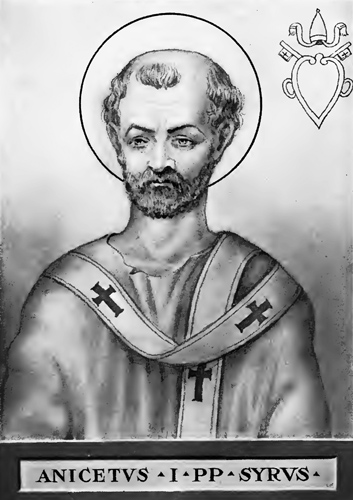
17 APRIL – SAINT ANICETUS (Pope and Martyr)


Anicetus, a Syrian by birth, governed the Church during the reign of Marcus Aurelius Antoninus. He passed a decree which forbade clerics to nourish their hair. The ordinations which he held in five Decembers gave 17 Priests, 4 Deacons and 9 Bishops. His Pontificate lasted 8 years, 8 months and 24 days. He was crowned with martyrdom for the Christian faith and was buried on the fifteenth of the Calends of May (April 17th), in the Cemetery afterwards called the Cemetery of Callixtus, which is on the Via Appia.

Dom Prosper Guéranger:

A Pope and Martyr of the second century appears on the Calendar today. The Martyrs stand in clusters near our Risen Lord. They are the eagles of which He speaks in His Gospel, as gathering together around their longed-for object (Matthew xxiv. 28). Anicetus is not the only Pope whose Martyrdom has to be celebrated during Paschal Time. Others will come, adding to our Easter joy. The Saint who claims our attention today is one of those whose holy actions are shrouded in the venerable gloom of the Church, and yet his memory will be held in veneration to the end of time, not only as being the eleventh successor of Saint Peter in the See of Rome, but as having imitated him also in holiness of life. Saint Polycarp, whose feast we kept on the twenty-sixth of January, came from Smyrna to Rome in order to visit him and receive his advice. There have also been transmitted to us one or two instances of the zeal with which he defended the Church against the heresiarchs Valentine and Marcion. In a word, we know that he was a Martyr, and that is enough to immortalise his name.

* * * * *

Holy Pontiff who so many long ages ago was made partaker of the glory of Him whose Vicar and Martyr you had the privilege to be, we this day celebrate your blessed memory with filial affection. In you we venerate one of the pillars of the early Church. And though your name has been handed down to us without the history of those holy deeds which merited for you a martyr’s palm, we at least know that it was dear to the faithful of the age in which you lived. Now that you are in Heaven your zeal for the glory of God is greater than it was when you were on this Earth. Pray, then, for the Church of these sad times. Upwards of two hundred Pontiffs have followed you on the Chair of Peter, and Christ has not yet come to judge the world. Assist your Successor who is our Father. Assist the Flock entrusted to his charge, for the dangers that now threaten us are extreme. Your Pontificate was during a stormy period. Pray to our Risen Jesus that He would quell the tempest that is now howling round the Barque of Peter. Beseech Him to give us perseverance and courage. Obtain for us that we may fix our hearts on our heavenly country so that when God calls us hence, we may be prepared as you were. We are the descendants of the Martyrs. Their faith is ours. The hope that cheered them must be our consolation.

Also on this day according to the ROMAN MARTYROLOGY:

In Africa, the birthday of blessed Mappalicus, and many others who were crowned with martyrdom, as is related by St. Cyprian in his Epistle to the Martyrs and Confessors.

In the same country, the holy martyrs Fortunatus and Marcian.

At Antioch, the holy martyrs Peter, a deacon, and Hermogenes, his servant.

At Cordova, the holy martyrs Elias, a priest, Paul and Isidore, monks.

At Vienne, St. Pantagathus, bishop.

At Tortona, St. Innocent, bishop and confessor.

At Citeaux in France, the abbot St. Stephen who was the first to live in the desert of Citeaux, and who joyfully welcomed St. Bernard and his companions when they came there.

In the monastery of Chaise-Dieu in the diocese of Clermont, St. Robert, confessor, founder and first abbot of that monastery.

And in other places, many other holy martyrs, confessors and virgins.

Thanks be to God.

Monday, 15 April 2024

15 APRIL – FERIA

On this day according to the ROMAN MARTYROLOGY:

At Rome, the saints Basilissa and Anastasia. Of noble family, they were disciples of the Apostles, and as they persevered courageously in the profession of their faith in the time of the emperor Nero, they had their tongues and feet cut off, were put to the sword, and thus obtained the crown of martyrdom.

The same day, the holy martyrs Maro, Eutyches, and Victorinus who, with blessed Flavia Domitilla, were banished to the island of Pontia for the confession of Christ. Being recalled in the reign of Nerva, and having converted many to the faith, they were put to death in different manners by the judge Valerian during the persecution of Trajan.

In Persia, in the reign of the emperor Decius, the holy martyrs Maxinius and Olympiades who were beaten with rods and whips, and struck on their heads with clubs until they breathed their last.

At Perentino in Campania, St. Eutychius, martyr.

At Myra in Lycia, St. Crescens who consummated his martyrdom by fire.

Also the holy martyrs Theodorus and Pausilippus who suffered under the emperor Hadrian.

And in other places, many other holy martyrs, confessors and virgins.

Thanks be to God.

Saturday, 13 April 2024

13 APRIL – SAINT HERMENEGILD (Martyr)

King Hermenegild, son of Leovigild king of the Visigoths, was converted from the Arian heresy to the Catholic faith by the preaching of the venerable Leander, Bishop of Seville. His father, who continued in the Arian heresy, did his utmost, both by promises and threats, to induce him to apostatise. But Hermenegild returned him ever the same answer, that he never could abandon the true faith after having once known it. The father, in a fit of displeasure, deprived him not only of his right to the throne, but of everything he possessed. And when even this failed to break the energy of his soul, he had him put into close confinement with chains on his neck and hands. Hereupon the youthful king Hermenegild began to despise the earthly, and ardently to long for the heavenly, kingdom. Thus fettered and wearing a hair-shirt, he besought the Omnipotent God to support him. As to the glory of this fleeting world, he nobly looked on it with disdain, the more so as his captivity taught him the nothingness of that which could thus be taken from him.

It was the Feast of Easter. At an early hour of the night when all was still, his wicked father sent an Arian Bishop to him with this message: that if he would receive Communion from his hands (the Communion of a sacrilegious consecration!) he should be restored to favour. True to his Creator, the man of God gave a merited reproof to the Arian Bishop and with holy indignation rejected his sinful offer, for though his body lay prostrate in chains, his soul stood on ground beyond the reach of tyranny. The Bishop therefore returned from where he had come. The Arian father raged, and immediately sent his lictors, bidding them repair to the prison of the unflinching Confessor of the Lord and murder him on the spot. They obeyed. They entered the prison. They cleft his skull with a sword. They took away the life of the body, and slew what he, the slain one, had sworn to count as vile. Miracles soon followed by which Heaven testified to the true glory of Hermenegild, for during the night, there was heard sweet music near to the body of the King and Martyr — King indeed, because he was a Martyr.

It is said that lights were seen at the same time burning in the prison. The Faithful were led by these signs to revere the body as being that of a martyr. As to the wicked father, he repented for having imbrued his hands in his sons blood, but his repentance was not to salvation inasmuch as, while acknowledging the Catholic Faith to be the true one, he had not the courage to embrace it, for he feared the displeasure of his subjects. When in his last sickness and at the point of death he commended his son Reccared, a heretic, to the care of Leander the Bishop whom he had hitherto persecuted, but from whom he now asked that he would do for this son what he had by his exhortations, done for Hermenegild. Having made this request, he died and was succeeded on the throne, by Reccared who, taking not his wicked father but his martyred brother as his model, he abandoned the impious Arian heresy and led the whole Visigoth nation to the true Faith. He would not allow any man to serve in his armies who dared to continue the enemy of the God of hosts by heresy. Neither is it to be wondered at that, being the brother of a Martyr, he should have become a propagator of the true Faith, for it was by Hermenegilds merits that he has succeeded in reconciling so many thousands to the great God of Heaven.

Dom Prosper Guéranger:
It is through a Martyrs palm-branch that we must today see the Paschal Mystery. Hermenegild, a young Visigoth Prince, is put to death by his heretical father because he courageously refused to receive his Easter Communion from an Arian Bishop. The Martyr knew that the Eucharist is the sacred symbol of Catholic unity and that we are not allowed to approach the Holy Table in company with them that are not in the true Church. A sacrilegious consecration gives heretics the real possession of the Divine Mystery, if the priestly character be in him who dares to offer Sacrifice to the God whom he blasphemes. But the Catholic who knows that he may not so much as pray with heretics, shudders at the sight of the profanation, and would rather die than share, by his presence, in insulting our Redeemer in that very Sacrifice and Sacrament which were instituted that we might all be made one in God.
The blood of the Martyr produced its fruit: Spain threw off the chains of heresy that had enslaved her, and a Council held at Toledo completed the work of conversion begun by Hermenegilds sacrifice. There are very few instances recorded in history of a whole nation rising up in a mass to abjure heresy. But Spain did it, for she seems to be a country on which Heaven lavishes exceptional blessings. Shortly after this she was put through the ordeal of the Saracen invasion. She triumphed here again by the bravery of her children,  and ever since then her Faith has been so staunch and so pure as to merit for her the proud title of The Catholic Kingdom.
* * * * *
We offer you, O brave witness to the truth of holy Faith, our admiration and gratitude. Your courageous death was proof of the love you had for Christ, and your contempt of earthly honours teaches us to despise them. Heir to a throne, a prison was your abode here below. It was from your prison that you ascended to Heaven, wearing on your brow the laurels of Martyrdom — a crown far brighter than that which was offered you on condition of your apostatising from the Faith. Pray now for us: the Church asks it of you by inserting your name in the Calendar of her Saints. The Pasch was the day of your triumph: obtain for us that this may be a true Pasch to us — a real resurrection, which may lead us to the Heaven above where we may enjoy, with you, the sight of our Risen Jesus. Intercede for us, that we may be firm in the Faith, obedient to the teachings of holy Church and enemies to every error and innovation. Protect Spain, your fatherland, which owes to your Martyrdom long centuries of loyalty to the true Faith. Pray for her that she may ever continue to merit her glorious title of The Catholic Kingdom.
Also on this day according to the ROMAN MARTYROLOGY:

At Pergamus in Asia, the birthday of the holy martyrs Carpus, bishop of Thyatira, Papylus, deacon, and his sister Agathonica, an excellent woman, Agathadorus, their servant, and many others, who after various torments were for their blessed confession crowned with martyrdom in the persecution of Marcus Antoninus Verus and Lucius Aurelius Commodus.

In this same persecution, there suffered at Rome that remarkable man, Justin the Philosopher, who had addressed to the emperors his second Apology in defence of our religion, and upheld it by strong arguments. Being accused of professing Christianity by the intrigues of the Cynic Crescens, whose conduct and immorality he had reproved, he obtained the reward of a martyr as a remuneration for his faithful confession.

The same day, the martyrdom of the Saints Maximus, Quinctillian and Dadas during the persecution of Diocletian.

At Ravenna, St. Ursus, bishop and confessor.

And in other places, many other holy martyrs, confessors and virgins.

Thanks be to God.